

The US Strategic Petroleum Reserve (SPR) is the largest crude oil storage facility in the world. It’s capable of storing 714 million barrels of oil, slightly less than 10% of the US’s annual oil consumption. Built in response to OAPEC’s 1973 oil embargo, the SPR was created to insulate the US from oil supply shocks: to make up for shortfalls and prevent steep price increases should oil imports be interrupted. In the years since its creation, it has become one of the most frequently used energy policy tools in the US’s arsenal.
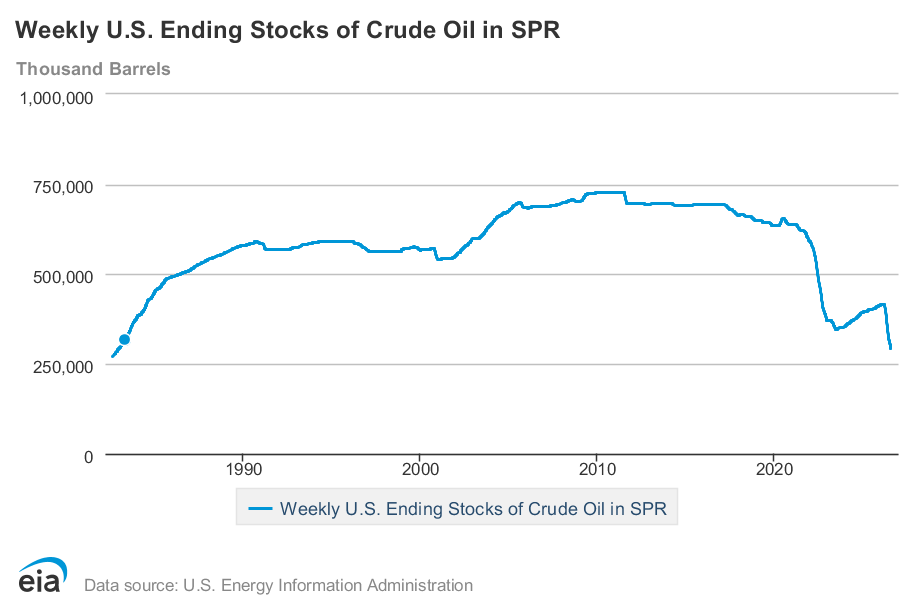
The SPR has gotten a great deal of attention lately, as the Trump administration has steadily delivered oil (around 120 million barrels as of this writing) from the reserve in response to Iran closing the Strait of Hormuz. Much of this attention has centered on technical factors related to how much oil can safely be released from the reserve: various folks have claimed, for instance, that the minimum safe operating level of the SPR is 300 million barrels of oil (a level that it went below the week of August 7), and below that damage to the storage facility can occur.
It’s not clear if the specific claim about the 300 million barrel level is true, but due to the way the SPR was constructed, it does indeed have limits on how much oil can be removed from it and how many times it can be emptied. Given the ongoing importance of the SPR, it’s worth understanding how it was built and how it works now.
Origins of the Strategic Petroleum Reserve
Almost as soon as oil became strategically important to the US, people began floating the idea of stockpiling it for emergencies. The first strategic stockpiles of petroleum in the US were created for the military: a Naval Petroleum Reserve (NPR) was created in 1912 by setting aside land containing oil deposits in California, and by the 1920s there were four NPR sites across the country.1 During WWII, Secretary of the Interior Harold Ickes advocated stockpiling petroleum “for military and civilian needs,” and was appointed president of the Petroleum Reserves Corporation, a government corporation that tried (but failed) to gain control over Middle East oil fields for emergency reserve purposes. In 1952, President Truman’s Materials Policy Commission proposed maintaining an emergency oil reserve, and President Eisenhower suggested creating one following the disruption of oil imports during the Suez Crisis.
But it wasn’t until the 1973 OAPEC oil embargo that the idea for a petroleum reserve for both civilian and government use stuck. By the early 1970s, the US’s demand for petroleum was increasingly outpacing domestic production, making the country more and more dependent upon imports; between 1963 and 1970 the US’s surplus oil capacity (how much domestic production could be boosted in the event of a crisis) had fallen by 75%, and between 1967 and 1973 US oil imports more than doubled. When OAPEC declared an oil embargo in October 1973, the impact on the US was immediate; gas prices jumped by over 40%, and widespread gasoline shortages occurred.
Even before the embargo, in response to tightening oil supplies and frequent threats from Middle Eastern countries to withhold oil, the Nixon administration commissioned a study on the impact of a major oil supply disruption from the National Petroleum Council. The council’s report, released a few months before the embargo, suggested that a large petroleum reserve could act as a buffer for import shortfalls. It considered several possibilities for storing the oil, including simply leaving known reserves in the ground and aboveground steel tanks, but concluded that the most cost-effective method would be underground storage in caverns hollowed out from large salt deposits known as “salt domes.” A subsequent report by the newly created Federal Energy Administration, formed following the oil embargo (and which later became the Department of Energy), likewise suggested that underground salt dome storage was the most economical way of storing large quantities of petroleum.
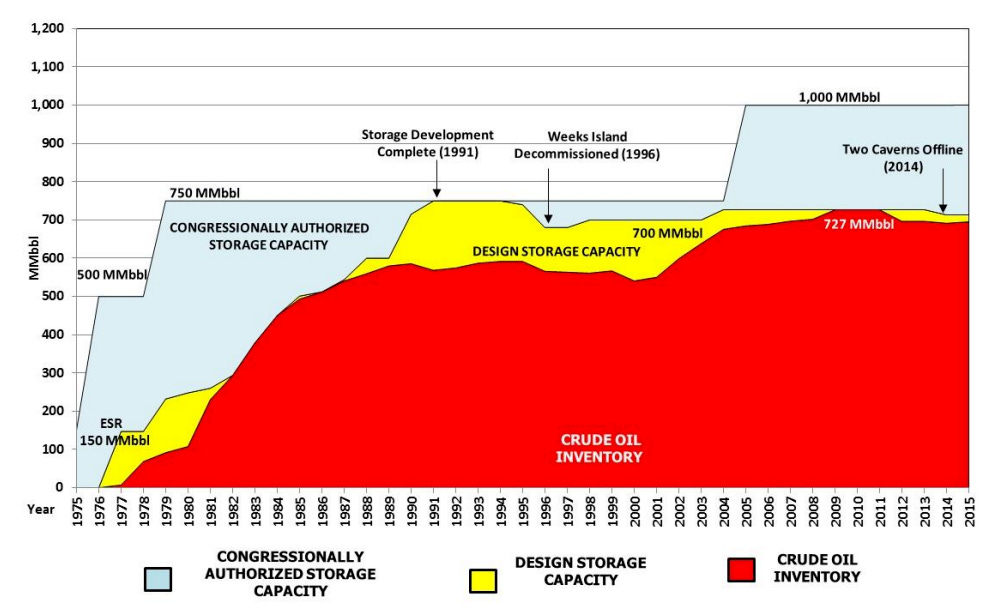
This suggestion became a reality in 1975, when Gerald Ford signed the Energy Policy and Conservation Act. Among the bill’s provisions was a mandate to establish a petroleum reserve of up to 1 billion barrels to “diminish the vulnerability of the United States to the effects of a severe energy supply interruption.” Construction on the SPR began in 1977.
Constructing the SPR
When planning the SPR, several options for storing the petroleum were considered, including using large numbers of idle oil tankers. But ultimately it was decided that the best option was what the National Petroleum Council and the Federal Energy Administration had both recommended: storing the oil in large, underground salt caverns.
Salt domes are enormous underground salt structures, potentially miles deep and miles across, formed when geologic forces push underground deposits of rock salt up through the rock above. They were first discovered in the mid-19th century, and began to be surveyed extensively in the early 20th century after oil was discovered near a salt dome at Spindletop in Texas: as the salt pushes up into the rock above, it can create pockets around the dome where oil and gas can accumulate. Because rock salt is largely impermeable to oil or gas, hollowed-out caverns within salt domes were a potentially attractive place to store large amounts of crude oil.
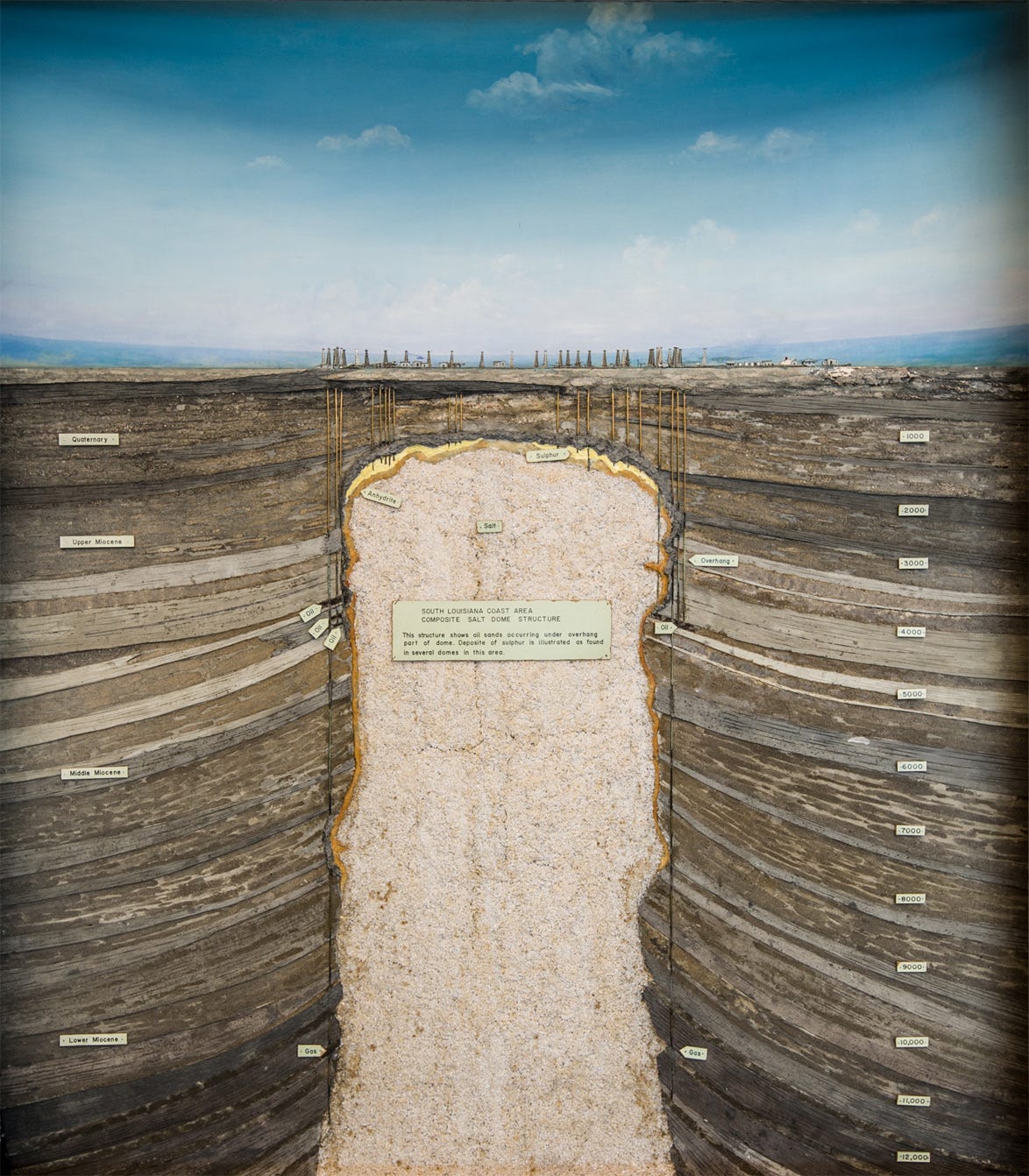
These caverns can be created by a process known as “solution mining”: drilling a well down into the salt dome and pumping water into it. The water dissolves the salt, and the resulting salty brine gets pumped back out, leaving behind a void where the salt had been. Mining rock salt by using water to dissolve it had been practiced in Europe for hundreds of years, but modern solution mining — drilling a well into an underground salt deposit and pumping water into it — first began around the 1860s–1870s in New York.2 By the 1970s, solution mining had become a widely used method for mining salt. Companies like Morton Salt used solution mining to obtain salt for food products, and Dow Chemical used solution mining as a source of chemical feedstocks.
Initially, the underground caverns created by solution mining were simply abandoned. But by the mid-20th century, they had begun to be used for underground storage. In the 1940s Canada first considered solution-mined caverns for underground storage, and beginning in the 1950s it had become a popular method of storing liquefied petroleum gas (LPG) in North America and Europe. By 1976, private firms in the US had created over 900 solution-mined caverns, with a total storage capacity of 300 million barrels. For storing unprecedented amounts of petroleum, solution-mined salt caverns were the obvious choice, and that’s what was chosen to create the Strategic Petroleum Reserve.
The Texas-Louisiana Gulf Coast was chosen as the location for the reserve: not only did the area have numerous salt domes that could be utilized for storage, but it was close to existing oil and gas infrastructure, making it easier to fill the reserve and draw it down when required.
Construction would be split into three phases. In Phase I, several existing salt caverns would be converted into crude oil storage at five sites along the Gulf Coast:
Four caverns at Bryan Mound, in Texas.
Five caverns at West Hackberry, in Louisiana.
Six caverns at Bayou Choctaw, in Louisiana.
Three caverns at Sulphur Mines, in Louisiana.
In addition to these solution-mined caverns, the SPR would also use a conventionally mined salt mine at Weeks Island in Louisiana. Collectively, the Phase I sites would give the SPR 248 million barrels of capacity. And because the caverns already existed, they could begin to be filled with oil quickly.
In Phase II, 29 new solution-mined caverns would be created at these sites, adding another 290 million barrels of storage capacity. In Phase III, a new site would be added at Big Hill in Texas, which would bring the total storage capacity to 750 million barrels.
Due to political pressure to get oil stored as soon as possible, the construction schedule was compressed, and the first oil entered the SPR in 1977. But the project was soon mired in setbacks. The Federal Energy Administration employees tasked with overseeing the project had little experience in managing large construction projects, and cost control proved difficult. Material and equipment specifications were created before plans were fully complete, creating problems when the selections later proved to be unsuitable. Equipment such as pumps was often chosen because of availability, not because it was best suited for the job, resulting in breakdowns and costly workarounds. Contractors taking advantage of management inexperience engaged in “extensive fraud”; used valves were sold as new, and drill bits were purchased, stolen, and then re-sold back to the government. One contractor was indicted for stealing 18 truckloads of equipment worth $427,000; another was accused of making off with $8 million worth of petroleum bound for Bayou Choctaw and pumping in “hazardous and toxic wastes” instead (though the government denied that this occurred). By the late 1970s, over two dozen SPR fraud cases were being investigated simultaneously.
And while the SPR project was broadly popular, it nevertheless had its share of opponents who tried to slow down the project. The governor of Louisiana, Edwin Edwards, felt the SPR was wasteful government spending and led a “virtual one-man crusade” against the project, using various environmental protection regulations to slow it down until he was sufficiently convinced that it would benefit Louisiana. Among the concessions Edwards was able to extract were slowing down site conversions to minimize the loss of local jobs, and getting the SPR office located in Louisiana instead of the originally planned Houston.
There was also broader environmental opposition. Creating the SPR caverns during Phases II and III would require creating and then disposing of large amounts of brine; while some of this brine could be pumped back underground, the lion’s share of it would be disposed of by pumping it into the Gulf of Mexico. But local fishermen, worried about the potential impact on fish and shrimp populations, objected, ultimately forcing brine disposal pipelines to extend much farther into the Gulf of Mexico than originally planned. Securing the necessary environmental permits required an enormous amount of time and effort in the first few years of the program, and by the end of 1978 the SPR Office had completed 25 NEPA-required environmental impact statements.
There were also numerous technical challenges involved with building the SPR. Phase I of construction involved converting existing solution-mined caverns, but these caverns had not been created for the purposes of petroleum storage: some of them turned out to be unsuitable; others were workable but proved to be incapable of holding as much petroleum as originally projected due to pressure limitations. Collectively, the Phase I caverns ultimately had 87 million barrels less storage capacity than first anticipated.
Technical challenges continued during Phase II, when solution mining of the new caverns began. Historically, most solution-mined caverns had been on the order of 1 million barrels in size; a few had reached the 4 million mark. But most of the Phase II caverns would be 10 million barrels or more, far larger than previous solution-mined caverns. SPR officials learned as much as they could about solution-mining caverns for petroleum storage from studying the West German petroleum reserve, which also used solution-mined caverns and was already in operation, but the much larger scale of the SPR (700 million barrels vs. Germany’s 30 million) meant that they were operating in uncharted territory. When mining began, for instance, it was found that brine could be disposed of underground much less quickly than anticipated, and that leaching took far longer than anticipated, both of which slowed down cavern construction.
Collectively, the technical, political, and managerial challenges encountered when building the SPR drove up costs and pushed back delivery dates. In 1976, the estimated cost of the SPR through Phase II was $766 million; just two years later that had risen to $1.47 billion (~$7.5 billion in 2026 dollars). The original plan called for Phase III to be complete by 1983, with 750 million barrels of crude in the ground. But the actual fill level in 1983 was roughly half that, with many caverns yet to be completed. Between 1980 and 1993, 49 new solution-mined caverns for the SPR were created, bringing its total storage capacity up to 750 million barrels, but the actual fill level would remain at just over 500 million barrels into the 2000s.
Since its completion, the SPR has continued to evolve. The small Sulphur Mines site began decommissioning in 1992, and in 1996 the Weeks Island facility began to be decommissioned when it was realized that groundwater was slowly leaking into it. And over the last 20 years three of the remaining Phase I caverns have been decommissioned, bringing the total number of storage caverns down to 60.
Operating the SPR
At a high level, the way the SPR works is relatively simple. Each cavern in the SPR is filled up with oil, which sits on top of a heavier layer of brine beneath it. To remove oil from a cavern, water is pumped down into it, which forces oil out the top. To fill the cavern back up with oil, oil is pumped in as brine is pumped out. The caverns are thus always completely full of liquid; the only thing that changes is where the oil-brine boundary is.
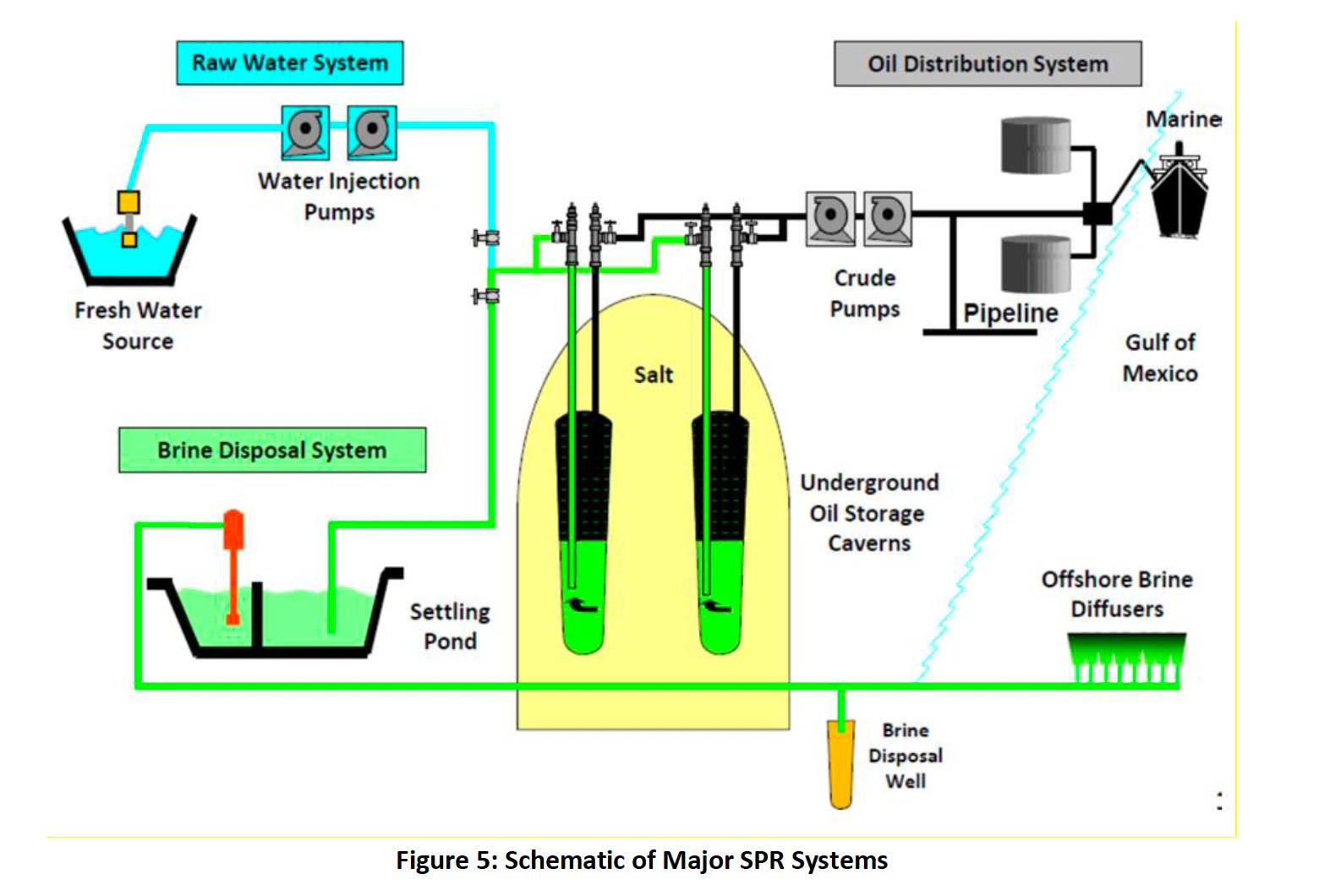
But this high-level description belies a lot of complexity. We think of physical infrastructure as something relatively static and unchanging, but in the SPR various forces are constantly reshaping the caverns.
One of these forces is cavern creep. The SPR caverns are thousands of feet below ground, and the weight of the ground constantly squeezes the sides of the caverns, compressing and shrinking them over time. As the caverns are squeezed, the liquid inside the caverns is pressurized, and this pressure, in turn, tends to resist further compression of the caverns. But if that pressure is relieved, which occurs during well repair operations known as “workovers,” cavern creep can accelerate. The SPR loses up to 2.4 million barrels (~0.33%) of storage capacity each year due to the effects of cavern creep, depending in part on the number and length of workovers required.
In the other direction, removing oil from the caverns requires water to be pumped into them. And when fresh water is pumped into the caverns, it dissolves some of the salt from the walls of the caverns. Every 100 barrels of water pumped in dissolves around 15 barrels of salt; removing all the oil from an SPR cavern thus increases its size by about 15%.
Because of this, SPR caverns have a finite lifespan. After enough drawdowns, the walls of the cavern become too thin to use it for storage; they can no longer withstand the stresses and may begin to leak oil into surrounding caverns or outside the salt dome itself.
Various factors affect how the walls of a cavern wear and how many drawdowns it has available. Phase II and III caverns designed specifically to store petroleum are tall and thin, like skyscraper-sized cigars, and are spaced far enough apart to allow for significant cavern growth over time. But many of the Phase I caverns, which were originally mined for other purposes, have irregular shapes or thin cavern walls that make it infeasible to use them for multiple drawdowns. These caverns are thus known as “single-cycle drawdown” caverns. There are currently 11 Phase I caverns in use at the SPR and six caverns that have one drawdown or fewer remaining.
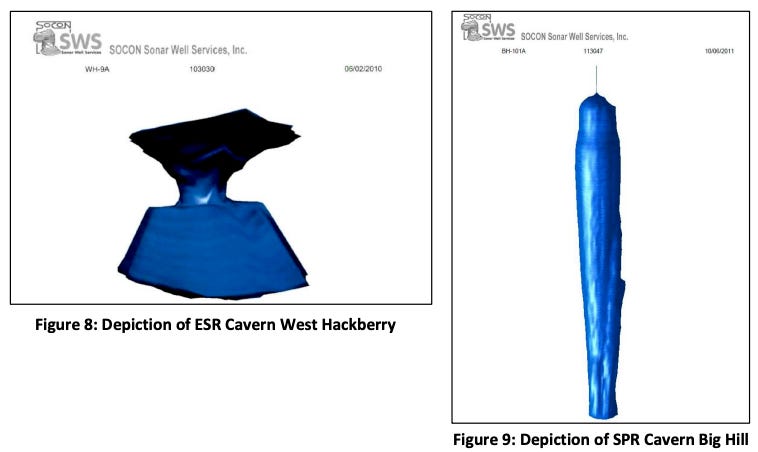
Cavern lifespan is also affected by how a cavern is used. When a cavern is fully emptied, wear on the cavern walls is relatively uniform, but if the cavern is subject to multiple partial drawdowns — removing a bit of oil, then filling it back up, then removing a bit more, etc. — this concentrates wear at the bottom of the cavern, resulting in “undesirable shapes” that can more rapidly reduce cavern lifespan. Conversely, it’s also possible to increase cavern lifespan by strategically emptying caverns in such a way as to wear the cavern into a more desirable shape.
Cavern wear is not simply “water dissolving the salt and the walls get thinner”; the geology of the SPR caverns is complex, and they can wear in complex ways. Changing stresses in the walls can cause “salt falls” (when a chunk of salt falls into the cavern) or open up cracks and fissures, causing leaks. Because of this, Sandia National Labs closely monitors SPR cavern conditions using tools like sonar. Each year it puts out a report estimating how many full drawdowns each cavern still has available. Because it can be hard to predict cavern behavior after repeated drawdowns, the maximum number of drawdowns it simulates is five (thus a cavern with five available drawdowns today might actually have several more than that available).
Limits of the SPR
The limited lifespan of SPR caverns, and the complex wearing forces that they’re subjected to, have led to a lot of speculation and assertion about how much oil can be safely removed from the SPR. Folks often claim, for instance, that the SPR can’t go below 300 million barrels of oil without damaging the caverns. I decided to look closely at what these limits actually are.
One limit on the SPR is that a minimum amount of “roof oil” must be kept in the caverns to prevent water at the top of the cavern from dissolving and damaging the cavern ceiling. As of 2016 this was about 12 million barrels, or around 1.7% of total SPR capacity.
Another limit you will often see mentioned is 70 million barrels: for instance, the DOE told CNBC earlier this year that 70 million barrels was the minimum amount needed to safely operate the SPR. It’s not amazingly clear what’s behind this limit, but this may be simply using the DOE’s definition of a “full drawdown,” which is when 90% of the oil in the SPR has been removed: 70 million barrels is about 10% of the SPR’s total capacity. It’s not clear if there’s an actual, physical limit at 70 million — that may be the level at which the oil-brine interface would be above the oil intake well, for instance — or if that’s simply a defined operational limit.
Above these lower limits, you see various claims about operating levels below which damage to the SPR starts to occur. Earlier this year a JPMorgan energy analyst claimed that 150–160 million barrels “must remain in place to preserve cavern stability and maintain operational flexibility.” Rapidan Energy, founded by former George W. Bush energy advisor Bob McNally, claims that this limit is at 170 million. A professor of petroleum engineering at Texas A&M, Siddharth Misra, claims that the operational limit is between 250 and 300 million barrels, below which “the risk of structural damage increases while the system loses its ability to pump oil at high speeds.” Former Biden energy advisor Amos Hochstein claims that he “know[s] plenty of people who think we can’t get near 300 [million] because physically you will damage the caverns where the oil is stored.”
Some of these claims can be verified. For instance, it’s true that draining the SPR beyond a particular point reduces the speed at which oil can be pumped out of it. Oil can only be pumped so quickly out of an SPR site, so as caverns empty the drawdown rate drops.
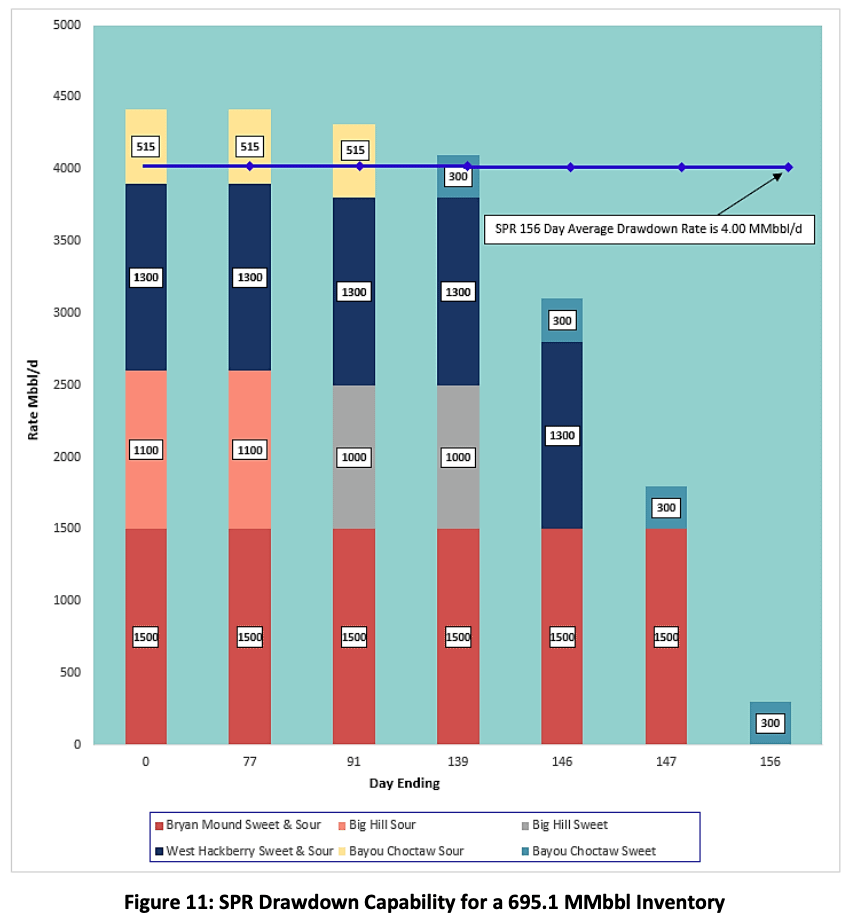
Additionally, because of the aging SPR infrastructure as well as the downtime needed for repairing that infrastructure, not all the oil in the SPR is available for drawdown at any given point. For instance, a recent GAO report noted that oil at several SPR sites might be unavailable during warmer months due to vapor pressure. Oil stored in the caverns gradually absorbs methane, and gradually warms up, both of which increase the vapor pressure within the oil. To be safely distributed the vapor pressure in the oil must be below a certain level, which can be achieved at a “degasification” plant. But several years ago the SPR’s degasification plant was dismantled and hasn’t yet been replaced, limiting its ability to distribute crude during warmer times of the year. More generally, the SPR has a huge maintenance backlog and has been described as being held together with “band aids.” A planned large-scale SPR renovation and maintenance program, Life Extension Phase 2, began in 2021 but was scaled back due to high costs.
There have also been various reports noting that the SPR may not have the ability to respond to a severe supply disruption below a level of 250 to 500 million barrels, and that outside of true emergencies it would be prudent to keep it above this level.3
However, no official report by the Department of Energy, the GAO, Sandia National Labs, or any other government agency mentions specific fill levels below which damage to the SPR occurs (other than the small amount of roof oil required). While Sandia puts out an annual report on the number of available drawdowns on a cavern-by-cavern basis, it doesn’t note any SPR-wide fill level limit below which damage occurs. I similarly wasn’t able to find any independent analysis or report pointing to some minimum SPR fill level and explaining specifically what drives it. So it’s not particularly clear to me what the source of claims about very high minimum fill levels is: if it’s from people talking to Sandia/DOE folks in some unofficial capacity, or if they’re inferring limits based on cavern stress data that Sandia provides but doesn’t make explicit, or something else. It’s notable to me that claims about minimum fill levels aren’t particularly consistent, and that different analysts/experts give widely different limits. It’s also notable that these claims often conflate different limits. (The Department of Energy, for its part, has denied the 300 million barrel limit.)
Conclusion
The Strategic Petroleum Reserve is the largest petroleum storage facility in the world and stores vast amounts of crude oil — over 700 million barrels — in underground salt caverns. These caverns behave in complex ways: they grow, shrink, and distort over time due to the various fluid and geologic forces that they’re subjected to, and the caverns have a limited lifespan due to water gradually dissolving the solid salt walls.
Because of these complex forces, and the gradual damage that gradually accumulates across the walls of the caverns, there’s widespread speculation and assertion that the SPR can’t be drained below some particular level without inflicting serious damage on the underground caverns.
It’s hard to know how seriously to take these claims. Many of them are made by experts, such as professors of petroleum engineering and former White House energy advisors. And there are various limits associated with removing oil from the SPR, such as the oil needed to keep water from damaging the roof of the caverns or the drop in withdrawal rates that occurs as the SPR empties. But it’s hard to find any sort of actual published estimate of these limits in a report or official document. This doesn’t mean that these claims are wrong, but it does make me wonder where the claims are coming from.
The Naval Petroleum Reserve later became part of a major presidential scandal during the Harding administration when Secretary of the Interior Albert Fall accepted bribes to let companies lease NPR lands at Teapot Dome in Wyoming.
Extracting preexisting brine deposits dates even earlier, to China around 250 BC.
The SPR also has a statutory storage limit of 252.4 million barrels, but this only applies to a particular type of release, one that as far as I know has never actually been conducted, so in practice this is a meaningless limit.
A public service. Thank you.
Thanks. Interesting article. I assume the water that gets pumped in is supersaturated with salt to minimise wear? I wonder if the draw down limit is, in part, a publicly available limit and the rest is earmarked for military, security and emergency services. The vagueness of the limit smells like operational security.