

Welcome to the reading list, a look at what happened this week in infrastructure, buildings, and building things. Roughly 2/3rds of the reading list is paywalled, so for full access become a paid subscriber.
Housekeeping items:
No essay this week, but I’m working on a longer essay about US construction productivity that should be out next week.
Sending the reading list a day early this week.
Housing
Goldman Sachs has a report out on what’s driving the decline in US construction productivity. I’ll have more to say about this report later, but broadly I think at a high level it correctly identifies many of the issues at work — lack of technological progress, land use regulation, and mismeasurement — but on the whole the analysis isn’t very good. [Goldman Sachs]
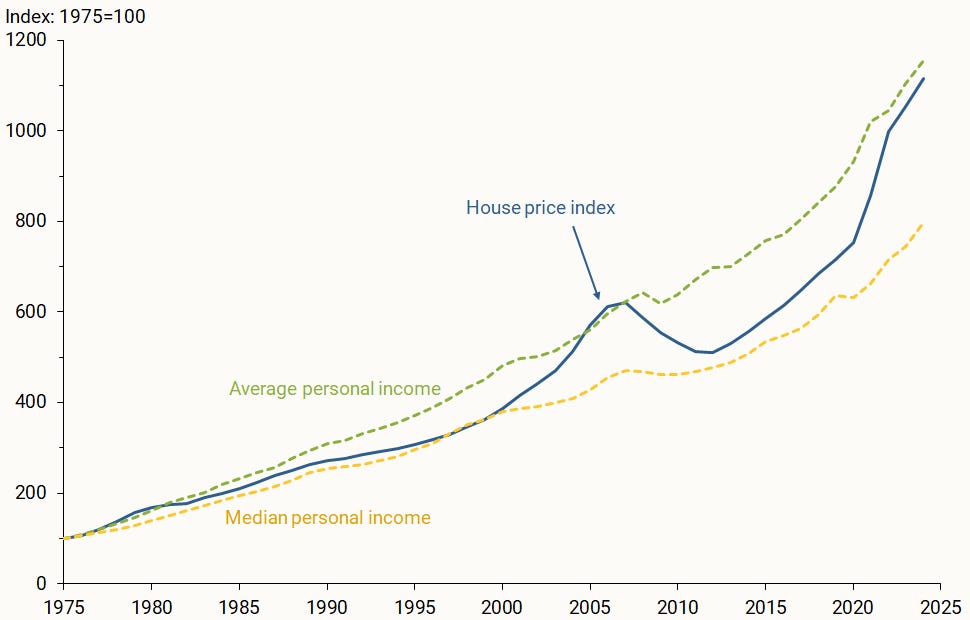
The San Francisco Federal Reserve has a note out looking at the relationship between income growth and rise in housing prices, noting that the growth in house prices closely tracks growth in average (not median) income. “Average income, an indicator of housing demand (green dashed line), grew essentially one-for-one with house prices from 1975 to 2024, even though median income failed to keep up. In other words, house price growth may simply reflect growth in housing demand, driven in part by growth in average income, such that questions of housing affordability may primarily be about differences in income growth at the top of the distribution relative to the middle.” [SF Fed]
Renting is cheaper than owning in every major US metro. [Axios]
Several major homebuilders are working on pitching a large-scale homebuilding program — potentially on the order of a million homes — to the Trump Administration. [Bloomberg]
How big is the US housing shortage? [WaPo]
Energy
The Trump Administration has made no secret of its opposition to wind and solar projects. Several offshore wind projects were ordered to halt construction (though now all have been allowed to resume), and Energy Secretary Chris Wright has described solar as a “parasite” on the grid. Now the New York Times is reporting that the administration is delaying issuing the permits for hundreds of wind and solar projects. [NYT]
On the other hand, there’s some (some) evidence that administration opinion might be shifting. A recent survey commissioned by First Solar (a US solar panel manufacturer) found that Republicans were broadly in favor of solar energy. “The survey polled 800 Republicans, Republican-leaning independents and Trump voters. Of those surveyed, 68% said they agreed with the statement, “We need all forms of electricity generation, including utility solar, to be built to lower electricity costs.” [Utility Dive] Katie Miller, wife of top Trump advisor Stephen Miller, recently tweeted that “Solar energy is the energy of the future.” [Twitter]
Relatedly, a problem common to both the Trump Administration and the previous Biden Administration is the executive branch trying to halt energy projects that it doesn’t like. This injects a huge amount of uncertainty into the process of getting new energy infrastructure built, making it harder across the board. My IFP colleague Aidan Mackenzie has a piece out about a new bill, the FREEDOM act, that would limit these sorts of executive branch efforts. “Sponsored by Representatives Josh Harder (D-CA), Mike Lawler (R-NY), Adam Gray (D-CA), Don Bacon (R-IL), Chuck Edwards (R-NC), and Kristen McDonald Rivet (D-MI), the FREEDOM Act creates real certainty for developers by establishing clear timelines for issuing permits, stopping administrations from revoking permits for fully approved projects, and enforcing these mechanisms with a process of judicial review and clear remedies.” [IFP]
Tesla is now manufacturing rooftop solar panels for residential solar. [PV Magazine]
Something I wasn’t aware of, but once I was, seems like an obvious idea: landfills increasingly have solar PV installations built on top of them. [Utility Dive]