


Welcome to the reading list, a weekly list of news and links related to buildings, infrastructure, and industrial technology. Roughly 2/3rds of the reading list is paywalled, so for full access become a paid subscriber.
Housekeeping items this week:
My book is a finalist for the Manhattan Institute’s Hayek Book Prize.
Housing
The Atlantic has a piece on how difficult and user-unfriendly most smart home technology still is. This was true when Gizmodo published its 2015 article Why Is My Smart Home So Fucking Dumb?, and it seems like it’s still true today. [The Atlantic]
The Department of Justice is apparently considering opening an antitrust probe into US homebuilders, possibly due to their coordination on prices through a trade group. “Leading Builders of America”. [Bloomberg]
The US house of representatives passes the Housing in the 21st Century Act. This is the house version of the ROAD to Housing Act which was passed by the senate back in October, and which I talked about on Statecraft. Among other things these bills remove the requirement that manufactured (mobile) homes have steel chassis, which the industry has long complained about. [X]
Trump and newly elected New York mayor Zohran Mamdani are apparently both enthusiastic about NYC zoning reform. [Politico]
Americans are taking on more and more credit card debt, but mortgage delinquencies so far remain fairly flat. [X]

Buildings are apparently more frequently collapsing in the Southern Mediterranean, possibly due to increased erosion due to rising sea levels. “Alexandria, a historic and densely populated port city in Egypt representative of several coastal towns in the Southern Mediterranean, has experienced over 280 building collapses along its shorelines over the past two decades, and the root causes are still under investigation.” [Wiley] [Usc]
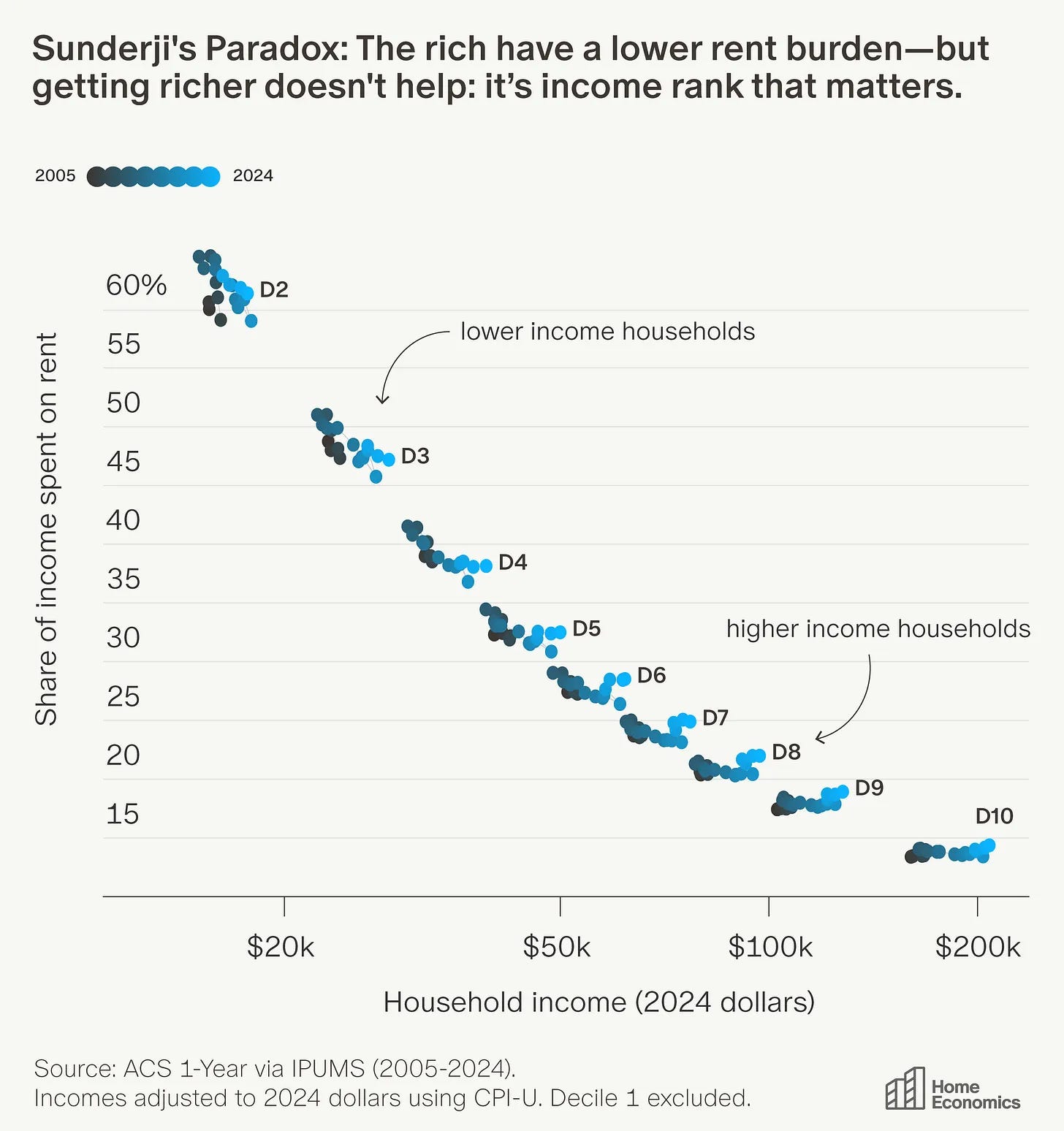
Sunderji’s Paradox: the rich spend a smaller fraction of their income on their housing than the poor, but as countries get richer these fractions don’t change. [Substack]
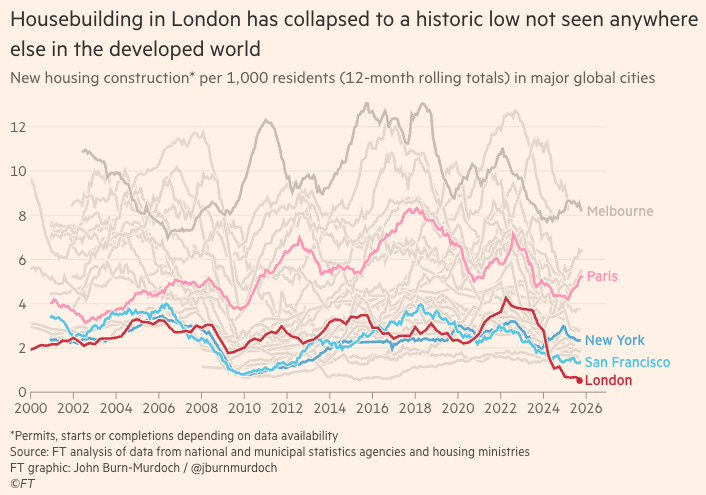
“London has been set a target of building 88,000 new homes per year over the next decade. Last year construction started on just 5,891 — 94 per cent below target, a 75 per cent year-on-year decline, the steepest drop in the country, the lowest tally since records began almost 40 years ago and the lowest figure for any major city in the developed world this century.” [FT]
Manufacturing
The WSJ has a piece on Corning, the glass company that’s manufacturing the suddenly-in-demand fiber optic cable for AI data centers. “In 2018, Weeks and O’Day went to Dallas to tour a data center owned by Meta, then known as Facebook. They marveled at the demand for fiber-optic cabling to connect all the servers inside that giant warehouse. Facebook was using a mix of copper cables and existing fiber optics, but found both ill-suited to the task. This spurred Corning’s engineers to make their cables thinner, but also tougher, so they could withstand tight bends, says Claudio Mazzali, Corning’s head of research. Five years later, ChatGPT made its debut, and demand for fiber-powered data centers exploded. “We’re thankful that we made the trip in 2018 and thankful that we made the bet,” says O’Day. At the time, they had no idea whether it would be a good investment or a dud, he adds.” [Wall Street Journal]
In other glass manufacturing news, the WSJ also has a piece about windshield manufacturers upset about a US-based, Chinese-owned windshield factory making windshields for far cheaper than they can. [Wall Street Journal]
Bloomberg has a piece on whether its only a matter of time before Chinese cars are available in the US. One interesting point is that it’s actually Korean and Japanese imports (which dominate the low end of the US market), not US brands, which might be most threatened by an influx of low-priced Chinese cars. [Bloomberg]
BYD’s January sales were 30% lower than last year. [X]
A US drone manufacturer was booted out of their space at the Brooklyn Navy Yard, apparently in part due to activist pressure upset that they were supplying drones to Israel. [Mondoweiss] [X]
The Whitehouse released a maritime action plan for revitalizing US shipbuilding. I haven’t had a chance to read through it closely, but it seems to be a collection of a few dozen policy recommendations. [White House]
We’ve previously noted that a big drawback of tariffs is that they can make domestic manufacturing less competitive by jacking up the price for inputs to manufacturing. Now the Trump Administration plans to relax the tariffs of metal and aluminum. [FT]