

Welcome to the reading list, a weekly roundup of news and links related to buildings, infrastructure, and industrial technology. This week: damage to the Ras Laffan LNG facility, housing bubble risks, North Korea’s naval production, Bezos’ $100 billion for manufacturing automation, and more. Roughly 2/3rds of the reading list is paywalled, so for full access become a paid subscriber.
War in Iran
Ras Laffan, the world’s largest LNG facility in Qatar, was extensively damaged by an Iranian missile, and production has been completely shut down. The facility is responsible for something like 20% of the world’s supply of LNG, as well as for a third of global helium supply, which is used for semiconductor manufacturing. [Bloomberg] [CNBC]
Oil shipments from the UAE’s port of Fujairah have declined by two-thirds thanks to Iranian drone attacks. [Lloyds List]
To try and address rising oil prices following the closure of the Strait Hormuz, the Trump Administration has waived the Jones Act (which requires transportation between US ports to be done by US ships) for 60 days. [Reuters] It also invoked the Defense Production Act to order oil drilling to resume off the coast of California. [LA Times]
China tries to entice Taiwan to reunify by offering it energy security in the face of Middle East oil disruptions. [Reuters] And BYD dealerships are seeing a surge of interest in EVs. [Bloomberg]
Urbanist Richard Florida wonders if the war in Iran means the end of Dubai. Making your city a haven for the global elite means it’s relatively easy for them to relocate somewhere else if things turn south. “Dubai, which sits near the Strait of Hormuz, was supposed to be safe. Instead, it has been under attack by Iran since Feb. 28. More than 260 ballistic missiles and over 1,500 drones have been detected over the United Arab Emirates; most have been intercepted, but their percussive booms have become part of the city’s soundscape. The city that had spent decades billing itself as a sleek sanctuary — luxe, apolitical, income-tax-free, floating above and apart from the fractious region around it — was suddenly no longer insulated.” [NYT]
Housing
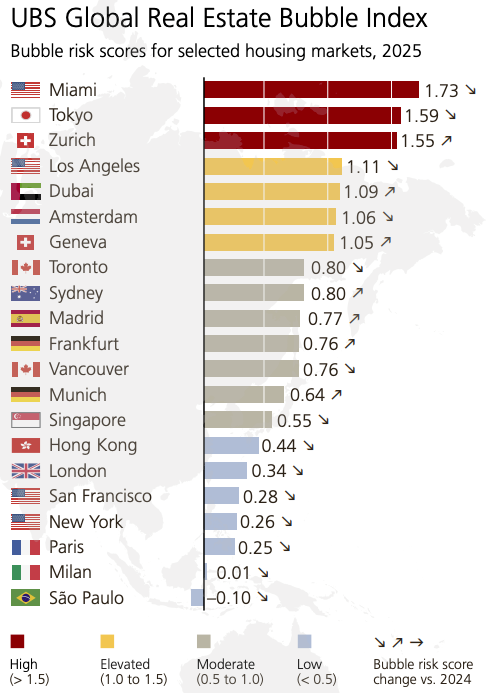
Swiss investment bank UBS has a report on which cities are at the highest risk of having a housing bubble, which they estimate by looking at trends in home prices, rents, and average incomes. Miami occupies the number 1 spot, followed by Tokyo and Zurich. [UBS]
Wired has an article about RealToken, which aims to “democratize access to real estate investment” by selling tokens representing shares of ownership in real estate properties. Apparently this has involved buying a bunch of dilapidated Detroit real estate and not maintaining it properly. “Last summer, the City of Detroit sued RealT and its founders, alleging “hundreds of blight violations.” Dorris’ property was one of many that city inspectors declared unfit for habitation. He told me that while his previous landlord wasn’t perfect, sometimes leaving Dorris to organize repairs, his building has deteriorated markedly since RealT entered the picture. The smoke detectors are missing, and the bathtub has no hot water, inspectors found. “The only way of washing is me standing over my sink,” says Dorris. “There are rats in the downstairs, there are squirrels in the upstairs.”” [Wired]
Marginal Revolution on how Denmark avoids the mortgage lock-in problem — where when interest rates rise, homeowners are reluctant to sell their home because their new one will have a higher interest rate mortgage. The Danish system has mortgages backed by a bond, which can be bought to pay off the mortgage. When interest rates rise, the price of the bond falls, incentivizing homeowners to purchase them. [Marginal Revolution]
Last Friday the Trump Administration released an executive order aimed at removing various regulatory barriers that add to the cost of building homes. [Whitehouse]