


Welcome to the reading list, a weekly roundup of news and links related to buildings, infrastructure and industrial technology. This week we look at plastic price jumps, crypto-backed mortgages, a proposed AI data center pause, US battery manufacturing, and more. Roughly 2/3rds of the reading list is paywalled, so for full access become a paid subscriber.
War in Iran
The disruption to oil and LNG supplies caused by the closure of the Strait of Hormuz is causing some countries to burn more coal. “India is burning more coal to meet higher summer demand. South Korea has lifted caps on electricity from coal. Indonesia is prioritizing using its domestic supply. Thailand, the Philippines and Vietnam are boosting coal-fired power.” [NPR]
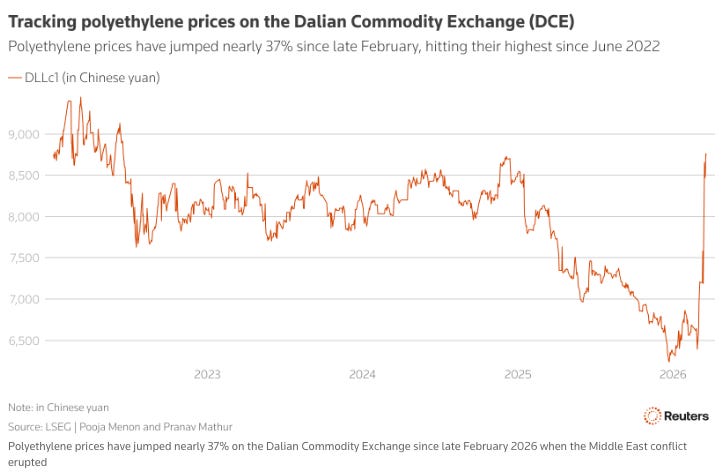
And because petroleum is used to make plastic, the closure of the strait is also driving up plastic prices. Dow Chemical plans a 30 cents per pound increase in April, following a 10 centers per pound increase in March. [WSJ] Plastic prices are up nearly 40% since February. [Reuters]
Petroleum is also used in the manufacture of pharmaceuticals, so the strait closure might affect the supply of generic medications. [CNBC] And last week I noted that production of helium (which is extracted as part of the natural gas drilling process) had also been disrupted, but I hadn’t clocked that liquified helium is used as a coolant for MRI machines. [X]

Another AWS data center in the mideast has apparently been damaged by an Iranian drone attack. [Al Jazeera]
To try and address rising gas prices, the EPA is temporarily waiving regulations on the sale of ethanol blended gas (which is restricted in certain locations at certain times of the year to reduce air pollution). [CNBC]
Iran has established a “safe shipping corridor” through the strait, allowing ships to pass for a $2m fee. [Lloyd’s List]
The closure of the strait seems to be good for Chinese battery manufacturers though: since the start of the war their stocks have spiked. “CATL’s China-traded shares have risen 19 per cent; Sungrow is up 19.4 per cent; and BYD, also the world’s top EV maker, has gained 21.9 per cent since the US-Israeli strikes were launched at the end of February.” [FT]
Housing
The New York Times on the ROAD to Housing Act, and the provision that would prevent the construction of build-to-rent single family homes. “Now, with the legislation back in the House awaiting a vote, critics are urging lawmakers to drop that build-to-rent restriction, arguing it would counter the intent of the bill, making it harder, not easier, to build homes when the country desperately needs them.” [NYT] Senator Elizabeth Warren is apparently unhappy about the resistance to these provisions of the bill, and is sending vaguely threatening letters to investors in multifamily apartments and manufactured homes. [Axios]
Another NYT article on the surprising success of some US malls. Apparently malls with higher-end, luxury tenants are doing fairly well. “There are roughly 900 malls in the United States, but only a small sliver are successful. The top 100 account for 50 percent of the entire sector’s value, according to Tibone, whereas the bottom 350 make up 10 percent. Revenue at class A malls is growing by 5 percent each year, and financing is easy to come by.” This is not totally surprising to me — malls in the Atlanta metro area seem crowded whenever I drive by or go in one, so I knew some must be succeeding — but it’s interesting to see that it seems to be specifically the high-end malls. [NYT]
Fannie Mae will now allow mortgages backed with cryptocurrency. “The mortgage company Better Home & Finance and the U.S. crypto exchange Coinbase Global unveiled a new mortgage product Thursday that allows home buyers to pledge their crypto holdings when getting a Fannie-backed mortgage, instead of selling the crypto to make a cash down payment.” What could go wrong. [WSJ]
Manufacturing
Elon Musk announces “Terafab” semiconductor fab to make chips for Tesla cars, Optimus, and space-based data centers. “We either build the Terafab or we don’t have the chips,” he said while on stage at an event in Austin. “We need the chips, so we’re going to build the Terafab.” [WSJ]