

Welcome to the reading list, a weekly roundup of news and links related to buildings, infrastructure, and industrial technology. This week we look at aluminum disruptions, the EV rust belt, the ongoing transformer shortage, SpaceX’s IPO, and more. Roughly 2/3rds of the reading list is paywalled, so for full access become a paid subscriber.
War in Iran
The world’s largest aluminum smelter in Bahrain was hit by an Iranian drone, bringing production offline. [Bloomberg] Other aluminum smelters in the area have cut production due to inability to ship through the Strait. This, in turn, has forced various EV manufacturers to cut production. “Gulf smelters that supply Toyota, Nissan, BMW, parts makers for Mercedes-Benz, South Korea’s Hyundai Mobis and hundreds of other automotive customers worldwide are defaulting on contracts or closing down. The U.S.-Iran war has effectively shut the Strait of Hormuz to commercial shipping, cutting off one of the largest flows of automotive-grade aluminum.” [Rest of World]
Israel bombed two Iranian steel factories. [NYT] The US bombed an Iranian bridge that was one of the largest in the Middle East. [BBC] And another Amazon data center was damaged by an Iranian drone. [Reuters]
The Philippines declares a National Energy Emergency. [Reuters] And Germany considers ramping up coal power to avert an energy crisis. [Politico]
Helium production in Qatar, which is responsible for roughly 1/3rd of the world’s supply, has been shut down. [NYT] We’ve previously noted that helium is a critical input for semiconductor manufacturing and MRI machines, but it’s apparently also crucial for mass spectrometers used in science labs. [X]
The world is running out of ways to deal with the disruption to oil supply that don’t involve using less oil. “In the first days of this war, the strait’s closure meant the immediate loss of 20 million daily barrels of crude and refined products. The industry went to work, activating a first layer of defense: using up stocks. The second layer came soon after as Saudi Arabia and the United Arab Emirates rerouted some exports using bypass pipelines to Red Sea and Gulf of Oman ports. The third defense came from politicians. The richest nations tapped their strategic reserves, injecting millions of barrels into the market. US President Donald Trump also made constant — and effective — verbal interventions. His jawboning about the chance of an end to the fighting helped tame panic buying.” [Bloomberg]
Italy denied US military aircraft permission to land at a base in Sicily for operations against Iran. [Bloomberg]
Because Iranian ships can traverse the Strait of Hormuz freely, Iran is actually making more money from oil sales than it was prior to the war. “Iran is now earning nearly twice as much from oil sales each day as it did before American and Israeli bombs started falling on February 28th. It may be pummelled on the battlefield, but the regime is winning the energy war.” [The Economist]
Housing
25 housing researchers signed an open letter opposing the provisions in the ROAD to housing act recently passed by the Senate that would limit build-to-rent housing. “If passed, the seven-year disposition requirement would result in a decline of more than 7% of single-family home completions and 18% of rental completions, according to analysis from Laurie Goodman and Jim Parrott at the Urban Institute, a Washington, D.C.-based think tank.” [Multifamily Dive]
Work on what would be the tallest mass timber building in the US (in Milwaukee of all places), has apparently stopped, and the project is facing foreclosure. [Multifamily Dive]
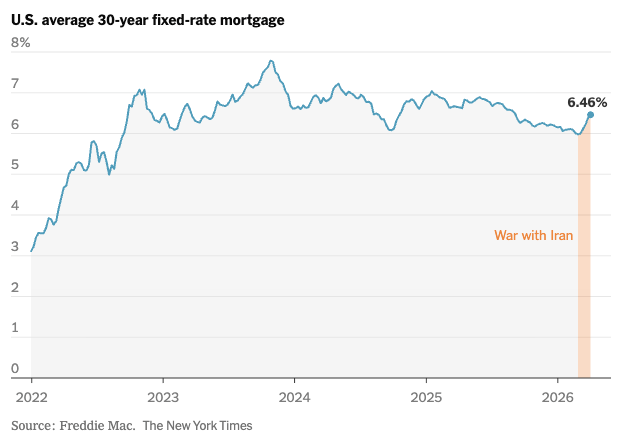
Mortgage rates had been steadily, if slowly, declining over the last year, but since the beginning of the war in Iran they’ve ticked back up. [NYT]
Japanese corporations keep buying US homebuilders. “Japanese builders have announced or closed acquisitions of 23 U.S. single-family home builders since 2020, more than double the number from 2013 to 2019. That doesn’t include the multifamily developers and construction-supply companies they have also bought. By some estimates, Japanese builders are now set to own about 6% of the U.S. home-construction market.” [WSJ]