Welcome to the reading list, a weekly roundup of news and links related to buildings, infrastructure, and industrial technology. This week we look at whether the Strait of Hormuz is open yet, building code cost benefit analysis, Intel joining Terafab, sponge cities, and more. Roughly 2/3rds of the reading list is paywalled, so for full access become a paid subscriber.
War in Iran
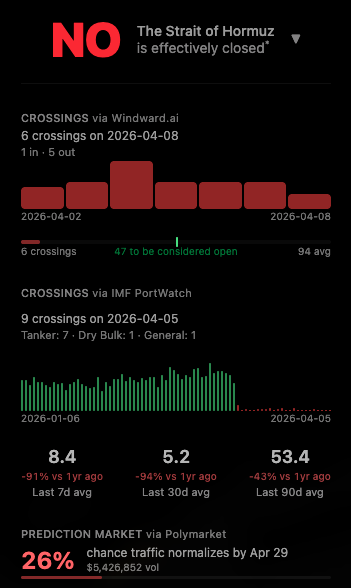
A two-week ceasefire between the US and Iran was announced earlier this week, in exchange for Iran opening the Strait of Hormuz. [BBC] But despite the agreement, so far Iran seems to have kept the Strait closed. [AP News]
“Is Hormuz Open Yet?” is a website for tracking the status of ship crossings in the Strait of Hormuz. [Is Hormuz Open Yet?]
Prior to the cease fire Iran was apparently attempting cyberattacks on US infrastructure. “Iran-affiliated advanced persistent threat (APT) actors are conducting exploitation activity targeting internet-facing operational technology (OT) devices, including programmable logic controllers (PLCs) manufactured by Rockwell Automation/Allen-Bradley. This activity has led to PLC disruptions across several U.S. critical infrastructure sectors through malicious interactions with the project file and manipulation of data on human machine interface (HMI) and supervisory control and data acquisition (SCADA) displays, resulting in operational disruption and financial loss.” [CISA] [LA Times]
Prior to the cease fire Iran threatened to target OpenAI’s Stargate data center in Abu Dhabi. [The Verge] And Microsoft is apparently considering designing more resilient data centers in high-risk areas. [The Register]
This week Iranian drone attacks targeted Saudi Arabia’s Jubail petrochemical complex, [Reuters] UAE’s Habshan gas facility [Al Jazeera], and power and desalination plants in Kuwait. [Al Jazeera]
The US supposedly located the weapons officer of the F-15E shot down in Iran using “Ghost Murmur,” a tool that allegedly uses “long-range quantum magnetometry to find the electromagnetic signal of a human heartbeat.” [NY Post]
Housing
A paper from UCLA’s Lewis Center takes a look at the process of building code development, and notes that provisions added to the building code rarely undergo any sort of cost-benefit analysis. “For example, when a fire marshall in Glendale, Arizona proposed two decades ago that US elevators be required to be larger than international standards to accommodate a 7-ft stretcher lying flat, the cost impact was reported as “none” (Grabar 2025). Today, it is among the reasons that a basic four-stop elevator in New York City costs about $158,000, compared to $36,000 in Switzerland (Smith 2024). These costs are ultimately borne not only as more expensive elevator amenitized buildings, but in the prevalence of newly constructed five- and six-story walk-ups in the US, which are inaccessible to many elderly and disabled tenants and are unheard of in most high-income countries (Smith 2024).” [Escholarship] Building code cost-benefit analysis was one of the points of advocacy from the White House Executive order a few weeks ago. [White House]
Most single-family homes in the US are built to the requirements of the (inaccurately named) International Residential Code. But apartment buildings are built to the somewhat-more-strict International Building Code, even small, house-like apartment buildings like triplexes. The Congress for New Urbanism proposes expanding the IRC to cover small apartment buildings as well. [CNU]
British building standards apparently recommend that windows be sized so that they’re cleanable from the inside by “95% of the elderly female population, without the need for stretching;” if this (non-binding, but often followed in practice) recommendation is followed, the result is extremely tiny windows. [X]
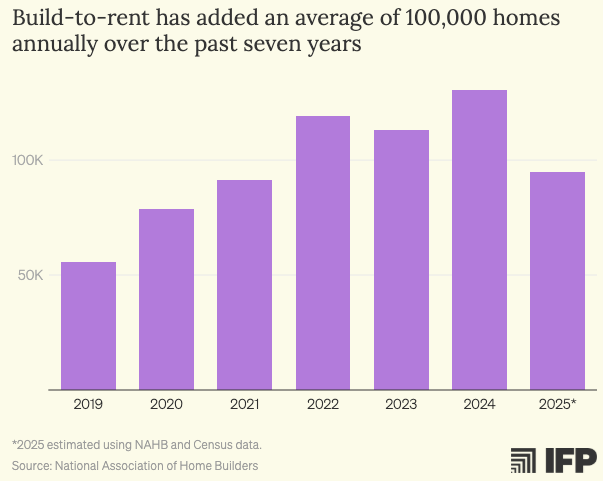
IFP’s infrastructure team has a good piece on how the build-to-rent provisions in the Senate’s ROAD to housing act would dramatically reduce new home construction in the US. (I’m a member of IFP’s infrastructure team, but didn’t help write this piece.) “At President Trump’s request, the Senate acted to prohibit institutional investors from buying up single-family homes. This provision is captured in Section 901 of 21st Century ROAD, “Homes are for people, not corporations.” But while the White House’s Executive Order and proposed legislative text would ban institutional investors from purchasing existing single-family homes, they explicitly protected investor financing of new rental homes. The Senate’s Section 901 goes further: it establishes a disposition requirement for investors to sell their newly built one- and two-family homes within a fixed period, discouraging investment in new rental homes and decreasing housing supply. The last-minute inclusion of Section 901 with this disposition requirement has jeopardized the overall package and fueled calls for a fix in the House. The housing industry, the pro-housing advocacy community, and both Democrats and Republicans in the House and Senate, as well as members of the administration, have voiced opposition to the section as written.” [IFP]