


Welcome to the reading list, a weekly roundup of news and links related to buildings, infrastructure and industrial technology. This week we look at Trump refusing to sign a housing bill, the high cost of US-made doors, slow trucking, why we stopped making new land, and more. Roughly 2/3rds of the reading list is paywalled, so for full access become a paid subscriber.
Housing
The ROAD to Housing Act has now overwhelmingly passed both chambers of congress (358-32 in the House and 85-5 in the Senate). [NBC News] But in a last minute twist, Trump has said that he won’t sign the bill until another piece of legislation, the SAVE America Act, passes first. “Hours after his own aides praised the bill and promised the president would sign it, Mr. Trump instead canceled a scheduled event at the Capitol. Eschewing an opportunity for rare bipartisan accord, the president opted to turn the bill into political leverage, aiming to force Congress — and members of his own party — to bow to unrelated demands over voting restrictions and the war with Iran.” [NYT] Not exactly clear how this will play out, since (theoretically) there’s sufficient votes to overcome a presidential veto.
Claims from the WSJ that the cost of homeownership is rising faster than overall inflation, though the sourcing here seems a little thin to me. [WSJ]
The National Institute of Standards and Technology (NIST) has released technical findings on the causes of the collapse of a condo building in Surfside, Florida in 2021. Apparently the failure was in large part due to failing to conform to building codes when the structure was built (due to both design and construction errors), which carved away what should have been a substantial safety margin in the loading applied to the building. [NIST]
One issue I worry about with stagnant construction productivity is that without being able to drive down costs by way of technical improvements, builders in a competitive market might be more incentivized to cut costs at the expense of quality. We’ve previously noted that the largest US homebuilders seem to have a rapidly rising rate of construction defects, and that trend seems to be continuing. “D.R. Horton and Lennar, the two biggest builders in the U.S. by total volume, have experienced the biggest surges in potential legal costs. Lennar’s self-insurance reserve, earmarked for liabilities that insurance won’t cover, rose 21% in fiscal 2025 to $336.9 million, according to the company’s annual financial statement. D.R. Horton’s reserves for legal claims, which include expectations for future claims, rose 57% to $1.1 billion from the end of fiscal 2022 to the end of fiscal 2025.” [WSJ]
A provision in the 2021 bipartisan infrastructure package requires that any infrastructure funded with federal dollars use US-produced construction materials. “Infrastructure” includes homebuilding, so any homes built or funded by the Department of Housing and Urban Development are hit with this requirement, which can dramatically drive up the construction cost of these homes. “Outfitting a 40-unit building with standard imported door sets runs about $67,000. The only American-made equivalent is a hospital-grade product built to keep germs off surfaces in an operating room, and it is priced like one: $546,000. More than eight times the cost, to open and close the same doors…On the Davenport job, the only compliant elevator the team could find cost about $75,000 more than the standard unit. The switchgear and the HVAC told the same story: the American product existed, but only at a premium.” [Substack]
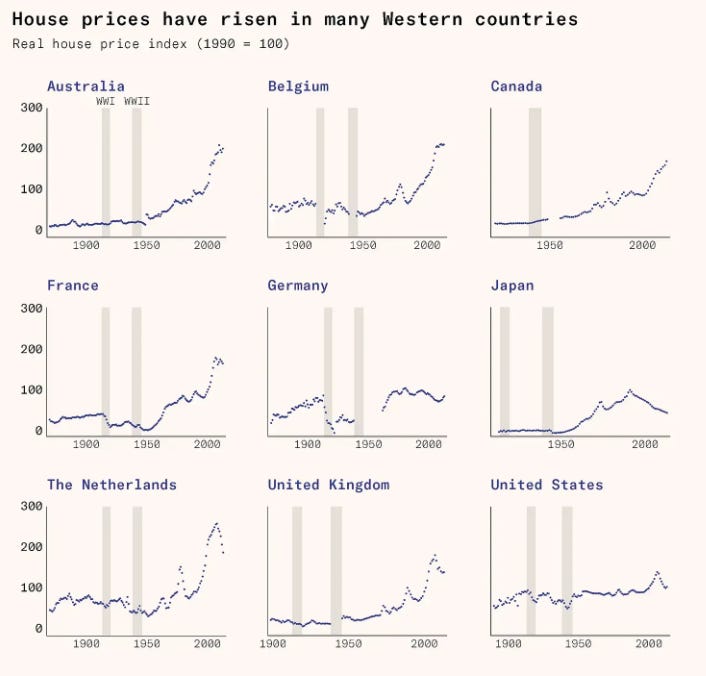
Works in Progress on how smashing NIMBYs created modern capitalism. [Works in Progress] And Works in Progress on how Europe’s housing problems are worse than America’s. [Works in Progress]
Manufacturing
The Mexican government wants to build a locally produced, inexpensive EV. [Gizmodo]
An open letter against California’s AB2047, which requires 3D printers to have detection algorithms to prevent the manufacture of firearms. “AB2047 requires every 3D printer sold in California to run a DOJ state-certified “detection algorithm” - a technology that can not reliably exist. If passed, it would pull a tool used in thousands of schools, libraries, labs, and small businesses out from under our communities.” [3D Printing Nerd]
US EV manufacturer Lucid lays off 18% of its workforce, right on the heels of a 12% layoff earlier this year. [CNBC]
On the other end of the spectrum, Chinese EV sales in Europe seem to be surging. “Leapmotor’s sales surged 465.1% in May, while Chery and BYD jumped 244.1% and 136.6%, respectively. Among other manufacturers, Geely and SAIC recorded increases of 12.6% and 13.9%.” [Reuters]
How Slate got the price of its EV truck down to $25,000. [Heatmap] Others have pointed out that despite the hype, this isn’t that much cheaper than an entry level Ford Maverick. [Ford]