


Welcome to the reading list, a weekly roundup of news and links related to buildings, infrastructure, and industrial technology. This week we look at adults living with their parents, Samsung’s profits, Native American data centers, Puerto Rico’s electricity grid, and more. Roughly 2/3rds of the reading list is paywalled, so for full access become a paid subscriber.
Housekeeping items:
No essay this week, but I’m working on a more involved piece about the predictability of legislation that should be out next week.
The Origins of Efficiency was chosen as one of McKinsey’s 2026 Book Recommendations.
Housing and cities
The 21st Century Road to Housing Act becomes law after Trump declines to veto it. [NPR]
49% of adults under 30 in the US are now living with a parent, according to a recent Federal Reserve Survey. “...young people say that living at home in 2026 doesn’t carry the stigma it once did because of how unaffordable life has become. About 55% of young adults who moved back home said it was out of financial necessity, according to a spring survey by financial services firm Thrivent.” [WSJ]
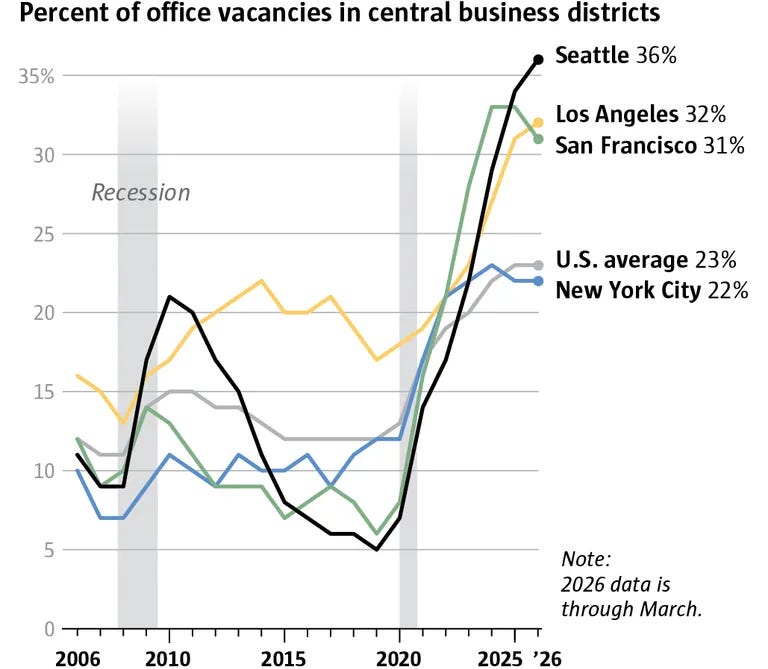
Seattle has more empty downtown office space than any other major US city. [Seattle Times]
How the enormous success of TSMC has spurred development in the surrounding city of Hsinchu. “While the rest of Taiwan and much of East Asia are grappling with a sharp population decline, so many children have been born in Hsinchu in recent years that the schools cannot keep up. Public high schools in the area now admit only students with sufficiently high test scores, a practice that Ms. Lo and a group of mothers have protested. Those who do not make the cut must commute to another school district.” [NYT]
There was concern earlier this week that a New York highrise being renovated might collapse, after several columns began to severely buckle. Thankfully it looks like it’s been stabilized for now. “The massive renovation project at 219-235 E. 42nd Street — a conversion of the former Pfizer headquarters into about 1,600 apartments — was scrutinized Tuesday as construction workers had to be safely evacuated after the building began swaying. Damage to structural columns at the 21st floor is visible to the naked eye. Several nearby buildings were also evacuated as a precaution.” [CNN]
Last year New York City added more apartments — 38,682 units — than it has since 1965. This is still a pretty small number of units for a city New York’s size, to be honest: Austin added over 30,000 apartments in 2024. [WSJ]
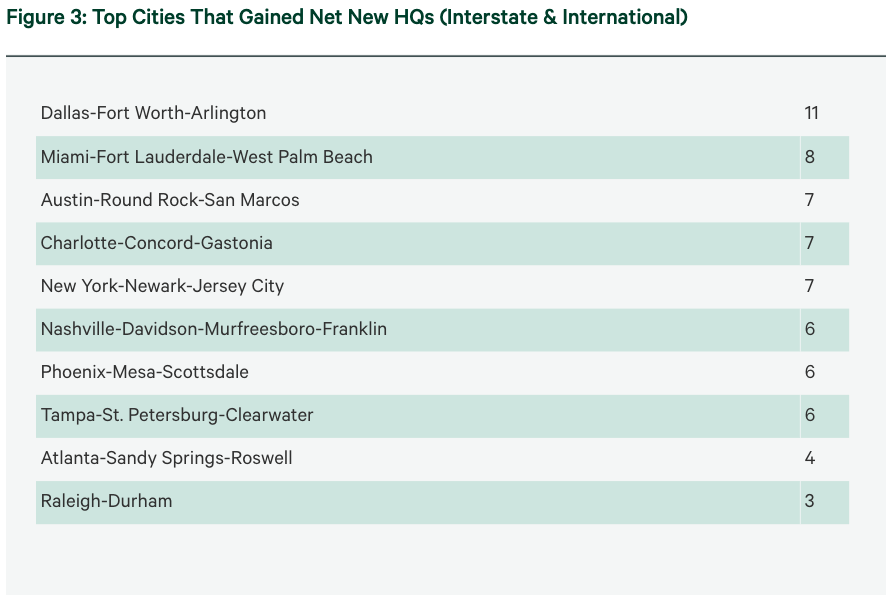
CBRE released its 2026 look at US company headquarters relocations. California continues to lose headquarters, Texas continues to gain them. [CBRE]
Are rising insurance costs driving Americans to relocate from flood-prone areas? “High-flood-risk US counties — those classified in the top 10% for their share of homes that are very vulnerable to flooding — lost a net 63,357 domestic residents from mid-2024 to mid-2025, nearly double the outflow recorded over the previous 12-month period, according to an analysis released Wednesday by real estate brokerage Redfin. In 2024, flood-prone counties collectively posted a net population loss for the first time in five years.” [Bloomberg]
Manufacturing
Atomic Semi, the semiconductor startup famously started by Sam Zeloof after building microchips in his parents garage, rebrands as “Fab2.” “Fab2 designs and builds every tool in its fabs in-house, from pumps, valves, and gas lines to lithography and the vacuum chambers that house it. The company assembles those components into machines, the machines into complete fabs, and then aims to mass-produce the fabs themselves. It pairs the hardware with Studio, an in-browser, collaborative EDA tool for layout, schematic, and simulation work, previously branded as Atomic Studio.” [Tom’s Hardware]
The Economist on whether China got its hands on ASML’s EUV machines. “Impossible, says ASML. Europe’s most valuable company has told American officials that it knows the exact location of all 340 EUV machines it has produced, including 26 decommissioned ones. None is in China, it says. What is more, only ASML can transport the highly sensitive machines, which it monitors online, and components that it ships are handled by ASML engineers in customers’ fabs. “ASML has never shipped an EUV machine to China, nor have we shipped to China any component, module or equipment specially designed to be used in an EUV machine,” the company says.” [The Economist]
Thanks to the huge jump in the price of memory due to the AI boom, Samsung’s profits in its chip division for 2026 will be more than the previous 40 years combined. [Toms Hardware]
An interview with some of China’s first cohort of “practical PhDs,” graduate students who develop a product instead of writing a thesis. [Nature]
After losing more than $1 billion of them to Iran, the US wants a cheaper reaper drone. [Ars Technica]