


Welcome to the reading list, a weekly roundup of news and links related to buildings, infrastructure, industrial technology. This week we look at pepper-spray drones, China’s chip Manhattan Project, Commonwealth Fusion’s fundraise, and a proposed Dulles Airport renovation. Roughly 2/3rds of the reading list is paywalled, so for full access become a paid subscriber.
Housing and Cities
It’s been a while since we checked in on 3D printed building company Icon. It seems like they’ve completed printing of 10 barracks buildings for Fort Bliss, and the first two of the buildings are now completed and occupied. [Army]
Some schools are buying pepper spray-equipped drones to deploy against active shooters. “At least nine schools — three in Florida, five in Georgia and one in Colorado — will have storage boxes that house the plastic, nonlethal aircraft made by Austin-based Mithril Defense. The drones, which can be activated by teachers, are capable of reaching a shooter within 15 seconds. The aircraft are designed to distract their targets by flashing strobes, blaring sirens, spraying them with pepper gel, or ramming into them at 60 mph.” [Washington Post]
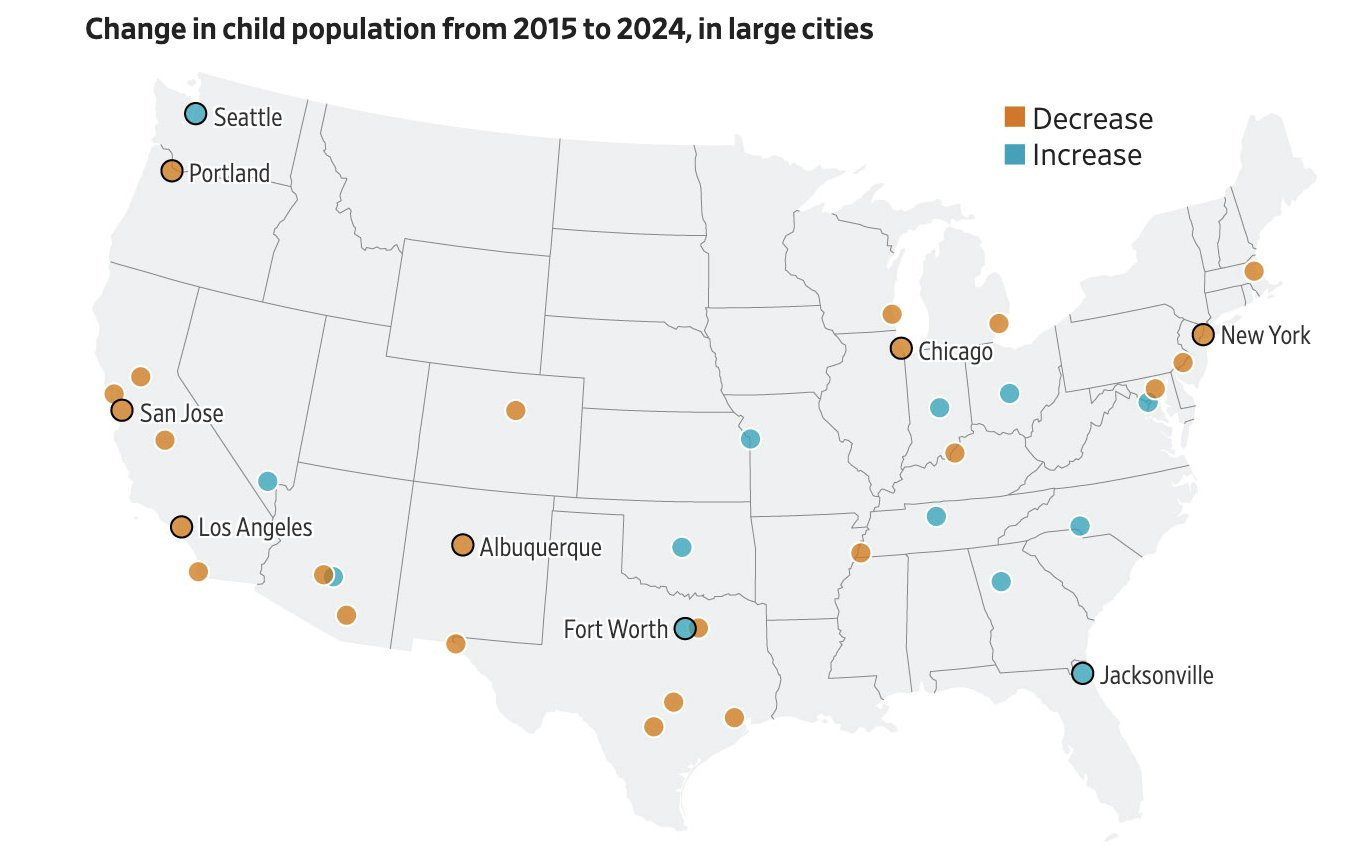
The Wall Street Journal on the decline of kids in big cities. “The number of children under 18 living in big U.S. cities is down 6% in the past decade, the Journal found, compared with a 1% decline nationwide. The drop is especially stark among families with little kids: The number of children under age 5 in big cities fell 15%, compared with a drop of 7% nationwide. Even cities that are gaining population are losing children.” [WSJ]
Manufacturing
The Financial Times on how things are turning around at Boeing, and how far the company has to go. “According to aviation research firm Leeham Co, Boeing’s commercial airliner division alone has lost more than $46bn since 2019. It estimates that, left with little pricing power after years of delayed and cancelled aircraft deliveries, the company lost an average of $2.8mn on each of the 314 planes it has delivered this year.” [FT]
Tesla is allegedly considering spinning off its China operation into a separate business, potentially to allow the company to merge with SpaceX. [WSJ]
Inside China’s “chip Manhattan Project” to catch up to the US in chipmaking technology. “Ding dusted off the same all-out approach China had used to produce its first atomic bombs, hydrogen bombs and satellites in the 1960s during a rift with the Soviet Union. He set up a committee that drew from the country’s best companies and labs to form specialized teams and directed them to master the different elements of the chip supply chain.” [WSJ]
Related, a Chinese company is now mass producing deep ultraviolet semiconductor lithography (DUV) machines. DUV is the technology that preceded EUV. [Tom’s Hardware]
Tesla says it plans to open source the designs for the discontinued Model S and Model X. [Electrek]
The US Senate is working on a bill that would ban automakers that have more than 15% Chinese ownership from selling cars in the US. This would include Mercedes Benz. [Car and Driver] And this week the US also banned the import of new models of Chinese robots and power inverters. [Reuters] And Starlink gets an exemption from the recent ban of foreign-made routers. [Ars Technica]
Related, this week China banned export of critical minerals that could be used for military purposes to 14 European companies. “As a result, the companies may struggle to buy many of the critical minerals they need to make products like rare-earth magnets and semiconductors, which are essential for cars, offshore wind turbines, robots, drones and other advanced manufacturing applications.” [NYT]
Both Ford and GM are competing to be the supplier for a new tactical pickup truck for the Army. [WSJ]