


Welcome to the reading list, a weekly roundup of news and links related to buildings, infrastructure, and industrial technology. This week we look at home price declines, the Strategic Petroleum Reserve, The Boring Company’s $4 billion fundraise, and more. Roughly 2/3rds of the reading list is paywalled, so for full access become a paid subscriber.
Housing and Cities
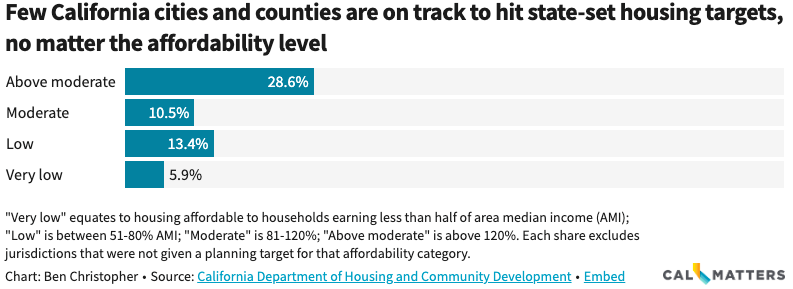
California is still not building enough housing. “After years of nudging, political trolling and litigating, most cities and counties now have state-approved plans in place. But as the production numbers show, it’s one thing to plan and another to build. Almost nowhere in the state is actually seeing the new construction necessary “to meet the housing needs of all Californians,” as housing regulators have described these targets.” [CalMatters]
Following the severe buckling of a column at an office to residential conversion project in New York, the Department of Buildings inspected 180 jobsites which had a connection to the team working on that project. No hazardous structural issues “posing an imminent danger to public safety” were found. [Construction Dive]
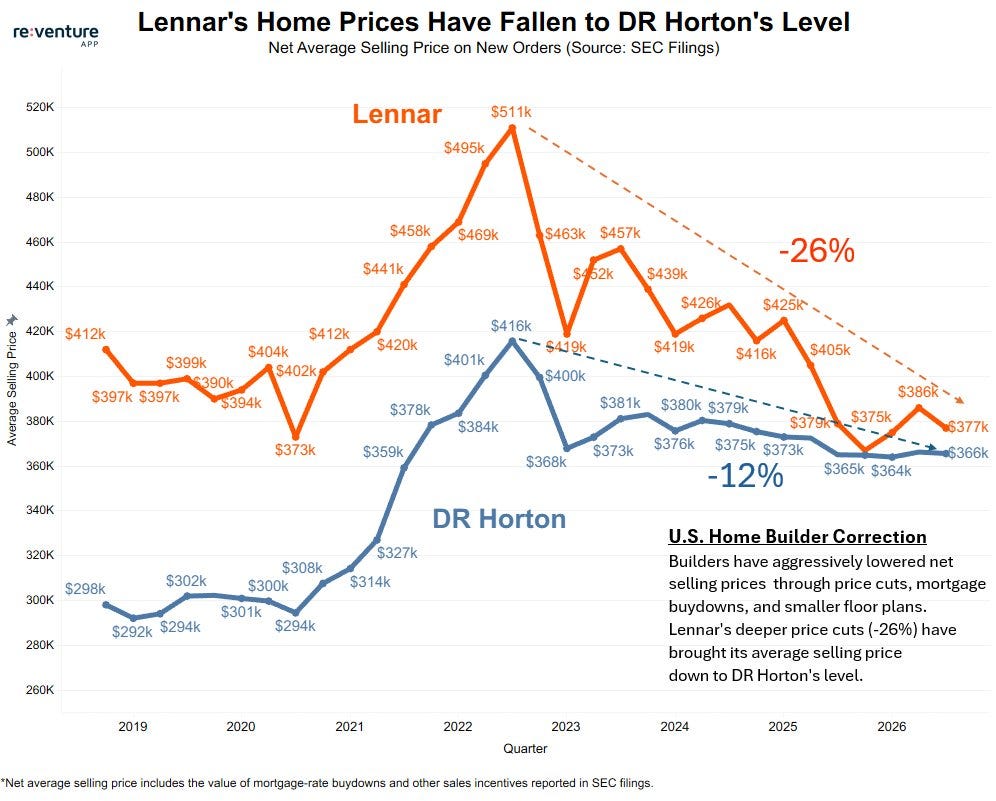
Lennar and DR Horton, the two biggest homebuilders in the US, have been reducing their prices for the last several years. “Lennar has reduced its average selling price from $511k to $377k, a nearly 25% decline (inclusive of incentives). DR Horton has cut from $415k to $366k, a 12% decline. Four years ago, this would have been hard to imagine.” [X] This matches a broader trend of declining home prices overall since 2022. [FRED] Interestingly, the Case-Shiller index hasn’t fallen. [FRED]
A cool map showing how much people in various cities in the US actually walk, compared to what their neighborhood walk score is. [National Walking Atlas]
Manufacturing
As part of his plan to tile the sky with orbital data centers, Elon Musk wants the Terafab project to eventually be able to produce 1000 gigawatts of computing power each year. Per Musk, currently the world produces about 20 gigawatts of computing power each year. [Manufacturing Dive]
The White House released a report accusing China of a “Great Transshipment Scam” — exporting nearly-finished goods to other countries and performing a very small amount of work there to mask their country of origin and get around tariffs. [SCMP]
The Wall Street Journal on how China is increasingly a manufacturer of not just consumer goods but of high-value industrial equipment. “The transformation is threatening the economic moats of advanced-manufacturing economies such as the European Union, Japan and South Korea. Producers of chemicals, machines, batteries and other industrial goods in those economies once depended on Chinese factories as customers, but now China is a formidable competitor abroad and even in their home markets. For the first time in decades, Germany imports more advanced capital goods from China than it exports there.” [WSJ]
Apparently 100,000 of the 383,000 members of the United Auto Workers union are academics, not autoworkers? “The University of California’s academic local alone represents some 48,000 workers—more than the UAW’s total membership at the global automaker Stellantis. Harvard’s graduate students account for another 4,000.” [City Journal]
South Korean shipbuilder Hanwha, which bought a Philadelphia shipyard in 2024, wants to acquire another US shipbuilder, Austal USA. Letting a foreign shipbuilder acquire these operations, and potentially getting them running more efficiently, seems like a pretty good deal for the US. [gCaptain]
Also on the subject of shipbuilding, the White House releases a memo calling for the Pentagon to source ships from foreign suppliers, and to construct or acquire a new Navy shipyard. [Workboat]