

Welcome to the reading list, a weekly roundup of news and links related to buildings, infrastructure, and industrial technology. This week we look at Los Angeles’ ADUs, electrical transformer manufacturing, gas turbine power plants, how water in the Colorado River is used, and more. Roughly 2/3rds of the reading list is paywalled, so for full access become a paid subscriber.
No essay this week, but I have a very long piece in American Affairs about why US transit construction costs are so high. You can read it here.
Housing and Cities
Los Angeles built over 10,000 ADUs in 2025, 37% of all housing units built in the county. [Smart Cities Dive]
There were 511 state bills introduced in 2025 across 40 states that pre-empted county land use authority in some way, 27% of which passed. A lot of land use restrictions are downstream of the local nature of land use authority — costs of development tend to be concentrated, and benefits tend to be diffuse, so local authorities are often incentivized to restrict development. State-level pre-emption should in theory help with this. [Smart Cities Dive]
Mexico plans on making it much harder to illicitly develop along the coast, and to tear down any illegal buildings that exist. “For years, wealthy developers have treated environmental fines as simply another line item in their budgets—a minor inconvenience easily absorbed by their profit margins. Tamborrel acknowledged this problem directly: “There are companies that allocate part of their budget to pay these fines and then continue operating; offenders prefer to pay the fine rather than request a permit.” But those days appear to be ending. Profepa has already closed four real estate developments in Puerto Vallarta and promises similar action along all of Mexico’s coastal states.” [Yucatan Magazine]
Claims (with video) that Amazon’s drone delivery service dropped a package in someone’s pool. [X]
The city of Mesa, Arizona is planning to sue several firetruck manufacturers, claiming that they’re colluding to drive up prices. [Mesa Tribune]
Manufacturing
Raytheon gets a $23 billion Navy contract for Tomahawk missiles. [Manufacturing Dive]
The New York Times has a photo essay on the laborious process of electrical transformer manufacturing. It’s not amazingly clear to me why this process isn’t more automated, and whether that would help to get them built faster or if the bottleneck lies elsewhere. [NYT]
1872 is a startup founded by several former SpaceX employees that wants to build highly automated factories for making steel parts. “The company is initially focused on automating the manufacturing of steel skids—rectangular steel frames that can provide a moveable foundation for modular buildings—with the goal of supplying customers who are developing AI data centers or small modular nuclear reactors.” [Ars Technica]
Energy
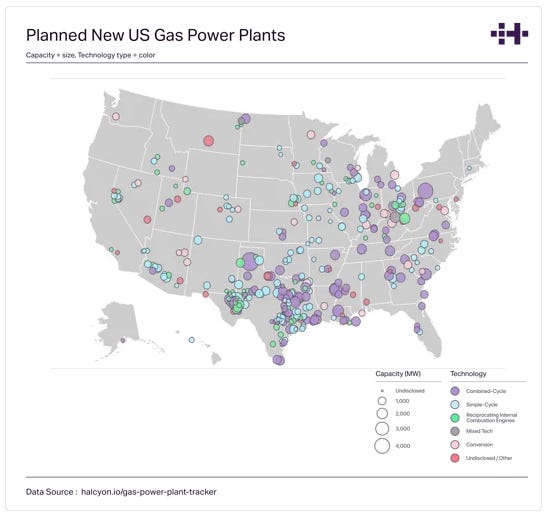
There are currently 270 GW of natural gas power plants in various stages of development in the US. This is roughly equal to 20% of all current US generation capacity. [X]
FERC approves a Southwest Power Pool (a regional transmission operator) plan to reduce grid congestion by “topology optimization” — responding to congestion by rerouting how power flows through the grid, rather than redispatching power plants. MISO, another regional transmission operator, already has such a program, and estimates that it has saved them almost $100 million so far this year. [Utility Dive]
The DOE cancels three planned National Interest Electric Transmission Corridors, designations designed to make it easier to build transmission projects. The DOE stated that transmission policy “must serve the American people, not special interests or a climate-alarmist agenda.” [Utility Dive]