


Welcome to the reading list, a weekly roundup of news and links related to buildings, infrastructure, and industrial technology. This week we look at AirBnB’s housing accelerator, rising steel prices, a resurgence of US coal power, low-head dams, and more. Roughly 2/3rds of the reading list is paywalled, so for full access become a paid subscriber.
Housing and Cities
Halina Bennet on what she’s learned from a year of covering housing for Matt Yglesias’ substack Slow Boring. “...the most consequential housing wins of the past year came from states preempting local control, not from localized enthusiasm for new building. The order of operations matters; the people who’ve led building efforts without state encouragement have often found trouble at the ballot box.“ [Slow Boring]
This week AirBnb announced a “housing accelerator” program, which is investing $250 million in “last-dollar financing” for promising multifamily housing projects. The program will also “support housing advocates tackling issues like outdated zoning, permitting delays, and complex processes.” [Airbnb]
We’ve previously noted the rising opposition to property taxes around the country, with states like Florida considering ending them entirely for certain types of property. A new paper from law professor David Schleicher takes a broad look at recent opposition to property taxes, what caused it, and what impacts it’s had. “In the last three years, a number of states have substantially reformed their property tax systems, providing huge tax benefits to owner-occupied homes and shifting the burden of paying for services like schools and police to commercial property owners (including rental apartment buildings), to other local taxes, and to state funding, which itself largely comes from sources like sales taxes and income taxes. A few, including Florida, Ohio, North Dakota, and Texas, have considered going further, either completely abandoning property taxation for owner-occupied housing or even abandoning property taxation entirely...Perhaps most notably, these property tax reforms will lead to higher housing costs, and thus constitute a substantial transfer of wealth towards people who already own homes and have already seen their net worth increase substantially in the post-COVID housing market.“ [SSRN]
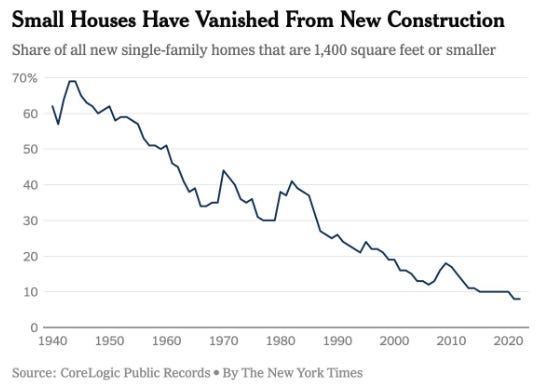
Median and average home sizes aren’t actually all that much larger today than they were in 1999 (there’s been about a 10% increase), but averages don’t tell you what the overall distribution of house sizes looks like over time. If you look only at smaller houses, less than 1400 square feet, the fraction of them has fallen precipitously. [X]
A new paper from Ed Glaeser on the impacts of various transportation technologies on urban density. [NBER]
The Fed raises interest rates 0.25%, the first raise since 2023. [Fox]
Manufacturing
Steel prices are up 25% year over year, and lead times are now at 55 weeks, thanks to (you guessed it) data center demand. [Construction Dive]
Trump says that he’d be ok with Chinese companies building cars in the US. [Reuters]
Supersonic aircraft startup Hermeus gets a license to manufacture Pratt and Whitney’s F100 jet engine, which powers aircraft such as the F15 and F16. The propulsion system Hermeus is developing, which is called a “turbine based combined cycle,” combines a traditional jet engine with a ramjet (which uses the aircraft’s forward motion to compress air into the combustion chamber, rather than a compressor). [X] [Hermeus]
The US house of representatives passes a bill requiring AM radios in cars. AM radio is apparently difficult for EVs to accommodate, because the large electric currents in EVs interfere with AM radio reception. [WSJ]