


Welcome to the reading list, a weekly roundup of news and links related to buildings, infrastructure, and industrial technology. This week we look at Icon’s fundraising, employment in China’s solar industry, grid-scale battery reliability, Tesla’s flying roadster, and more. Roughly 2/3rds of the reading list is paywalled, so for full access become a paid subscriber.
Housekeeping items this week:
I was on MTS Live talking about robots, prefabricated construction, and other things.
I’m quoted in this Dispatch article about data center construction.
Housing and Cities
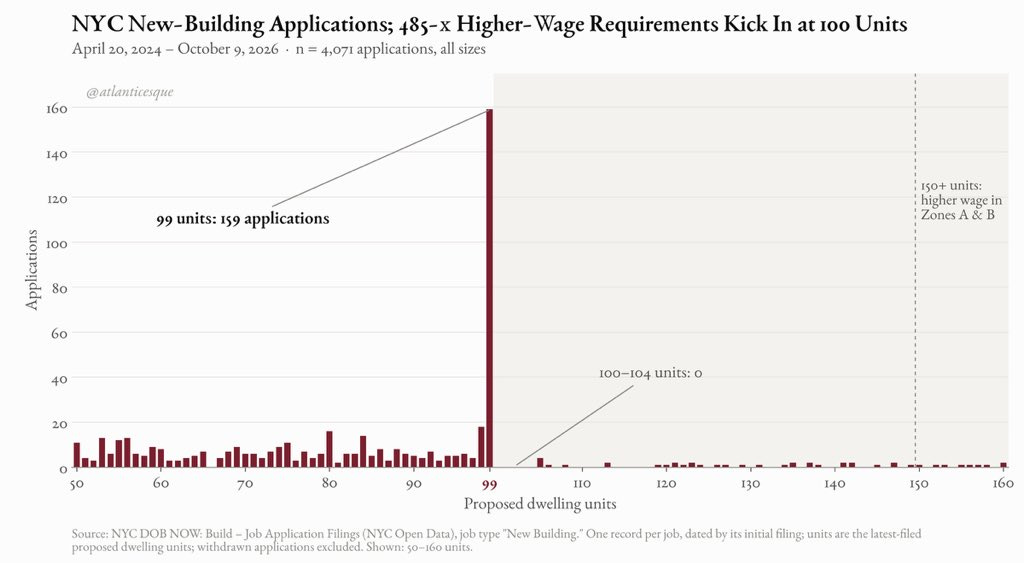
From the annals of “suspicious discontinuities,” New York City has a tax break for new projects that set aside some proportion of the units as affordable housing called “485-x.” If a project has more than 99 units, the required share of units that are “affordable” goes up, and so do the wages that need to be paid for construction workers, resulting in a very large number of projects that are exactly 99 units. [X] [Housing Wire]
DR Horton, the largest homebuilder in the US, signed an agreement to access the services of Canadian construction automation startup Promise Robotics for more than 1250 homes. Promise seems to offer some sort of AI-driven, robotic factory-based construction service. “Promise Robotics applies AI across the homebuilding production process by interpreting existing home designs, generating production plans and robotic instructions, orchestrating manufacturing, and connecting that production with site installation.” [Promise Robotics] One possible future I see for construction automation is “AI + robotics changes the logic of prefab construction and makes it more attractive,” so it’ll be interesting to see if things like this play out.
Also in construction automation news, construction 3D printing startup Icon raises a $200 million series D, at a $1.4 billion valuation. [Dealroom] This is surprising to me: I had sort of assumed things weren’t going well for the company. Though this does seem to be a “down round” — in 2022 its valuation was supposedly “approaching $ 2 billion” — I’m nevertheless adjusting my probabilities of success for Icon upward somewhat.
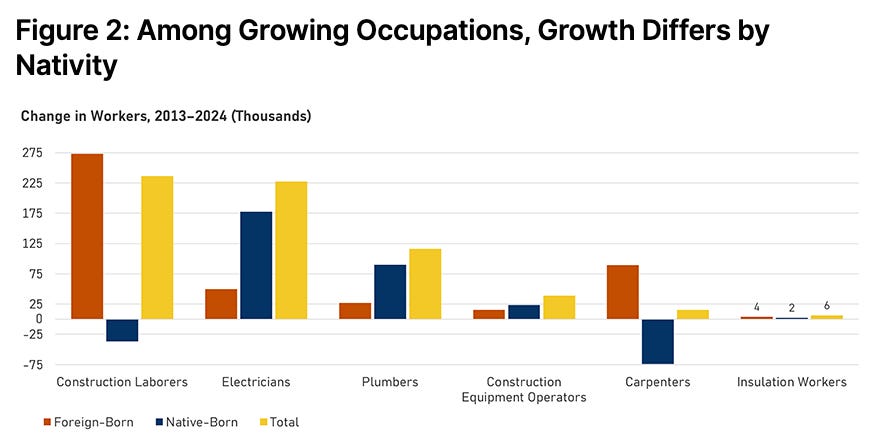
Some interesting data from Harvard’s Joint Center for Housing Studies on immigrants in the US construction industry. One stat I found notable: between 2013 and 2024, the number of foreign-born workers who were construction laborers or carpenters increased massively, even as the number of native-born workers in those occupations declined. But for electricians and plumbers (licensed professions), most of the increase came from native-born workers. [Harvard JCHS]
Manufacturing
GlobalFoundries, the semiconductor manufacturer that was spun off from AMD in 2009, will operate two new fabs planned for New York, funded by $21 billion from Japan. The US government is also taking a 4% equity stake in the company. [GlobalFoundries]
ASML says it can’t currently meet customer demand for lithography machines for 2027 and 2028, and is looking for ways to increase capacity. [ASML]
Ruthless competition in China’s solar industry: employment at China’s five biggest solar manufacturers fell 21% last year, and 31% the year before. [Reuters]
The US isn’t the only country with a small number of companies that make the grain-oriented electrical steel (GOES) needed for power transformers. Only two EU companies, Thyssenkrupp and Stalprodukt, make it, and as in the US they can’t make the highest quality steel. “The global leaders—the companies that make the world’s best GOES—by and large are in [South] Korea and Japan,” Alimento says. “In the U.S. and in the EU, domestic manufacturers are not capable of making that quality of GOES, because it is a heavily protected trade secret.” [IEEE Spectrum]
Thanks to ongoing memory shortages as a result of AI data center construction, smartphone shipments are down 20% year over year. [Counterpoint]