


Welcome to the reading list, a weekly roundup of news and links related to buildings, infrastructure, and industrial technology. This week we look at a Brooklyn building collapse, BAAJA’s odds of passing, reusing old memory in new phones, a nationwide aircraft ground stop, and more. Roughly 2/3rds of the reading list is paywalled, so for full access become a paid subscriber.
Housing and Cities
A 3 story building in New York partially collapsed into an adjacent construction site that was being excavated, killing 8 people and injuring 18. Good reminder that for as burdensome as various building regulations can sometimes be (particularly in New York, with its ubiquitous sidewalk sheds), they don’t exist for no reason. [Construction Dive]
On the other hand, that doesn’t mean that we shouldn’t evaluate code requirements to see if the benefits they bring are worth the cost. An article in the Washington Post argues that many requirements to upgrade electrical panels for higher load devices are often unnecessary. “Outdated industry practices and in some places outdated electrical codes are regularly resulting in the recommendation that people need to upgrade their electrical panels if they want to add appliances such as induction stoves, heat pumps and electric-vehicle chargers. The expense — at a median of $3,500, and triple or quadruple that in some settings — is deterring some energy-efficient upgrades and making the projects far more costly for those who proceed. But some researchers say panel upgrades are almost always unnecessary. One report this year found that 98 percent of homes with 100-ampere panels, the smallest common size, have room to add popular electronic devices.” [Washington Post]
The US now has over 1500 mass timber buildings, up from fewer than 100 a decade ago. [The Real Deal]
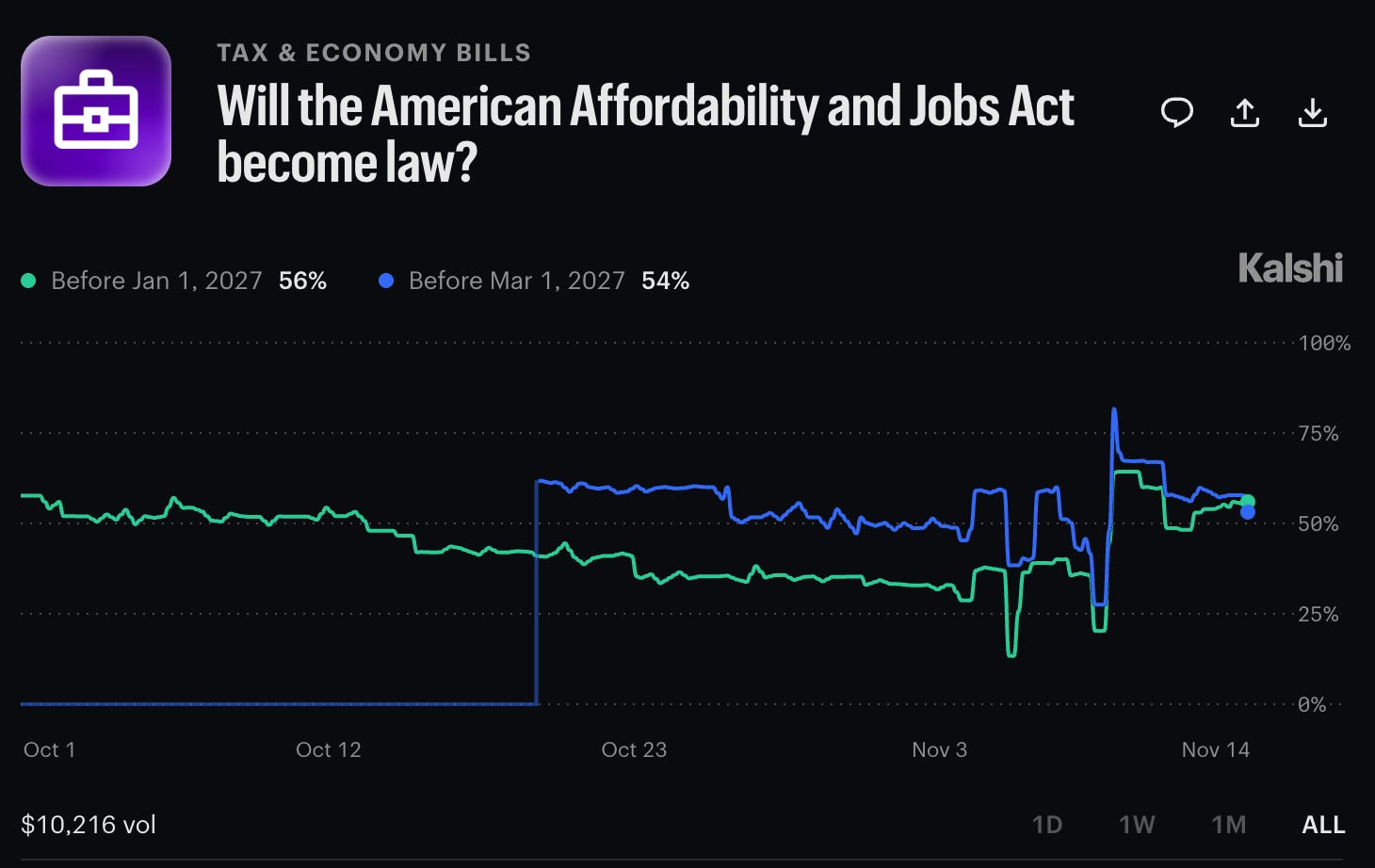
The current probability of permitting reform bill BAAJA becoming law is little over 50% on Kalshi. [Kalshi]
A Houthi missile hit Saudi state oil company Aramco’s skyscraper in Riyadh. [X]

A new Nicholas Bagley paper on the cost of federal permitting, arguing that the real costs of things like NEPA is the huge amount of effort agencies put in to try and make things “litigation proof”. “The evidence does suggest, however, that the bulk of the costs of the federal permitting regime stem from the defensive measures agencies and developers take to guard against the risk of a bad outcome in court. That insight allows for a rough evaluation of the likely effects of popular permitting reform ideas. Some—including popular ones like time limits and statutes of limitations—are unlikely to accomplish much. Only those reforms that change the incentives created by the risk of judicial review will meaningfully move the needle.” [Nicholas Bagley]
A progress report from the Center for Land Economics, which advocates for land value taxes to make more efficient use of urban land. ”Three states passed laws enabling land value taxes in some form: Kentucky, Virginia and New York. In each of them we’re now helping cities work out how to put them into practice. Five more states and DC considered similar bills. This is the most legislative momentum the movement has seen in decades…” [Land Economics]