

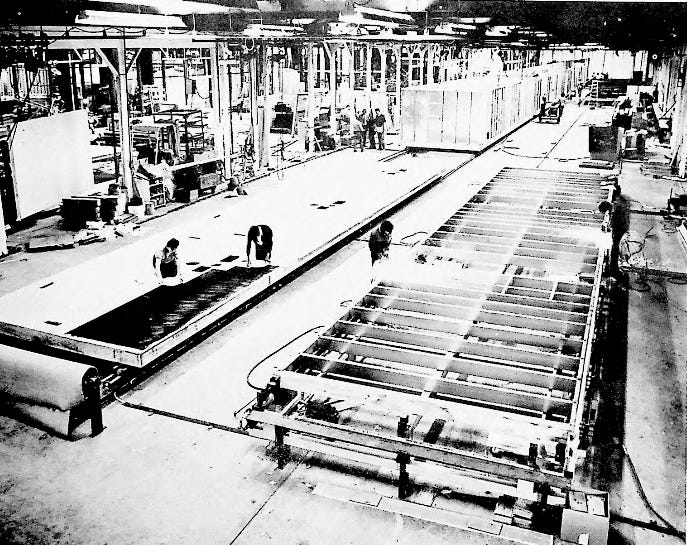
Many who look at the high and rising cost of housing see the problem as fundamentally one of production methods; more specifically, that homes could be built more cheaply if they were made using factories and industrialized processes, instead of assembling them on site using manual labor and hand-held tools. This idea goes back decades: in the 1930s, Bauhaus School founder Walter Gropius argued that the reason car prices had fallen while home prices hadn’t was because car manufacturing was highly automated, and home construction wasn’t. Nearly 100 years later, the construction startup Katerra raised billions of dollars in venture capital to pursue this same thesis, using factories and mass-production methods to deliver low-cost homes. (Full disclosure: I managed an engineering team at Katerra.)
One particularly ambitious effort to bring homebuilding into the world of mass production was Operation Breakthrough, a US government homebuilding program which ran from 1969 through 1974. A project of the newly-established Department of Housing and Urban Development (HUD), Operation Breakthrough was started to “break through” the barriers which prevented the large-scale adoption of industrialized building methods. It aimed to do this by attacking every part of the home construction process: funding new, industrialized methods of building homes, developing new codes and standards with which to evaluate them, and turning the highly fragmented housing market (characterized by numerous jurisdictions operating under different sets of requirements) into large pools of aggregated demand that could efficiently absorb large-volume home production.
While thousands of homes were built as a result of Operation Breakthrough, it ultimately failed in its goals to shift US homebuilding into a regime of industrialized building. Within a few years of the program concluding, most of the systems developed by Breakthrough were no longer in production, and prefabricated construction is a smaller share of US homebuilding today than it was in the 1960s before the program began. By looking at the history of Operation Breakthrough, and understanding what went wrong, we can better understand the barriers to industrialized homebuilding, and what overcoming them might require.
The Origins of Operation Breakthrough
In the 1960s, it was widely believed that the US was on the cusp of an enormous housing shortage. While homebuilding had been growing rapidly following the end of WWII (rising from 325k housing starts in 1945 to 1.9 million in 1950), the projected demand for housing in the wake of the baby boom was growing even faster. Birth rates rose from 2.2 children per woman at the depths of the Great Depression to 3.6 children per woman by the end of the 1950s. By 1960 the US had a population of just under 180 million, up from 140 million in 1945. The population was projected to reach 250 million by the mid-1980s, and over 300 million by the year 2000.
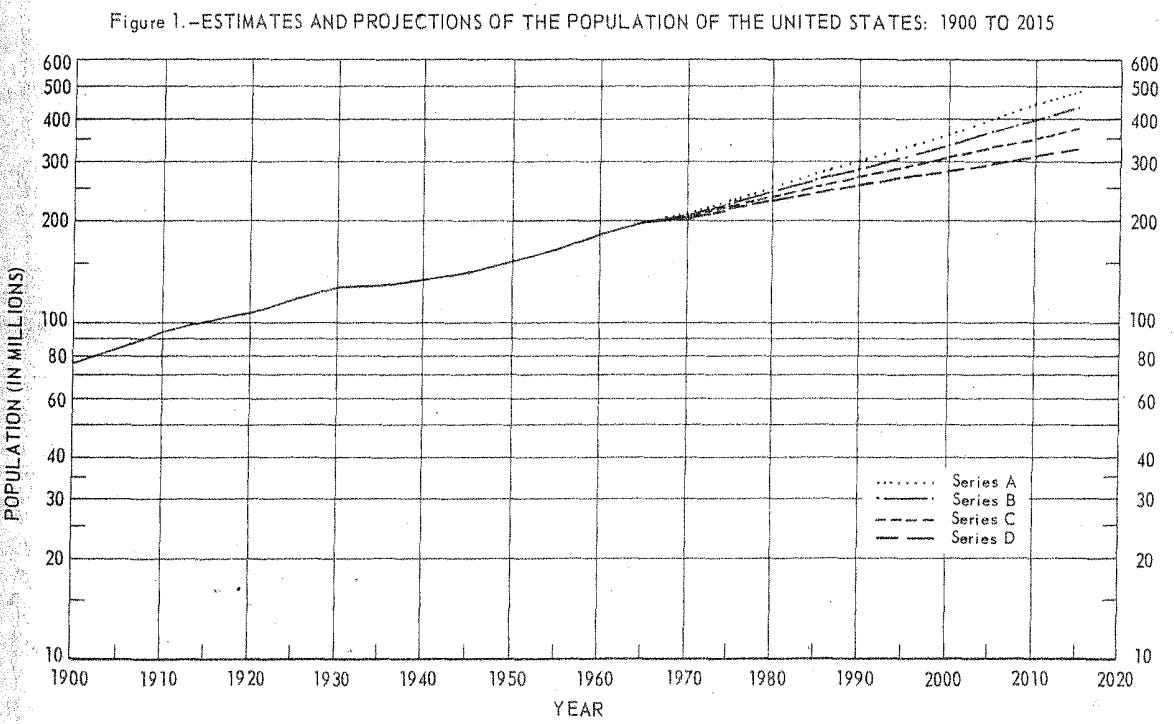
These millions were moving, more and more, to dense cities and metro areas. In a March 1965 address to Congress, President Lyndon Johnson stated that by the end of the century the US needed to build as many new homes as had been built since the arrival of the first colonists on American shores.
In the same Congressional address, Johnson called for the creation of a Department of Housing and Urban Development. The new cabinet-level agency would be formed from the existing Housing and Home Finance Agency (which in turn had been created in 1947 as an amalgamation of several other US housing programs). Within this new department would be an Institute of Urban Development, which would research technology that could reduce the cost of housing construction.
The bill creating HUD passed several months later, in August of 1965, but without the recommended research institute. However, the next year Congress authorized the creation of a “National Commission on Urban Problems” (later known as the Douglas Commission) which would study, among other things, various problems in the homebuilding industry. The following year, Johnson created a President’s Committee on Urban Housing. Johnson’s presidential commission was led by Edgar Kaiser, the son of famed industrialist Henry Kaiser, and the former general manager of Kaiser’s enormously productive wartime shipyards.
Both commissions studied ways to reduce housing construction costs, and considered whether prefabrication and/or mass production was a viable strategy for doing so. The Douglas Commission noted that while prefabrication of homes had resulted in some cost declines, no major “breakthrough” had occurred. With the proper encouragement, however, this might change:
The production of new products for the construction industry, experimentation with new materials and new production techniques, and exploration of advanced systems approaches to buildings, should be encouraged. Every effort must be made to eliminate roadblocks consistent with protecting health and safety. In the short run the greatest savings will be realized through increased scale and the use of existing prefabrication techniques at large scale. In the long run, wholly new systematized approaches may be forthcoming. [Emphasis mine.]
Kaiser’s presidential committee similarly noted that, while the housing industry was more efficient than was commonly believed, it was still “less dynamic and more resistant to change than most other major industries,” and that it “conspicuously requires stimulation through judicious public policies.” The committee wrote that:
The housing industry is operating with at least modest efficiency and has experienced more technological advances than the casual observer would suspect. The fiercely competitive structure of the industry encourages builders to adopt more efficient techniques as they are developed. On the other hand, the prevalence of institutional barriers, such as zoning ordinances and labor practices, and the low level of research in the industry, are signs that much progress can still be made.
As these reports were being prepared, Congress and the president were taking further steps to stimulate US housing production. The Housing and Urban Development Act of 1968, which allocated billions of dollars for housing development, was passed with the ambitious goal of creating 26 million new housing units over the next 10 years. At 2.6 million new homes each year, this was more housing than had ever been built in the US.
Most of the bill involved modifying or expanding existing government housing programs. However, one amendment of the bill (Section 108, later known as the Proxmire amendment), aimed to “encourage the use of new housing technologies in providing decent, safe, and sanitary housing for lower income families.” Per Section 108, HUD was required to create up to five plans for new housing technologies, build at least 1000 units of housing using each type of technology, and study the costs and benefits of each new housing type.
After the bill passed, HUD set to work implementing this program, seeking recommendations from the National Academies of Sciences’ Building Research Advisory Board (BRAB). BRAB recommended that HUD use the Section 108 technological program to test several homebuilding hypotheses:
That major technological changes (as opposed to incremental changes) could dramatically improve productivity, reduce cost, and make it possible to produce more homes.
That said technological change required large, aggregated housing markets, which could only be assembled by reducing onerous building codes, zoning requirements, and other regulations which had fragmented the housing market.
That mass-produced homes would be found acceptable by the people living in them and the communities in which they were built.
Critically, the BRAB report strongly suggested that the program be an experimental one, to determine whether the above hypotheses were correct, rather than a demonstration program that assumed they were:
The program should be viewed throughout the planning, implementation, and subsequent evaluation phases as objective experimentation; the undertaking should not be allowed to be characterized as demonstrations of foregone conclusions nor to foreclose the evolution of other financial, organizational, or technological developments in the housing industry.
But even before BRAB’s report was complete, changes in the administration would shift how Section 108 was implemented. (This pitfall of ambitious government programs has been described as the “Law of Inescapable Discontinuity” — the fact that government programs are unlikely to be conceived and implemented by the same people.) Richard Nixon took office in January 1969, and he appointed George Romney, Governor of Michigan and the former CEO of American Motors, as Secretary of HUD.
Romney had competed with Nixon for the Republican presidential nomination a year earlier. Having won, Nixon may have nominated Romney for Secretary of HUD as something of a snub, and as a way of sidelining a political rival. Romney, however, considered the Secretary of HUD to be a “cabinet post of untapped potential where he could improve America’s cities and improve the cause of race relations.” During his tenure Romney conceived of many new HUD programs, even restructuring the agency to help transform what he saw as a collection of separate bureaucracies into something more organized and coherent.
Operation Breakthrough was one such Romney brainchild. The program was a larger and more ambitious undertaking than the Section 108 program which had been recommended by the BRAB report. Rather than a mere experiment that would build homes using new technologies, Breakthrough aimed to reorganize the entire country’s system of housing production. “What we are trying to do” said Romney:
is focus not only on technical ingenuity, but the whole concept of modern industrial management on each stage of the problem…The identification of markets; the identification and more effective use of available land; the design of the product and its environmental situation; and its financing and distribution to the consumer.
Romney’s background was in automobile manufacturing, and he strongly believed that mass production methods were the answer to America’s looming housing crisis; all that was needed was to clear the obstacles that had thus far prevented them from succeeding. Operation Breakthrough was thus directed “not only at technological advancement of housing,” but at “breaking through the various nonhardware constraints to more efficient production of housing.” To do whatever it took to industrialize homebuilding on a large scale.
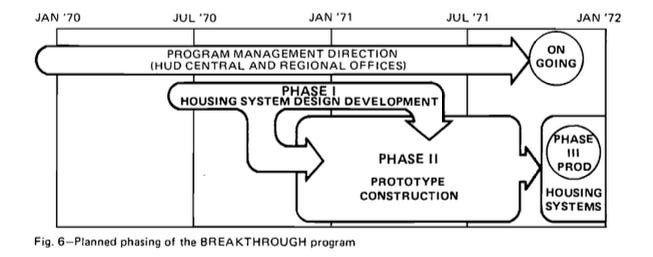
Operation Breakthrough would be a three-phase program. In Phase I, HUD would solicit designs for industrialized housing systems — housing built in factories, or using like factory-like methods — and work to develop the most promising ones. In Phase II, the chosen systems would be constructed on several sites around the country to test their performance, see whether consumers would accept them, and to demonstrate the systems to prospective developers. In Phase III, large-scale production of the best performing systems would be undertaken. Concurrently with these phases, HUD would work to create the aggregate housing markets that could absorb large volumes of industrially-produced housing. This would involve working with state and local jurisdictions to relax code requirements, developing evaluation criteria so that developers could be confident houses built using novel technology would be “safe, sound, and durable,” and working with labor unions so that they’d accept the use of prefabrication. To administer this program, Romney appointed former NASA administrator Harold Finger. On the eve of the first human moon landing, and just months after Romney’s arrival at HUD, they began to build their housing moonshot project.
Phase I
In June of 1969, HUD sent a Request for Proposal (RFP) for industrialized housing systems to over 5000 organizations around the country. Respondents could submit either proposals in two types: Type A (well-specified systems for entire buildings) or Type B (systems that either had not yet been fully developed or were for only part of a building). Proposals could be for any type of housing system, from single family homes to high-rise apartment buildings. Responses were due in 90 days.
Despite the short window of time, HUD received 632 proposals, many more than they had anticipated. 244 proposals were Type A proposals, whole-building systems which were ostensibly fully developed. The proposals were for a broad array of different housing types — single family homes, townhouses, multifamily apartments — and were submitted by a variety of organizations. Some came from existing large-scale homebuilders, such as Levitt and Sons. Others came from existing prefabbers, like National Homes and Scholz Homes. Some were from manufacturing companies outside the homebuilding industry, including General Electric, Martin Marietta, and Westinghouse. Architects, universities, and building product manufacturers also submitted proposals. Some systems used volumetric modules (i.e., large boxes), others used panelized construction, sometimes in exotic arrangements: a system by architect Aitken Collins and Associates used foldable plastic sandwich panels to form a sort of three-dimensional A-frame, which could be erected in 2 to 6 hours “manually or with helicopter assistance.” Systems used both conventional building materials — wood, concrete, steel — as well as more exotic ones, such as plastic and carbon fiber.
Of the 244 Type A proposals, 22 were selected by a government panel to proceed to Phase I. Systems were chosen on the basis of whether they would be sufficiently practical and durable, whether they could cope with different site conditions, and whether the submitter had the necessary organizational and financial resources to actually produce the proposed system in volume. Selections were also made to ensure a breadth of different housing types, costs, materials, and degree of innovation (from the conventional to the radically new).
14 of the 22 systems were module or panel systems utilizing wood or concrete, and which were already in relatively widespread use. National Homes and Scholz homes, each selected for a Phase I contract, had already built tens of thousands of prefabricated homes in the US, and Rouse-Wates’ system had been used to build thousands of homes in Britain.
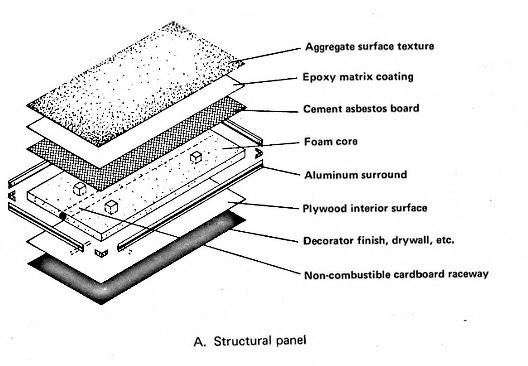
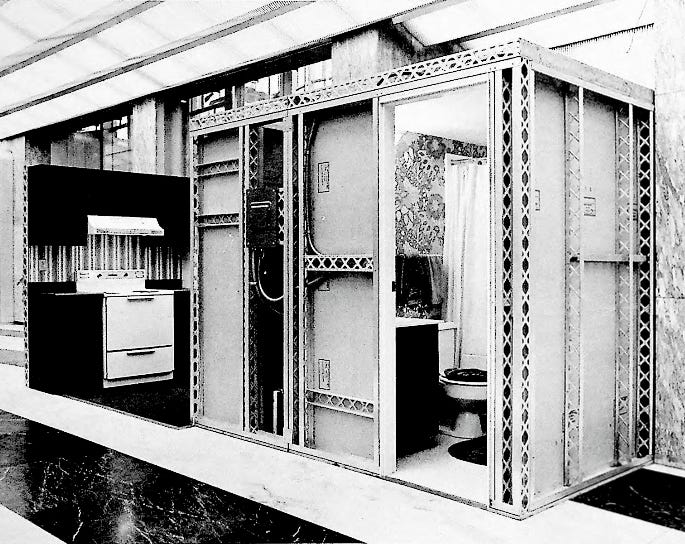
But some of the systems were more novel. Aluminum manufacturer Alcoa proposed a system which used aluminum-framed service modules (including kitchens, bathrooms, and other services like plumbing and HVAC) around which the rest of the house would be built. Pantek, a subsidiary of satellite manufacturer Ball Aerospace, proposed a panel-based system made from layers of epoxy, foam, aluminum, and plywood, which they had originally designed as a chemical-resistant flooring system for laboratories. Housing startup Stirling Homex proposed a concrete highrise system which would raise the building up on huge hydraulic jacks one level at a time, with individual modules slid in from below.
However, even these systems were often new implementations of existing ideas. Aluminum framing and craneless module erection via hydraulic jacks, for instance, were both old ideas by the late 1960s. Some commenters noted that there was little that was truly radical in the selected Breakthrough proposals, and program administrator Harold Finger admitted that “very little of what we are doing requires basic research or totally new hardware technology.” HUD defended its system choices on the grounds that the intent was to get systems into large-volume production as rapidly as possible, and they had selected systems based on their evaluation of whether the companies were able to do so; likewise, the short window (90 days) for response to the RFP gave scant time to develop a truly novel system from scratch. This naturally biased the evaluation towards systems that were less novel, and had less technical risk. As we’ll see, even the modestly innovative systems chosen often needed to be reworked to be more conventional.
One interesting outcome of the process is how many aerospace companies were included. GE (which specifically mentioned its aerospace expertise as relevant), Ball Aerospace (a satellite manufacturer) and TRW (developer of the ICBM) all were chosen for Phase I. Another selected participant, Material Systems Corporation, had been formed specifically to take aerospace innovations (such as composite materials) and apply them to the construction industry. And though it didn’t contribute a building system, Boeing was heavily involved in the overall project, managing first one, and then all of the project sites, as well as preparing various reports for HUD.
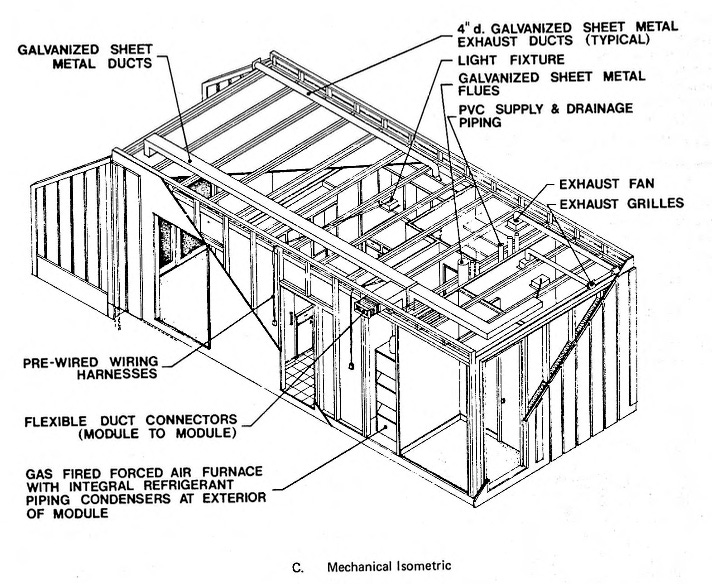
Breakthrough was conceived and implemented at the peak of the Apollo Program, and it was thought the approaches and organizations responsible for that success could be applied to other industries. The director of Breakthrough, Harold Finger, was a former NASA administrator and literal rocket scientist, and Breakthrough was deliberately modeled after successful aerospace and R&D projects. For instance, the Phase II project sites were managed using PERT/CPM scheduling methods that had been adopted from NASA and other aerospace development projects. Beyond the openness displayed towards aerospace companies, much of the language in the Breakthrough documentation is reminiscent of aerospace (electricity was installed in some buildings using “wiring harnesses”) and generally reflected the systems engineering approach NASA used to manage projects.
Following their selection for Phase I, the successful proposers set to work on their Phase II demonstrations. Many of the systems chosen had to be modified significantly before the Phase II contracts were signed. Christiana Western Structures, the modular housing subsidiary of the Christiana Oil Corporation, had originally proposed fully enclosed fiberglass-lined wall panels with a high-level of completion, such that they came from the factory with services like plumbing and wiring installed. Further development suggested that this highly integrated, prefabricated system would be too expensive, and it was changed to a more conventional open wall panel system. Aerospace manufacturer TRW had originally planned to use large, rotating mandrels to wrap box modules in a layer of fiberglass, but this was changed to use panels instead of volumetric modules. Overall, more than half of the 22 systems chosen had to be modified substantially prior to Phase II.
Part of the reason for these development difficulties was in how the systems were evaluated. The systems had originally been chosen by a panel of government evaluators, and the original RFP implied that they would need to meet the requirements of various existing building codes. However, HUD was convinced that inconsistent and varying building code requirements were a major impediment to large-scale adoption of industrialized construction. Thus HUD, instead of using existing codes, worked with the National Bureau of Standards to develop a set of guide criteria to evaluate the housing systems.1 These criteria were intended to make it easier to use factory methods and innovative technology by being performance-based: instead of specifying some material or building system (as was the case with many existing building codes), the guide criteria would specify some level of performance (i.e., requiring some level of strength, or durability, or fire resistance) giving designers the freedom to meet it in whichever way they deemed best.
However, in practice the guide criteria proved burdensome. The performance-based language was different and more complex from what many of the participants were used to, and many of the requirements (such as acoustic isolation) were substantially more stringent than existing code requirements. The guide criteria also demanded various performance tests of the systems be undertaken — such as impact, bending, and fire resistance — particularly for the more novel systems.
In part because of these difficulties, and in part because getting the project sites ready took longer than anticipated, the program was delayed significantly. It was originally planned for Phase I to be completed within four to six months, with construction on the prototype sites beginning in November of 1969. But by March of 1971 there were still no homes under construction. Despite these difficulties, sites were prepped and every system chosen was eventually developed to the point where it could proceed to Phase II — construction of the demonstration projects — and by September of 1971 all Phase II contracts had been signed.
Phase II
As the 22 chosen housing systems were being evaluated and developed during Phase I, HUD was working in parallel to find the sites where they would be built during Phase II. In the summer of 1969, RFPs were sent to jurisdictions around the country for sites where HUD could build demonstration homes with building code and zoning requirements waived or relaxed. HUD received 218 proposals, ultimately selecting nine sites in eight different states, each of which would receive several hundred demonstration homes from several different producers Altogether, just under 2800 demonstration housing units would be built.2
Prototype Site Planners — teams of architects, engineers, and other professionals — were contracted to design the layout of each site (building location, landscaping, etc.), and Prototype Site Developers were hired to manage the construction at each location, though these were later eliminated in favor of Boeing managing all project site construction. For each role, HUD selected several participants from a large pool of applicants
To try and speed up the program, work began on the prototype sites before Phase I was complete. By the end of 1970, ground had been broken on seven of the nine prototype sites, and construction would proceed over the next several years. This was a large, complex construction program — each site would have hundreds of housing units built on it, built using several different building systems (many of them novel), and marketed in different ways. Some units were sold as market-rate housing, others specifically for low-income residents (using HUD Section 236 financing), and others for the elderly.
Unsurprisingly, difficulties arose during construction. Though HUD worked hard to get local residents and officials on board with the program, they weren’t universally successful. Local residents were often not thrilled to have low income housing built near them, or were simply opposed to what they saw as the intrusion of “big government” into the private market. In Macon, the mayor reversed his support of Breakthrough and publicly renounced the project, though this wasn’t enough to stop construction; in Indiana, a local paper continually voiced its objections throughout the program; in Sacramento, a small group of vocal citizens hired a lawyer to try and overturn county approval.
Despite the efforts made by HUD to accommodate organized labor, there were several labor union-related disruptions to the project. A Teamsters strike in Sacramento delayed material deliveries, and Teamsters picketed the Breakthrough site for several days. In New Jersey, a union jurisdiction dispute about underground utility placement shut the job down for months, and there were further disputes regarding laying underground pipe and supervising the unloading of prefab modules. Likewise, though HUD worked to eliminate local code restrictions, there were nonetheless some complications. At some sites the local jurisdiction required changes to the building system designs before they would approve them, and in New Jersey the city building inspector, worried about the risk of relatively untested building systems, declared that “no codes would be waived” and that he intended “to apply the closest possible scrutiny to the project.”
Issues of transportation costs also arose. Most producers needed a factory within a few hundred miles of the jobsite for their system to be economically viable, otherwise transportation costs would exceed any factory savings from prefabrication. Two producers, Shelley and CAMCI, were originally slated to demonstrate their systems at the Memphis site, but they determined the market in that region was not strong enough to justify a nearby factory, and shipping from farther away would be uneconomic; both withdrew from that project site. Home Building Corporation was similarly slated to build using its system in Macon, but because of the 900-mile distance from its factory in Missouri, it determined that transportation costs would be too high, and so withdrew from that site as well.
There were also a variety of difficulties encountered with the building systems themselves. Many of these were the sorts of things that often come part and parcel with modular construction. Some modules were damaged during transportation and erection; some producers couldn’t arrange their modules to be delivered right when they were needed, so needed to temporarily store them on site. In some cases, “zip up” — stitching modules together, and finishing the interior — took far longer than anticipated. Leaks at joints in the modules, and in the flat roofs that some producers used, weren’t uncommon, sometimes due to poor quality control. The precast concrete system employed by Building Systems International initially had such poor quality that the developer halted erection work. (There, panel joints were of widely varying sizes, 20% of cast-in conduits didn’t align, and steel alignment was so poor that there were concerns of the systems’ structural integrity.)
Despite the evaluation that took place during Phase I, many of the more innovative systems proved difficult to implement in practice. This may’ve stemmed from the overlap between Phase I and Phase II, which caused the systems to be developed as site selection and planning were already underway . The developers worked to accommodate these practical difficulties.
Stirling Homex’s hydraulic jack system was abandoned in favor of conventional, crane-based erection, and Home Building Corporation similarly abandoned a plan to slide modules into place using a conveyor in lieu of a crane. But no system seems to have had more difficulties than the novel composite panels used by Material Systems Corporation. Fabricating the panels proved to be difficult and the design of the panels needed to be changed following extensive testing by the NBS. Once in place, the panels tended to leak, causing some residents of MSC homes to move out in frustration. The problems were severe enough that MSC’s demonstration project at St. Louis was cancelled, though MSC units were built at other sites.
Well-vetted systems used by established prefab companies, by contrast, appeared to encounter many fewer problems. By the time of Operation Breakthrough National Homes had built roughly 400,000 prefab homes over its history, and its Breakthrough operations appeared to go smoothly, with its deliveries better scheduled and its homes built faster and with higher quality than many other producers.
Because of the various difficulties and program delays, construction of the Phase II units took much longer than anticipated. Originally planned to be completed by November of 1970, it wasn’t until 1975 that all units were completed, sold, and occupied. But while some potential buyers didn’t care for some of the home designs (the “imaginative” design of the Hercoform houses proved slow to sell), occupants were quite happy with them overall. A 1974 survey of residents at eight different sites found that 90% of them were satisfied with their homes.
Phase III
Phase II production of the various building systems was relatively small-scale: a few hundred units for each system spread across the entire US, not enough to show any benefits from large-volume production. Phase III was when the systems would enter mass-production, and the benefits of scale would, hopefully, be realized. To incentivize the producers to enter large-scale production, they were promised Section 236 financing — a HUD program which subsidizes the construction of low-income housing — for up to 1,000 homes apiece.
Not every producer planned to enter Phase III. Some, like Stirling Homex and Townland, had gone bankrupt during Phase II. Others, like Pemtom, found that their systems weren’t economical and worth pursuing. All in all, 17 of the 22 building system producers planned to participate in Phase III.
Interestingly, most builders planned on licensing their systems, subcontracting the actual fabrication and construction to local contractors or fabricators. Few of the systems were innovative enough that they couldn’t be built by existing panelizers, precasters, or manufacturers.
But as these plans were being made, the political tide was turning against Breakthrough. As soon as Romney was appointed in 1969, he clashed with Nixon, and newspapers began speculating how long Romney would last in the administration. Throughout his tenure, Romney found the White House unwilling to sufficiently support his various program ideas, including Breakthrough: in 1969, Congress allocated $20 million to Breakthrough, which was $25 million less than had been requested and by the 1970s, further funding for the project appeared to be in danger. To counteract this, the program was accelerated, and Phase III production began before Phase II was completed.
These issues crested in August 1972, when Romney submitted his letter of resignation to HUD, citing “lack of access to the president and poor relations with White House staff members.” Nixon did not accept Romney’s resignation, convincing him to remain until after the 1972 election. In January of 1973 both Romney and Harold Finger were replaced by new appointees who did not have the same enthusiasm for Breakthrough, and that same month Nixon cut funding for any additional Section 236 projects.
The turn against Operation Breakthrough was not merely because Romney and anyone associated with him had become “persona non grata” in the Nixon administration, though that appears to be part of it. Breakthrough had been organized for the express purposes of meeting huge projected demand for housing, because it was believed that the existing homebuilding industry would be unable to step up to the challenge. But this proved to be incorrect: existing, conventional homebuilders essentially doubled output from 1.2 million units in 1965 to nearly 2.4 million units in 1972. On top of this, a method of factory-built housing outside of Breakthrough — mobile homes — was proving more and more popular, rising to nearly 600,000 units being produced annually by 1972. In light of these developments, Operation Breakthrough appeared much less necessary than it did at the start of the Nixon Administration.
Additional Section 236 funding was cut before Phase II of breakthrough was complete: construction was still in progress on most of the prototype sites. But thanks to the acceleration of Phase III, the already-allocated Section 236 funding remained available, and by 1975 around 25,000 units of Phase III housing were under construction. In addition, another 7,000 units were being built outside of Section 236 funding.
But these tens of thousands of units were not enough. Without a sustained source of government funding, Phase III proved to be a brief blip, rather than the seed of a new, industrialized homebuilding regime. The housing system producers continued to withdraw their systems from the market. From the 17 that planned to participate in Phase III, only 14 actually did so. By 1976, only 5 systems were still being marketed. Hercules Chemical company had invested $10 million in production facilities for its “Hercoform” housing system, but it sold off its factory in 1973 after three years of losses in the business. Levitt and Sons had similarly spent $3 million on a highly automated factory to produce its building system. The factory came online in 1971 and was shuttered just three years later. Alcoa apparently sold around 50,000 of its “heart” units, but ceased producing it in 1977. GE similarly left the housing business in the late 1970s. Scholz Homes, founded in 1946, closed its factory and ceased operations in 1983. Only National Homes and FCE Dillon appeared to still be in the homebuilding business by the mid-1980s; neither company is in business today.
Altogether, Operation Breakthrough cost the government around $72 million (around $500 million in 2026 dollars): $22.1 million spent on Phase I development costs, and $49.5 million on compensating builders for the difference between housing system costs and their market value.
Why did Operation Breakthrough fail?
Operation Breakthrough is generally considered to be a failure. The original goal — to rapidly introduce mass-produced, industrialized construction methods to the homebuilding industry — wasn’t achieved. A 1976 GAO report on the outcomes of Operation Breakthrough noted that it “did not create the large, continuous markets necessary for efficient industrialized housing construction or document and obtain answers to questions on cost savings to be gained by using such construction methods.” In 1971 George Romney predicted that by the 1980s at least two-thirds of new homes would be factory-built. The actual fraction in 1984 was 36%, roughly half of his prediction, with factory-built homes constituting a falling share of new housing ever since. Today it’s roughly 10%, most of which are manufactured (mobile) homes. Outside of manufactured HUD-code homes, factory-built homes make up about 3% of the US single family home market, and an even smaller share of the multifamily apartment market.
The proximate reason that Breakthrough failed seems to be overextension. The program tried to do too much, too fast: the original BRAB report cautioned that investigating large-scale production of novel housing technology should be pursued as an experimental program, designed to answer questions and gather information, rather than a demonstration program that assumed such methods would be successful. But while Breakthrough kept some of the trappings of an experimental program, it became a rushed demonstration program in practice. Respondents to the RFP were only given three months to submit a building system, little time to develop much in the way of truly novel systems, and the criteria respondents were judged by favored the selection of existing technology. The guide criteria used to evaluate them weren’t ready when the RFP was sent out and the systems were chosen, and several building systems had to be redesigned once they became available. Construction on the prototype sites similarly began before analysis of the existing systems, resulting in numerous difficulties with the more innovative methods. Funding was cut for the program before construction was even finished on the prototype sites, and little was done in the way of market aggregation or of technology development — there were no broader union agreements, no further work to develop or secure wider adoption of the guide criteria, no research funding for iterating on the system designs. (One report speculated that Breakthrough was able to get the original union agreements for the program only because the unions believed Breakthrough would be a short-term program that wouldn’t have larger impacts.)
To have a chance at succeeding, Breakthrough likely needed more government support, over a much longer period of time. A 1970 article in Progressive Architecture argued that the program needed “more money, more staff, and the guarantee of a large market to ensure that its goals can be reached.” A 1975 study of the program by the Real Estate Research Corporation concluded that “one principle conclusion of the program is not to attempt too much too quickly because the adoption and diffusion of an innovation is not an instantaneous process. A 1974 report by the National Academies of Sciences noted that “government housing programs must be planned on the basis of a long view” and that “the timeframe allocated for reaching Operation Breakthrough objectives proved unrealistic.” And a 1976 analysis of government demonstration programs by the RAND Corporation succinctly noted that “Breakthrough had too many program objectives and too little time and money to achieve them.”
I would argue that the deeper reason behind the failure of Operation Breakthrough is the elusive nature of the benefits of industrialized building methods. It has long been believed that factory-based construction will yield the same benefits for housing as it has for manufacturing: dramatic improvements in production efficiency, and dramatic reduction in prices. But in practice these benefits have been difficult to achieve. Sweden, which has large-scale adoption of factory-built methods, does not appear to benefit from substantially improved productivity or decreased homebuilding costs. National Homes, one of the participants in Operation Breakthrough built half a million prefabricated homes in the US over the course of its history, but its prefabricated methods didn’t transform the industry the way Ford’s assembly line transformed car manufacturing. More than 30,000 housing units using Breakthrough systems were ultimately constructed, but they nevertheless had difficulty competing with conventional, site-built construction, and none of the systems survived outside of government support.
This doesn’t mean that there are no benefits to be had from prefabrication: we can see the cost benefits in things like manufactured (mobile) homes, or of precast concrete parking garages, which are far less expensive than alternative construction methods. And it doesn’t mean that something like Breakthrough couldn’t work. But to be workable, such a program would need a much greater level of government support than Breakthrough got, and it would need to be rooted in understanding of the actual mechanisms that make it so difficult to drive down costs with factory-based homebuilding.
The National Bureau of Standards would change to become the National Institute of Standards and Technology, or NIST, in 1988.
Originally this was planned to be 11 sites, but due to budget limitations (Congress allocated HUD less funding than it had requested), the number of sites was cut down to 9.
It's been a good series exploring construction costs. It would be helpful for me if you addressed directly the somewhat mundane and worker oriented problem that concerns me: in my "world" the more or less hand and jobsite tools I use to do construction have vastly improved my efficiency: I have laser levels, cordless long lasting powerful tools, press-connect copper, flexible lines, pre-hung doors, etc. An enormous number of 'things' that make my work speedier. How have all these advances not resulted in much more sq. ft. production per worker hour? My 'feelings' tell me that in my area the bureaucracy captures all the possible savings: high fees, more inspections, more labor requirements, supervisions, etc. I have land I would happily build on but the simple act of connecting a home to the sewer system is over $20,000. Having the county bring the water line 50' down the street: $100,000. Having the electric company upgrade their side of the power grid: $50,000. In my area, there is no possible way to capture this investment through rent. I could build a home efficiently with my team of a few people cheaply and quickly, and yet it would take years and $100,000s of dollars in fees and increased property taxes to do so.
So: if you felt the interest in dividing construction costs between: materials, the on the ground labor, the supervision, the fees etc. - that would give me real direction. If the labor at the site has not become vastly improved from 1970 to 2025, then something is wildly wrong: our site tools are so much better, that portion of construction should have had costs lowered dramatically.
I don’t believe this is really the main issue. The issue is that there is nowhere to PUT the homes because of regulations.