

For the better part of the last several hundred years, coal was the fuel of choice for generating power. Burning coal powered Thomas Newcomen’s steam engine, invented in Britain in the early 18th century, and the first of a line of increasingly efficient converters of coal to usable energy. The Newcomen engine was in fact so inefficient and consumed so much coal that it was almost exclusively used at coal mines, where fuel could be obtained cheaply. The improved steam engines that followed over the 18th and 19th centuries — Watt’s rotative engine, high-pressure Cornish engines, triple-expansion engines, Parsons’ steam turbine — were likewise fired by coal. By the early 20th century, Britain was burning 52 million tons of coal a year to provide power for factories and mines.
The rise of the gas-powered automobile in the early 20th century shifted a substantial portion of coal consumption to petroleum, but coal still remained favored for industrial power. And this didn’t change with the emergence of the electric power grid: Thomas Edison’s first central electricity generating station at Pearl Street in New York used coal-fired reciprocating engines, and coal was the primary method of generating electric power in the US well into the 21st century.
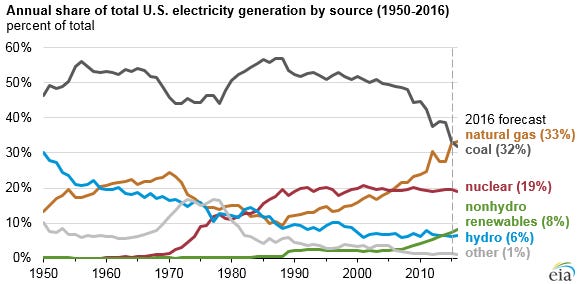
By the end of the 20th century, however, this trend was starting to shift. For most of the 20th century coal made up around 50% of US electricity generation, but after peaking at around 57% of electricity generation in the mid-1980s, coal started to decline as a share of electricity generation in the US. And starting around 2008, coal-generated electricity began to decline in absolute terms, falling from over 1.6 trillion kilowatt-hours produced in 2009 to around 0.8 trillion in 2020. Today, coal supplies around 16% of US electricity, a share that seems likely to continue to fall long-term.
As coal became less popular, many coal plants — over 200 since 2008 — have simply shut down.1 But some of these plants were instead converted to burn natural gas in place of coal. Since 2008 there have been around 140 such conversions.
Given recent attempts to reinvigorate the coal industry, with the Trump Administration forcing plants to stay online and trying to fund the construction of new coal plants, it’s worth understanding what drove so many plant operators to cease burning coal and switch to natural gas.
Drivers of coal-to-gas conversion
The spate of coal-to-gas conversions that began around 2008 was the product of two factors.
The first was regulatory. Burning coal emits a great deal of harmful pollutants (such as mercury), and over time regulation of these emissions has become stricter. In 2000 the Environmental Protection Agency (EPA) decided to develop regulations for the emission of mercury, and while this was temporarily delayed by the Bush Administration, by 2008 it was clear that stricter coal plant emissions would be a reality. In 2011, the EPA proposed a new set of coal plant emissions restrictions, the Mercury and Air Toxics Standards (MATS), which dramatically reduced the amount of mercury, toxic metals, and acid gases that coal and oil plants were allowed to emit. MATS, however, didn’t apply to natural gas plants, as gas burns much more cleanly and produces dramatically less harmful particulate emissions.
Alongside this new, more stringent regulation, the US shale gas boom made natural gas an increasingly attractive fuel for generating power. Between the late 1980s and 2011, natural gas went from 10% to nearly 30% of US electricity generation. And while the price of gas had risen through the early 2000s, it began to fall steeply in 2008. What’s more, it was projected to stay cheap for the foreseeable future.
Faced with increasingly strict environmental regulation and the rise of widely available and affordable natural gas, coal plant owners were faced with several options. One was to simply shut down their plants. Another was to install the required equipment to reduce emissions enough to comply with MATS regulations. This equipment was expensive to install and acted as a drag on plant efficiency, since it took energy to operate, but it was nevertheless often worth it. Today there are 219 operating coal plants in the US, all of which are in compliance with the original MATS regulations.
But some plant operators, instead of installing the required emissions equipment to comply with MATS, opted to convert the plants to burn natural gas. Converted plants were generally older, smaller-capacity plants that were relatively inefficient, used to provide extra capacity when needed rather than supplying baseload power.
Converting coal plants to burn natural gas wasn’t a new idea — the idea first began to be discussed in the 1980s, and during the 1990s and 2000s a few plants were converted — but the shale boom combined with the new, more stringent MATS regulations created a much stronger incentive to do so.
Converting a coal plant to burn natural gas
There are a few different ways of converting a coal power plant to a natural gas plant, depending on how much of the original equipment you replace. At a high level, a coal plant consists of a boiler that burns coal and uses that energy to turn water into steam, a turbine which converts the heat energy of the steam into rotational energy, and a generator connected to the turbine which converts the mechanical rotational energy into electric current. Different conversion strategies replace different portions of this equipment.
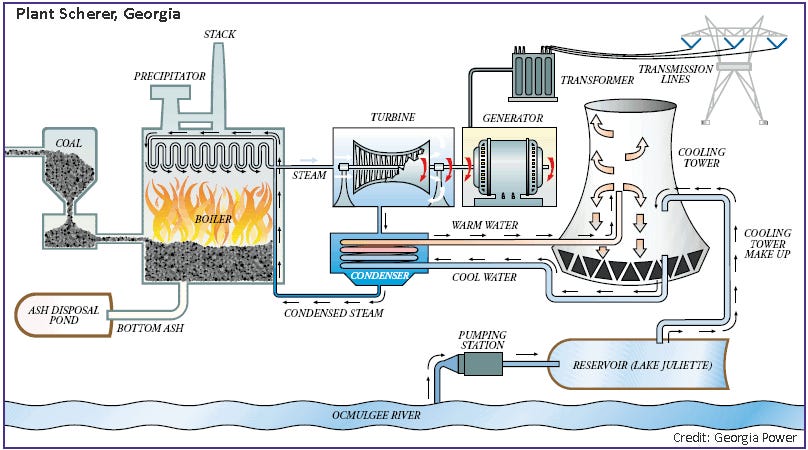
The simplest, cheapest option is to convert the coal boiler into one that’s capable of burning natural gas. The boiler can be converted to run on only natural gas (losing its ability to burn coal) or be converted such that it can burn gas, coal, or some combination of the two.
At minimum this sort of conversion requires adding a system for delivering natural gas into the boiler and replacing the coal burners with natural gas burners. But because natural gas burns differently than coal, this may also require other upgrades, such as new flame scanners (which monitor how combustion is taking place in the boiler) and structural upgrades (because the temperatures in certain parts of the boiler might be higher when burning natural gas). It also often requires adding a natural gas pipeline to bring gas to the plant, which might involve laying 20 miles or more of underground pipeline. Because natural gas doesn’t require the sort of complex material handling that coal does — it can simply be piped directly into the boiler — the upgraded plant typically requires many fewer employees than the original coal plant did. The Joliet coal plant near Chicago, which was converted to a natural gas peaker plant in 2016 before being shuttered entirely in 2023, is an example of this sort of coal-to-gas conversion.
The benefit of this sort of conversion is that it’s comparatively simple and inexpensive, and most coal-to-gas plant conversions in the US have been of this type. The drawback is that because the boiler is burning a fuel it wasn’t originally designed for, the converted plant operates less efficiently and with less capacity than it did while burning coal, and much less efficiently than a brand-new combined-cycle plant would.
Another option is to replace the entire coal boiler with a natural gas boiler, while keeping the rest of the generation equipment. This is less common, but it does happen. An example of this sort of conversion is Iowa State University, which operated a small 46-megawatt combined heat and power coal plant. In 2016 the university replaced three of the plant’s five coal-fired boilers with natural gas boilers. (The last two boilers were eventually also modified to burn natural gas).
More common than just swapping out a coal boiler for a gas boiler is replacing the coal boiler with a gas turbine and a gas boiler (which in this configuration is called a Heat Recovery Steam Generator, or HRSG), to create a more efficient combined-cycle plant. An example of sort of conversion, which is sometimes called “repowering,” is the Big Bend coal power plant near Tampa, Florida, which was converted in 2023.
And finally, a “conversion” can also simply rip out the entire existing plant — boiler, turbine, generator — and replace all of it with a modern combined-cycle plant. This is essentially a brand-new plant that uses some of the services (the grid interconnection, water availability) as the old plant. The Tennessee Valley Authority’s Allen plant near Memphis, Tennessee is an example of this sort of conversion. This type of conversion is the most expensive, but it gives operators the greatest increase in efficiency. Roughly a third of coal plant conversions in the US have been this sort of total replacement.
The future of coal-to-gas conversions
It doesn’t seem likely that we’ll see many more of these coal-to-gas conversions. For one, there are just a lot fewer coal plants in the US than there used to be: we’re down to just over 200 from a peak of nearly 600. The most obvious candidates for conversion — smaller, older plants that might be useful for peaking — have probably already been converted. And as grid-scale batteries change the economic logic of peaking, even new gas plants are looking less attractive than they used to; I can only imagine that a less-efficient converted coal plant is even less compelling.
It’s possible that a new round of more stringent air pollution regulations might push some of these existing plants into burning natural gas rather than coal, though it’s unlikely we’ll see such a thing during the Trump Administration. (In 2024 the Biden Administration strengthened the original MATS rules, but these additions have since been repealed by the Trump Administration.) Similarly, the enormous demand for power caused by the AI boom might have some effect. We’re already seeing coal plants slated for shutdown staying online instead due to high power demand and the huge backlog for things like natural gas turbines. It’s possible such logic might incentivize converting some remaining coal plants into burning natural gas instead. But overall, I suspect that the heyday of coal-to-gas conversions is behind us.
There were around 586 operating coal plants in the US in 2008, compared to 219 today. Around 140 of the plants were converted to natural gas, leaving an estimated 230 or so that have been shut down.
For another take on the death of coal, see:
https://robertbryce.substack.com/p/coal-roars-back?r=ewwfu&utm_medium=ios
It might be worth mentioning that coal does have some advantages. On site storage is a big one. Coal is abundant and found all over the world making it much less dependent on geopolitics.
For those of you panicking about a sudden dump of mercury into the air, the MATS standards were not done away with entirely, they were just dialed back to the 2012 standards.