


Welcome to the reading list, a weekly roundup of news and links related to buildings, infrastructure, and industrial technology. Roughly 2/3rds of the reading list is paywalled, so for full access become a paid subscriber.
Housing
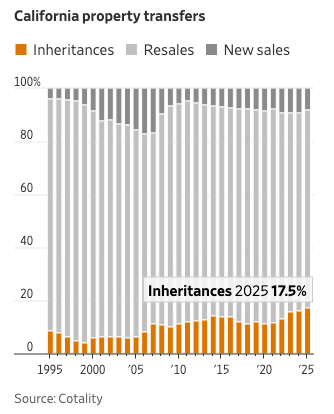
Thanks to California’s Prop 13, which limits annual property tax increases to 2% over the most recent sales prices, a very large (and increasing) fraction of homes in California are transferred through inheritance. “About 18% of all property transfers in the state last year, representing nearly 60,000 homes, were made through inheritance, according to a recent analysis by real-estate data firm Cotality. That share is a record for California in data going back to 1995, up from 12% in 2019. It is also roughly double the national share of 8.8% last year.” [WSJ]
Claims about the rising cost of housing’s impact on US fertility. Based on a (data-derived) economic model, so take with a grain of salt. “I vary housing costs directly within the model, finding that rising costs since 1990 are responsible for 11% fewer children, 51% of the total fertility rate decline between the 2000s and 2010s, and 7 percentage points fewer young families in the 2010s.” [X]
Los Angeles makes it easier to convert offices into apartment buildings. This is a perennially popular idea for increasing the supply of housing that is often hard to make work in practice (since these sorts of conversions are typically very expensive), but good to make it easier to do. [LA Times]
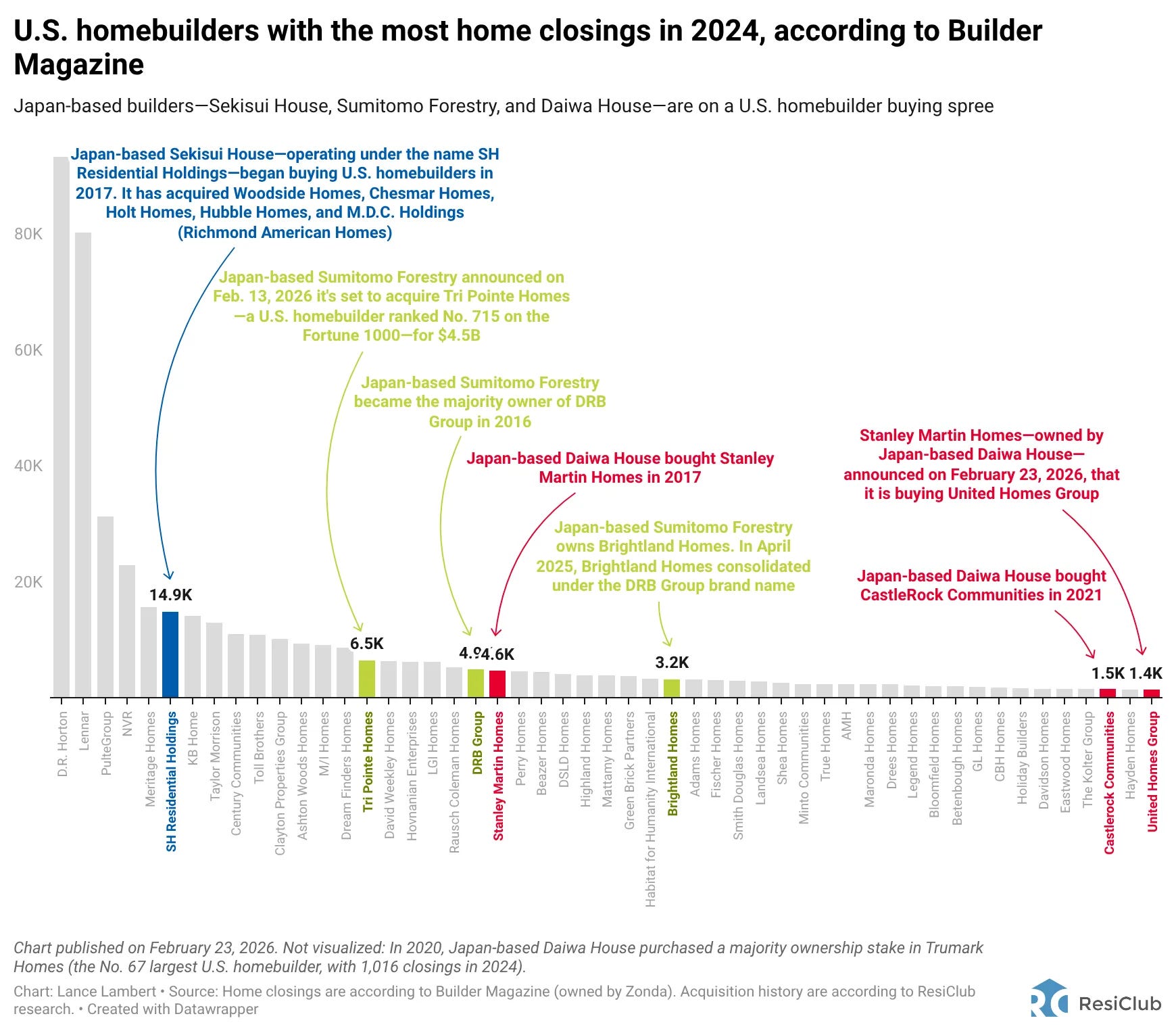
An interesting look at the largest homebuilders in the US, and the Japanese corporations that are acquiring them. I wonder if we’re finally starting to see the sorts of concentration in US homebuilding that we see in other industries. [Resiclub]
ONX Homes is a Florida-based prefab homebuilding company started by ex-Katerra folks, and using a Katerra-esque business model, that I’ve written about previously. There’s reports that things aren’t going well in their Austin division, and that a development they’re working on has been abandoned. [X]
Energy
Since historically it’s been prohibitively expensive to store electricity, the grid needs to balance electricity supply and demand moment to moment, bringing power sources online as demand rises and bringing them offline if it falls. If there’s a mismatch — such as if, say, dozens of data centers which collectively draw several thousand megawatts of power simultaneously disconnect because of grid disturbances — that can cause damage to the grid if its not carefully managed. “Early last year, a cluster of data centers in Virginia suddenly dropped off the power grid, threatening the stability of the already vulnerable system. The roughly 40 data centers, which had been using enough electricity to supply more than one million homes, simultaneously switched to backup power sources in February 2025, when a high-voltage power line malfunctioned. The sudden plunge in electricity demand forced the grid operator to take quick action to avoid potentially serious damage.” Grid operators have been able to handle these occurrences so far, but they’re apparently worried what might happen in the future if even larger disconnects occur. [WSJ]
China plans to invest $574 billion in upgrading its power grid over the next five years. [Reuters]
The Washington Post has an article on what might be an increasing willingness to embrace solar PV in the Trump administration. “A growing number of prominent Trump allies — including former House speaker Newt Gingrich, veteran strategist Kellyanne Conway and GOP pollster Tony Fabrizio — are promoting solar as electricity demand surges and energy affordability climbs the list of voter concerns.” [Washington Post]
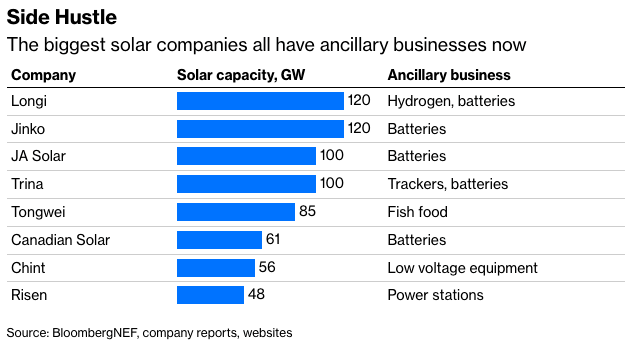
Solar PV manufacturers are increasingly diversifying their businesses. [Bloomberg]
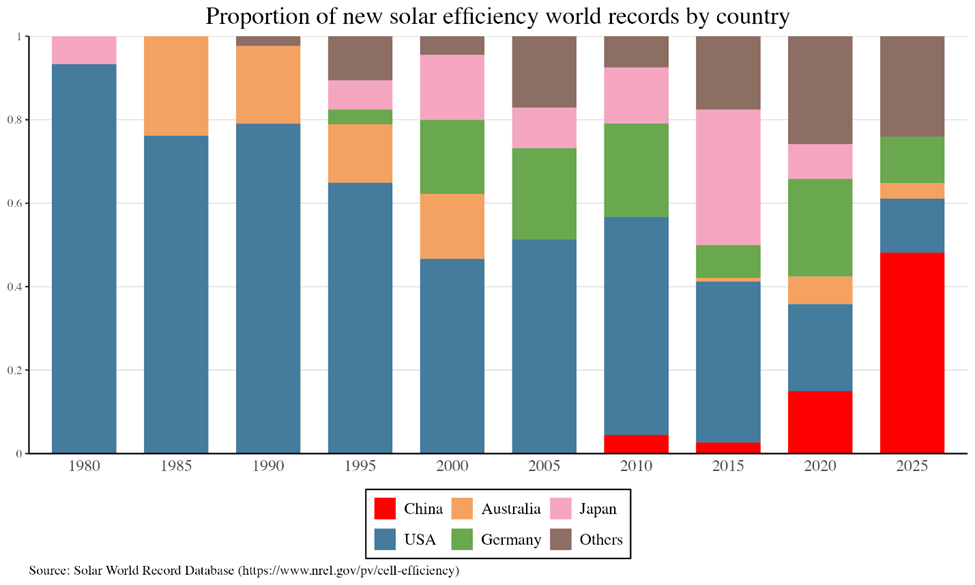
Cool graphic showing where solar panel efficiency records (the fraction of sunlight a panel can convert into usable electricity) have been set over time. It used to be the US developing increasingly efficient solar panels. Now those records are being set in China. [VoxDev]
The Department of Energy released the new nuclear safety rules that it had reportedly been updating. Apparently 750 pages, 2/3rds of the previous rules(!) have been cut, including what seems like references to ALARA (requirements that radiation exposure be “As Low As Reasonably Achievable.”) [NPR]