


Welcome to the reading list, a weekly roundup of news and links related to buildings, infrastructure, and industrial technology. This week we look at a quadruped welding robot, the China Shock 2.0, transformer startups, China’s mysteriously moving satellites, and more. Roughly 2/3rds of the reading list is paywalled, so for full access become a paid subscriber.
No essay this week, but working on a more involved piece about construction costs in the US and around the world that should be out next week.
War in Iran
The US has blockaded the Strait of Hormuz, preventing Iranian ships from transiting the strait. “On Monday, the United States imposed its own naval blockade, intent on ending Iran’s dominance of the waterway and cutting off its oil income by blocking all traffic to and from its ports…Since the U.S. blockade took effect, no ships linked to Iran have been spotted leaving the region, according to the vessel‑tracking company Kpler.” [NYT] Negotiations between the US and Iran are apparently ongoing, but the strait seems to be closed as of this writing. [BBC]
The strait’s closure continues to disrupt supply chains around the world: Russia has imposed export controls on helium [Reuters], airlines continue to be squeezed by the high cost of jet fuel [WSJ], and a Japanese bathroom manufacturer shut down production due to a lack of glue. [Nikkei Asia]
Thanks to the war, GPS signals are being jammed across the region. One consequence? Food delivery drivers are having trouble delivering their orders. [Rest of World]
The Saudi East-West oil pipeline being used to bypass the Strait of Hormuz had been damaged by an Iranian drone attack, but now appears to be back online. [Reuters]
Housing
Homeownership rates by state in the US. Some of these figures surprise me: it’s not hard to understand why California and New York might have low homeownership rates due to the high costs of real estate, but Georgia, Texas, and North Dakota being on the low end and West Virginia being on the high end are more surprising to me. [X]

Also on the subject of home ownership, the White House released a report on “Rebuilding and Protecting the American Dream of Homeownership.” It looks at various causes of high housing prices in the US, and concludes with some recommendations for states and local jurisdictions to reduce housing costs:
Unleashing manufacturing innovation: “...align codes with accepted standards for modular, prefabricated, panelized, and other off-site built housing.”
Streamlining the stages of homebuilding: “...create a fast-track process for all housing developments that features capped timelines and permit fees, appropriate and justifiable impact fees, third-party inspections, and an expedited appeal process that ensures faster and less arbitrary dispute resolution.”
Protecting consumer choice and private property rights: “...curtail gratuitous mandates that restrict housing supply, such as restrictions on the number of units that can be built in any given time period, costly green energy building requirements, and discriminatory labor rules.”
Most of these seem like reasonable ideas to me. [White House]
Manufacturing
The Pentagon wants to get US auto manufacturers involved in weapons production, as the wars in Ukraine and Iran run down ordnance stockpiles. This was widely done during WWII, but it’s not obvious how easily today’s car manufacturers could pivot. [WSJ]
Also on the subject of weapons manufacturing, Detroit is angling to be the epicenter of a new US drone manufacturing industry. “Thanks to ramped-up military spending on drones and their proliferation in civilian uses, the market for American-made unmanned aerial systems is expected to grow to more than $50 billion by 2030, from $5 billion this year…Companies are scrambling to build a supply chain from scratch, and states are vying to be at the center of it. In July, Gov. Gretchen Whitmer of Michigan, a Democrat, issued an executive directive calling for a statewide effort to scale up “advanced air mobility” manufacturing, which includes drones and electric planes.” [NYT]
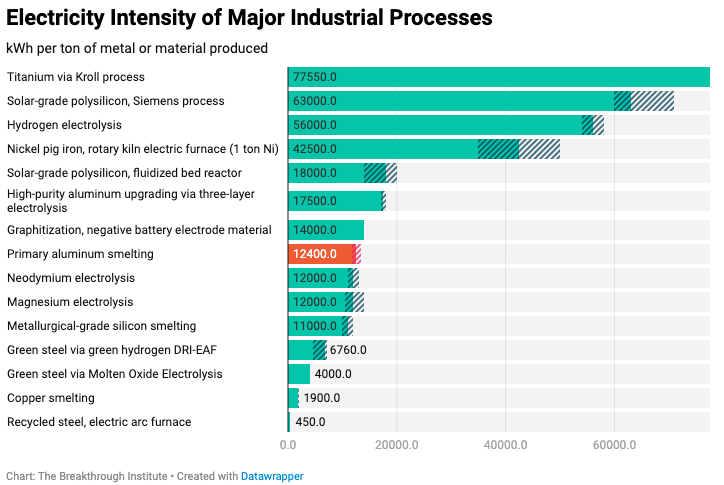
Tulsa, Oklahoma is building the first aluminum smelter built in the US in 50 years, which would double(!) US smelting capacity. [WSJ] Related, this Breakthrough Institute Piece on aluminum and China’s manufacturing prowess has an interesting graphic showing which materials require the most electricity to produce. Titanium requires way more electricity, and electric arc steel requires way less electricity, than I realized. [Breakthrough]
When I looked at welding automation a few years ago, one of the startups I highlighted trying to push automated welding forward was Path Robotics, which at the time was developing a system that could automatically plan out a welding path based on computer vision and a CAD model it had been provided. Now the company just introduced an automated welding system mounted to a robot dog. The utility of this isn’t amazingly obvious to me — I think most welding is probably done in repeatable locations where the dog is unnecessary, in locations that would be tricky for a dog to access, or require some kind of workholding that this doesn’t seem equipped with — but it’s cool nonetheless. [X]
A cool short video clip showing manufacturing of wooden propellers using Blanchard-style pattern-tracing lathes. [X]
Slate Auto, the Jeff Bezos-backed startup that wants to build a no-frills EV truck, raised another $650 million, bringing its total funding to $1.4 billion. [TechCrunch]