


Welcome to the reading list, a list of news and links related to buildings, infrastructure, and industrial technology. This week we look at trapped buildings, in-home data centers, cardboard military drones, Brightline’s potential bankruptcy, and more. Roughly 2/3rds of the reading list is paywalled, so for full access become a paid subscriber.
Housekeeping items:
In this week’s newsletter about how early inventions could have appeared, I flagged the safety pin as an invention that could have been invented much earlier, and would have been useful had someone thought of it. The major inventions list (which I sourced from Wikipedia) lists the invention date for the safety pin as 1849, but Claude thought there was no reason that the safety pin couldn’t have been invented as early as 500 BC. Turns out Claude was right, and safety pin-like devices were around 3000 years ago.

This raises my confidence in the rest of Claude’s timeline estimates.
War in Iran
Amazon says that repairs to its damaged Middle East cloud operations could take months. [Reuters] And Iran attacked a UAE petroleum complex. [Reuters]
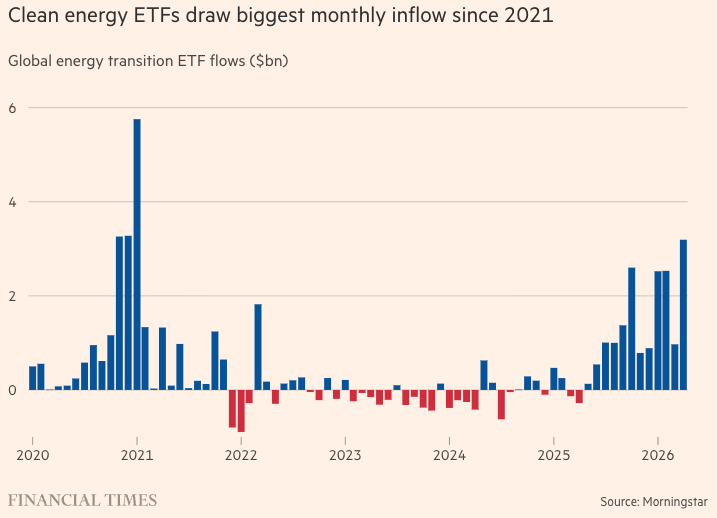
The closure of the Strait of Hormuz has caused investors to funnel more funding into clean energy stocks. [FT]
Due to the risk of damage to undersea cables going through the Strait of Hormuz, hyperscalars like Google and Microsoft are buying capacity on fiber-optic cables strung alongside Iraqi oil pipelines as a backup. [Rest of World]
Housing
How many buildings are “trapped buildings” — buildings that wouldn’t be allowed to be rebuilt because they don’t meet modern code requirements, but also can’t be torn down or substantially modified because of historic preservation laws? [X]
Using AI as an interior design tool predates the modern AI revolution — I believe AI tools were being used for “virtual staging” of real estate listings before the rise of LLMs — but it’s worth keeping an eye on its progress. Homedesign.AI lets you reimagine some interior space by uploading a picture and having the AI modify it. [HomeDesigns AI]
I had to see this news item three or four times before I realized it was serious and not someone doing a bit. A startup is working on micro-data centers that can be installed in people’s homes, taking advantage of their extra electricity capacity. “Span is a California-based startup that originally launched with “smart” electrical panels designed to help homeowners save money on their electricity bills. Now, with the help of Nvidia, it has come up with something new — small, fractional data centers, or “nodes,” called XFRA units, that can be put on the side of residential homes and small commercial businesses. The idea is to take advantage of unused electrical capacity on local grids, which the Span smart panels can pinpoint.” [CNBC]
Manufacturing
The Wall Street Journal has a piece on Ford’s efforts to build a $30k electric truck, which despite the company’s enormous losses on EVs is still going forward. “With its new truck, Ford says it has eliminated thousands of feet of heavy copper wiring, cut out hundreds of parts and made it 15% more aerodynamic than its other pickups. The process included rethinking the assembly line, which Ford helped to pioneer. That process is traditionally iterative, slow and depends on scores of outside partners. On Ford’s new “assembly tree,” a modular system stamps out two massive, aluminum castings and a battery that get merged at the end of the process—closer to how Tesla and China’s automakers build EVs. “We’ve never blown the whole thing up before and just started over,” Coffey said. “If and when we build this, we will rewire Ford.”” [WSJ] And another similar article in the New York Times. [NYT] Presumably some PR firm is earning their keep getting these articles placed.
There’s lots of debate about how fast the economy might grow if we truly develop Artificial General Intelligence (AGI) that can do anything a person can do. The big divide in this debate tends to be between the economists, who think growth rates might be a few percentage points, and the technologists, who think growth rates might be vastly higher. Here’s an interesting contribution to the debate, an estimate of how fast the economy could theoretically grow based on analysis of actual industrial production rates. “In this post, I compute the maximum rate at which an autonomous AI economy could grow, once its production is concentrated in the sectors most important for self-replication. I take the conservative case for this calculation: full automation, but no other technological improvement. Using US input-output data, I find this economy could double in about a year…” One interesting item in this analysis: under this rate of growth, construction would be a much larger share of GDP than it is currently. [Defenses in Depth]
The NYT on Geely, the Chinese car manufacturer jockeying with giant BYD. “In an unexpected development, Geely beat BYD in sales in the first two months of the year and is rapidly broadening its lineup. Geely is now pushing overseas, more than doubling exports to Europe, the Middle East and elsewhere in the past year and taking on global rivals on their home turf.” [NYT]