

Welcome to the reading list, a weekly roundup of news and links related to buildings, infrastructure and industrial technology. This week we look at squatter removal services, Apple finding uses for defective chips, process heat use in California, the brewing Colorado River crisis, and more. Roughly 2/3rds of the reading list is paywalled, so for full access become a paid subscriber.
War in Iran
Iran wants to charge US tech companies for use of the undersea cables that pass through the Strait of Hormuz. [Ars Technica] And Iran is starting a Bitcoin-backed ship insurance service [Bloomberg]
The hundreds of ships stuck in the Persian Gulf are starting to get damaged by all the barnacles and jellyfish that they’re accumulating. “...the Gulf’s shallow sandy seabed and warm waters have put ships at anchor or adrift there at risk of sand and sea creatures clogging up gratings that protect the vessel’s internal pipework. Seafarers are also struggling to get hold of critical parts when systems have broken down.” [FT]
An interesting example of the complexity of petroleum and petrochemical supply chains: a cooking oil shortage in India is driving up gas prices in California. “India, the most populous country, uses LPG as its primary cooking fuel. Cut off from Middle Eastern LPG, which represented over 90% of India’s total imports of the fuel before the Iran war, New Delhi has directed refiners to maximize LPG output. To comply, refiners have cut production of alkylates - motor fuel additives made using LPG as feedstock. For California, shrinking alkylate supply compounds concerns of a potential gasoline shortage due to declining fuel production and exports from Asian refiners struggling to access Middle Eastern crude oil. Alkylates are highly sought in California because they burn cleaner than other additives, and the state requires a unique gasoline blend to reduce smog.” [Reuters]
The US has lost 42 aircraft so far in the war with Iran, most of which (24) are MQ-9 Reaper drones. [National Security Journal]
Housing
The House passes its version of the Senate’s Road to Housing Act, without the build-to-rent restriction, 396 to 13. [NPR]
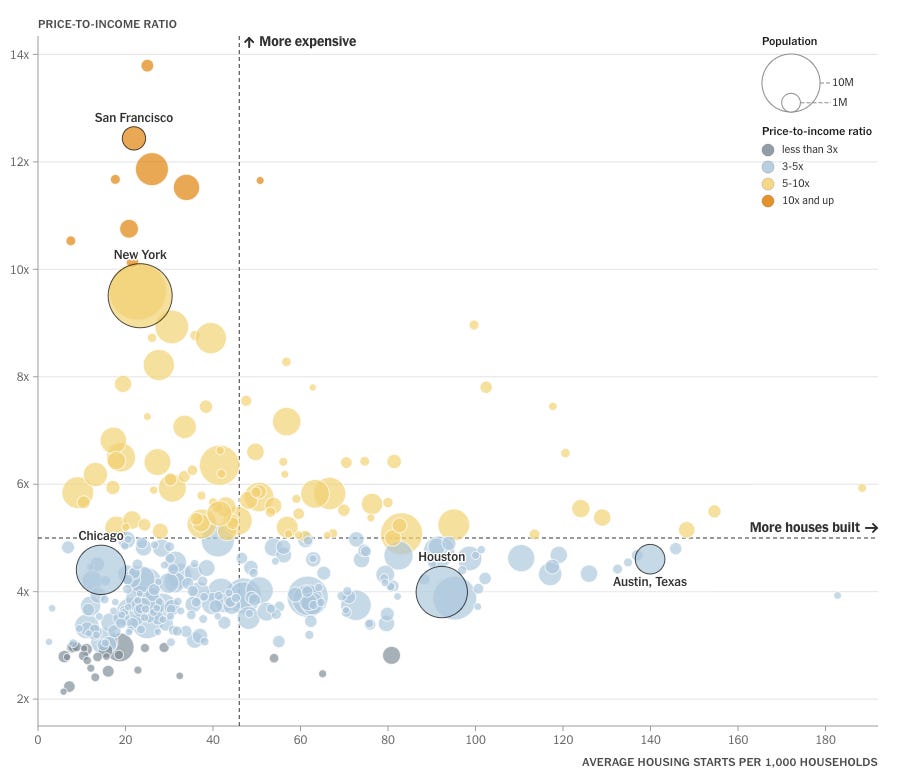
The NYT has a big, data-driven opinion piece on the need for the US to build more homes to bring down the price of housing. “The situation in expensive coastal areas, however, is far worse. They have enacted onerous zoning and building rules that limit home construction. They have allowed the “not in my backyard” instinct to prevail. Many of these areas vote Democratic and identify as politically progressive, yet their housing policies have increased inequality. By maximizing home prices, these parts of blue America have benefited existing homeowners, who tend to be older and richer, at the expense of everyone else. Nationwide, the relationship between home prices and home construction is even stronger than many Americans realize.”
Because California makes it so difficult to remove people living in a residence (whether they’re there legally or not), some California landlords are hiring “squatter removal services” to intimidate illegal squatters from vacating the properties they’re occupying. “Jacobs claims to have developed a long list of tools and tactics that enable him to remove squatters far faster than the court system, all while staying within the bounds of the law. Chief among them is a weapon he carries on every job: a katana, a curved Japanese sword that’s more synonymous with samurai warriors than clearing squatters. “In most industries, swords just don’t make any damn sense,” Jacobs says. “In this particular one, it actually does.” The lightly regulated katana, he explains, is an ideal weapon for indoor self-defense and intimidation.” [Reason]
Washington state legalizes scissor stairs, interlocking stairways that let you combine two stairways in one shaft. Scissor stairs are, like single-stair apartment buildings, a space-saving building design feature that’s common in other countries but mostly illegal in the US. [Sightline]
Manufacturing
Because of their microscopic size and their sensitivity to minute changes in chemical concentrations, semiconductor fabricators invest an enormous amount of effort into process control to minimize the number of defects that occur on a microchip. Defects nevertheless still occur, and when they do there’s often no real way to repair them. But that doesn’t mean the entire chip is useless; it just means you need to find a way to use it without the damaged areas. “The chip powering the Neo is Apple’s A18 Pro, the same chip first used inside the iPhone 16 Pro two years ago, but with one key difference. The Neo version of the chip has a “5-core” graphics processor, one less than the version inside the 2024 iPhones, indicating that Apple was able to save some of the A18 Pro chips with a defective core for future use. Defective cores can be disabled, leaving a chip that still functions perfectly well to power different, often cheaper devices—in this case an entry-level laptop instead of a top-of-the-line iPhone. It is the latest example of Apple deploying a decades-old chip industry strategy to squeeze profits from lesser-performing processors by selling them like eggs, gas, diamonds or hotel rooms, segmented by good, better and best.” [WSJ]