


Welcome to the reading list, a weekly roundup of news and links related to buildings, infrastructure, and industrial technology. This week we look at a new housing bill, General Motors joining the grid-scale battery game, skepticism about data center delays, solid-state air conditioning, and more. Roughly 2/3rds of the reading list is paywalled, so for full access become a paid subscriber.
Housekeeping items:
This week IFP published its Transit Abundance Playbook, a collection of 15 specific policy ideas for bringing down the cost and time it takes to build transit in the US. I have a piece in the playbook here.
Housing
The US house and senate have reached a deal on a combined version of the Senate’s ROAD to housing act. The combined version looks like it’ll be a good bill, as the burdensome build to rent provisions have been eliminated. [X] [Politico]

Do housing developments that include grocery stores like Costco or Safeway have a better chance of succeeding? “The grocery anchor brings a constituency that ordinary apartment developments lack. A developer fighting NIMBYs alone is on hostile rhetorical terrain. The actual political economy is more complicated, but at community-meeting altitude “developer” is shorthand for “rich greedy person,” and that’s the altitude these fights are conducted at. A developer fighting NIMBYs with Costco or Safeway as co-sponsor is in an entirely different argument. Costco is consistently rated one of the most-trusted retailers in America. Its CEO Ron Vachris has described the Coliseum project as a way “to enter markets where traditional big-box development would be nearly impossible,” and the Coliseum alone is expected to create 400 permanent retail jobs plus thousands of construction jobs. The Marina Safeway has the kind of intergenerational neighbourhood loyalty no developer can manufacture by himself; opposing 800 flats above it is one thing, but opposing the expansion of the Singles Safeway (57% bigger, with a wider deli counter and more checkouts) is much stranger to argue at a community meeting.” [Governance.fyi]
Works in Progress on how the Squamish Nation in Canada went about building the enormous “Senakw” housing project in Vancouver. “Senakw has an unusual history. The land it is built on was home to the Squamish people until they were forced out in 1913. Almost a century later, a court case restored the land to the descendants of those who were expelled, along with almost 100 million Canadian dollars in compensation. Freed from the restrictive planning rules that hold back densification in the rest of Vancouver, the Squamish decided in 2019 to use the land to build apartment blocks that, as well as housing Squamish people, are expected to generate around C$10 billion in income, equivalent to more than two million per person.” [Works in Progress]
Manufacturing
Semiconductor startup Phoenix Semiconductor is building replacements for the obsolete, no-longer produced microchips used by long service-life equipment such as military jets. “When the U.S. Navy’s fleet of F/A-18F Super Hornet fighter jets is headed for the scrap heap because an essential chip is unavailable, what do they do? They turn to Ryan Hatcher, the CEO and founder of Phoenix Semiconductor. Hatcher repackages off-the-shelf semiconductors into devices that are virtually identical to the phased-out chips.” [IEEE Spectrum]
Also on the subject of military manufacturing, the Trump Administration has invoked the Defense Production Act to deal with supply constraints in munitions manufacturing. [Reuters]
Indium phosphide is a mineral used for light-detecting semiconductor devices, such as fiber optics. China controls 70% of the world’s supply of indium, and issued export restrictions on indium phosphide in 2025. Those restrictions are starting to bite. “The U.S. urgency to resolve China’s export controls on the compound highlights how indium phosphide (InP) has emerged as a powerful trade weapon for Beijing that experts and executives say could disrupt the global rollout of AI data centres. “InP is one of several supply chain bottlenecks collectively gating AI data centre buildouts,” said Konrad Wang, a research analyst at SemiAnalysis. With AI workloads growing exponentially, InP is in high demand as it is a core material with no substitute in the new technology that data centre developers are turning to - using light through optical fibres, or photonics, instead of electrical signals through copper wire.” [Reuters]
Not satisfied with the tariffs on Chinese EVs, two Michigan lawmakers want to ban Chinese cars from even entering the country. [Techdirt]
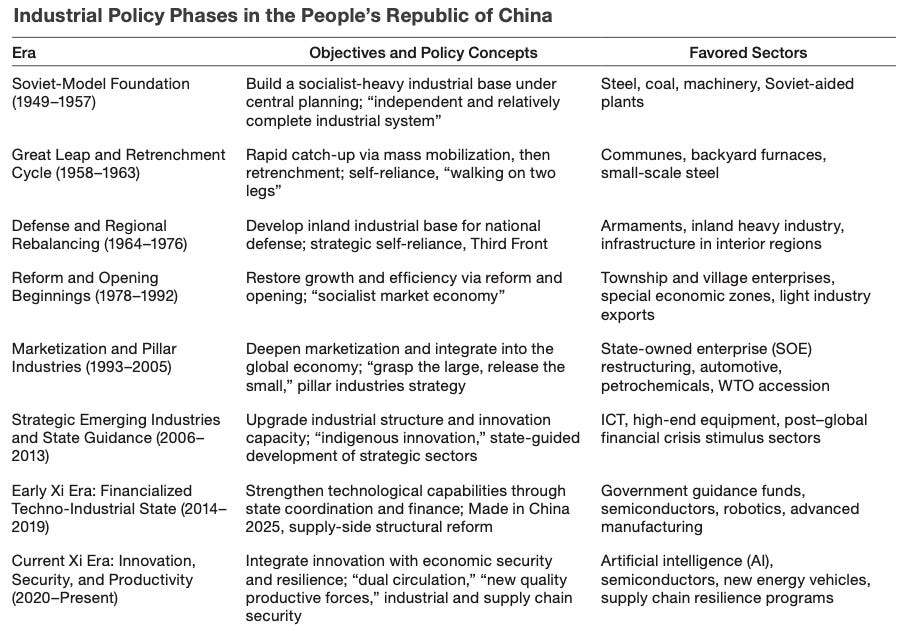
The IEA released its 2026 electric vehicle trends report. [IEA] And RAND released a long report on how China’s industrial policy has evolved over the last 10 years or so. [RAND]
The US is worried China might have one of ASML’s most advanced EUV lithography machines. [Bloomberg]