


Welcome to the reading list, a weekly roundup of news and links related to buildings, infrastructure and industrial technology. This week we look at minimum lot sizes, Boeing’s next 737 MAX, Fervo short sellers, Figure AI’s training data, and more. Roughly 2/3rds of the reading list is paywalled, so for full access become a paid subscriber.
No essay this week, but I’m working on a piece about manufacturing isotopes that should be out next week.
Housing and Cities
Almost two thirds of US homebuilders said immigration enforcement is affecting their labor force, up from 23% in March and 13% a year ago. [WSJ]
I had always heard of “minimum lot sizes” as one of the many land-use regulations that restricts the supply of new housing, but I had no idea how extensive they were. But a new report from AEI claims that 90% of jurisdictions have some sort of minimum lot size, and that this is a major barrier to constructing smaller, less expensive starter homes. [AEI]
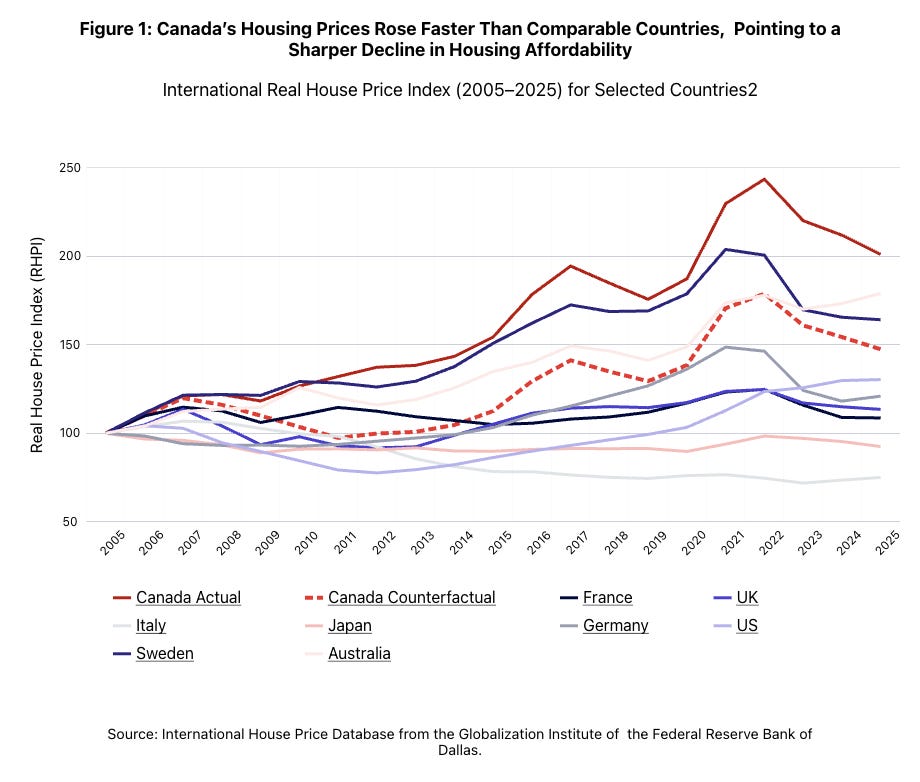
Canadian real house prices have more than doubled since 2005. [CMHC]
Airbnb bans making guests do the dishes and take out the trash. [The Verge]
The Wall Street Journal on rising pedestrian deaths on US roads. It places the blame chiefly on road design, though it doesn’t explain why road design would cause a sudden uptick around 2009. [WSJ] See also my previous essays about US pedestrian deaths.
The market share of modular and panelized housing construction in the US remains very low. “The total market share of non-site-built single-family homes (modular and panelized) was just 3% of single-family homes in 2025, according to NAHB analysis of completion data from the U.S. Census Bureau’s Survey of Construction (SOC). This matched the 3% market share recorded in both 2023 and 2024.” [NAHB]
Manufacturing
The FAA certifies another version of Boeing’s 737 MAX, the 737-10. Boeing currently has 1555 orders for it. [Boeing]
Worries about the shipbuilding gap between the US and China often focus on commercial ship output (of which the US has virtually none), but it seems that there’s also a substantial gap in naval vessel output. “The combined tonnage of combat ships built by China in the two years through to December 2025 amounted to 636,208 tons, compared to 270,509 tons for the United States, according to data compiled by Flottes de Combat and French maritime industry association Gican.” [Defense News]
Former Tesla executive Drew Baglino’s solid-state transformer startup, Heron Power, signs an agreement for 1 GW worth of manufacturing capacity for data center developer Vantage. [Heron Power]
Is optical fiber going to be the next data center-induced shortage? “Tightening supply is projected to push spot prices for finished optical fiber products to 2.8–5 times their 2025 levels or higher. In response, telecom operators are shifting from short-term purchasing to long-term supply agreements (LTAs) to lock in fiber supply early.” [TrendForce]
Helium has been re-added to the US’s list of critical materials. A good time to revisit my piece on why helium is hard to replace. [X]
Seems bad. “[T]he U.S. aluminum industry, the world’s leading supplier just 25 years ago, produces a mere 1% of global output today. Moreover, there are zero operating smelters in the United States—or in a NATO country—capable of producing the high-purity aluminum required for military applications; the only comparable sources—China, Russia, and the United Arab Emirates—are highly precarious.“ [American Primary Aluminum Association]
Former OpenAI research chief Bob McGrew’s manufacturing startup Arda, which is doing manufacturing automation, raises $160 million. ““When a design changes, you can retrain a human in a day — but it takes three to six months in order to change the automation to reflect the new design,” McGrew said. “We’ve built a software and AI product that basically allows manufacturing engineers to build assembly lines much faster.”” [CNBC]