


Welcome to the reading list, a weekly roundup of news and links related to buildings, infrastructure and industrial technology. This week we look at BAAJA, rayon for missiles, US gas consumption, Cyberarmageddon, and more. Roughly 2/3rds of the reading list is paywalled, so for full access become a paid subscriber.
No essay this week, but I’m working on a long follow up to my technological search essay that should be out next week.
Housing and Cities
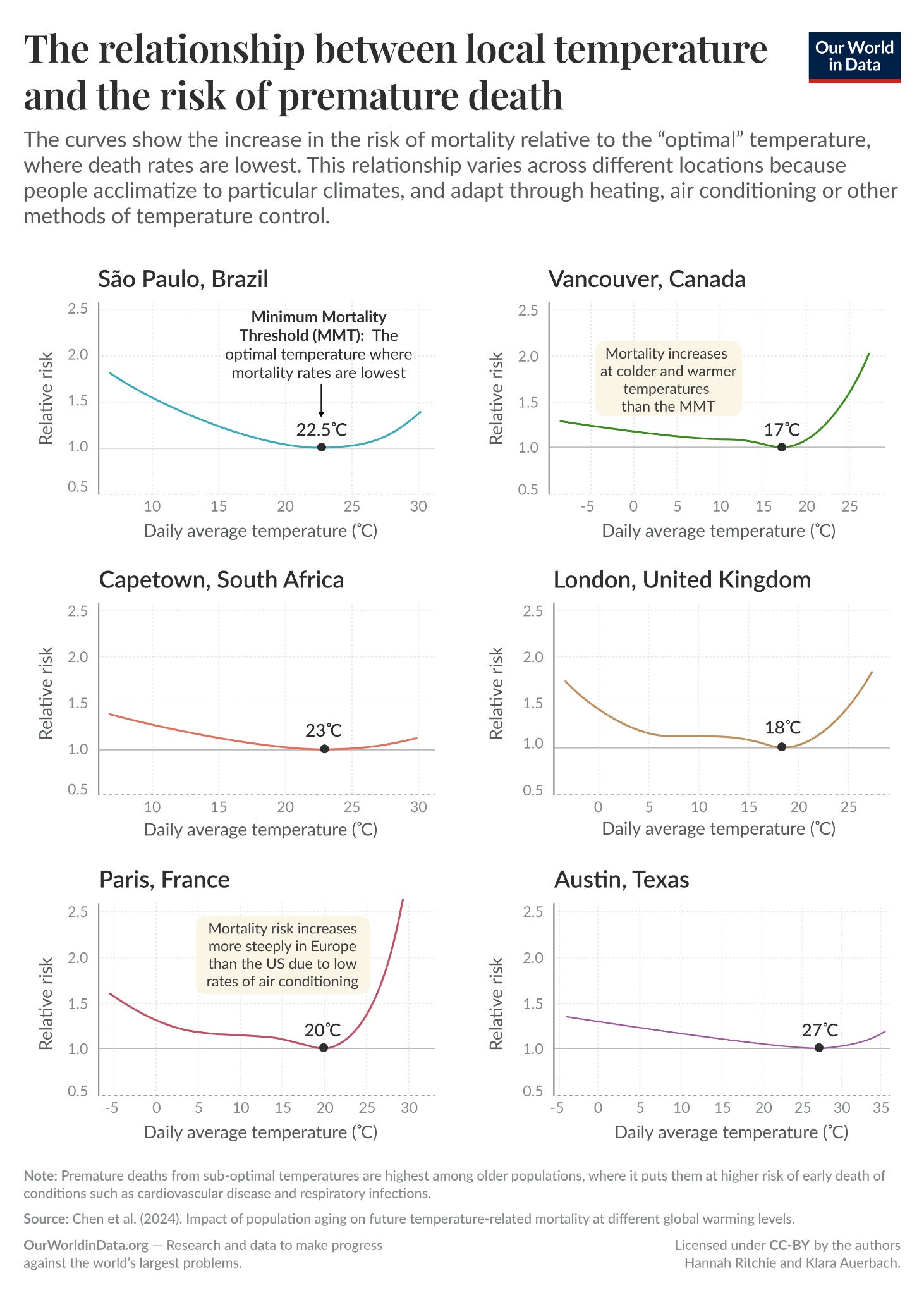
A neat dataset showing the relationship between excess deaths and temperature in cities around the world. You can really see the sensitivity to high temperatures in places without AC. [Our World in Data]
The Senate passes the permitting reform bill BAAJA. [NYT] And Kalshi now gives BAAJA a 75% chance of becoming law. [Kalshi] And New Mexican Senator Martin Heinrich is in the Economist arguing for BAAJA. “The Bipartisan American Affordability and Jobs Act—which the Senate voted to advance on November 9th and which I co-sponsor with another Democrat and two Republicans—does not remove environmental considerations, the ability to litigate projects or the ability for local communities to comment. Those are necessary. But it does make these reviews a standardised part of a predictable process.” [The Economist]
New type of nimbyism just dropped: people opposed to delivery drones flying over their backyard. [WSJ]
How Dubrovnik, the Croatian city where King’s Landing scenes were shot in Game of Thrones, is coping with huge masses of tourists and (checks notes) Montenegrin drug cartels. [The Times]
Manufacturing
From the annals of manufacturing bottlenecks: producing more Patriot missiles requires, among other things, a specialized rayon fabric called Raycarb, processed by a single US company who sources it from a tiny number of companies (apparently just two), who are unable or unwilling to ramp up capacity as fast as the US would like. “Only one rayon product of this kind is approved for use in the most advanced Patriot missiles, and it comes from the Kansas factory of a single supplier, Park Aerospace. With Patriot stockpiles shrinking, the Pentagon official pushed Park for more rayon to help ramp up missile production. It soon became clear that the company’s hands were tied. The problem lay not in Kansas but thousands of miles across the Atlantic near the vineyards of Bordeaux in France. That’s where Park’s supplier, ArianeGroup—a maker of space rockets and ballistic missiles—produces the carbonized rayon fabric, which it then ships to Park for further processing. ArianeGroup had been clear that supply was limited.” [WSJ]
Manufacturing automation startup Hadrian is buying Kutztown Foundry and Machine, a company that makes castings for, among other things, nuclear submarines. [Manufacturing Dive]
The US Marine Minerals Administration, formerly the BOEM, held an auction for seabed mining rights on 31 million acres of seabed near American Samoa. [Maritime Executive]
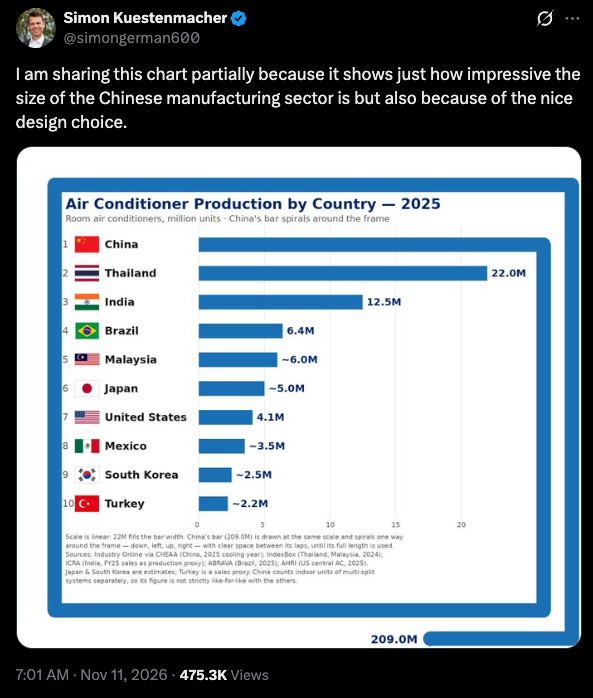
China produces a lot of air conditioners. [X]
Apparently Tesla will sell you a Cybercab, under a somewhat strict set of conditions. “Tesla is now inviting “select customers” to buy a Cybercab for personal use at $29,990, but the car won’t move unless you also pay $299 a month for an “Autonomy Subscription.” And it only works inside Tesla’s Robotaxi service areas in Texas and Florida, the same geofences that have turned out to be significantly smaller than what Tesla advertises.” [Electrek] And a factory to produce Tesla’s Optimus is under construction at Giga Texas. [YouTube]
A bunch of planned naval vessels have been cut by the US Senate appropriations committee. [X]
The GAO says the F-35 program has about 26 million spare parts, collectively worth about $31 billion, spread around 700 sites around the world. [Tom’s Hardware]