

Thanks to Kyle Schiller at Marathon Fusion for conversations and information that informed this essay. All errors are my own.
Much of modern civilization is built on top of chemical reactions, either to produce new materials (as in the blast furnace, which converts iron oxide into metallic iron), or to generate energy. Chemical reactions, as we’ve previously noted, work by rearranging how atoms hold their outermost electrons. Combine an atom of sodium and an atom of chlorine, for instance, and sodium’s outermost electron will end up in chlorine’s outer electron shell in an ionic bond, creating sodium chloride — common table salt.
With these sorts of chemical reactions, we’re only shifting around atoms and the electrons that orbit them in the form of chemical bonds. The interior of the atom — the atomic nucleus, which contains an atom’s protons and neutrons — remains unchanged. But if you create the right conditions, it’s possible to rearrange the interior of atoms as well. In nuclear fission, the reaction that powers nuclear power plants, the nucleus of an atom splits, creating several new atoms and releasing an enormous amount of energy in the process. In the fusion reaction taking place within the sun, hydrogen atoms are fused together, their individual nuclei combining to form helium. In particle accelerators like the Large Hadron Collider, charged particles are accelerated into each other using electromagnetic fields, and scientists study the various fragments created by the collisions.
By changing the number of protons or neutrons in the nucleus, these nuclear reactions can create things that can’t be created via conventional chemistry. Change the number of neutrons in an atom, and you get a new isotope of that particular element: an atomic variant of the same chemical, but with a different mass. Change the number of protons, and you end up with a different element entirely, possibly one that doesn’t occur in nature at all.
Typically, the products of these reactions (which we’ll simply refer to as “isotopes”) are unstable: they decay into some other, more stable isotope, emitting radiation in the process, which can be harnessed for various purposes. Carbon dating, for example, relies on the fact that living organisms absorb carbon-14, an isotope of carbon with eight neutrons in the nucleus that eventually and reliably decays into atomically stable nitrogen-14 (the “14” indicates the number of protons and neutrons — carbon-14 has six protons and eight neutrons, while nitrogen-14 has seven protons and seven neutrons). Another process, radiographic welding inspection, uses a variety of radioactive isotopes, such as iridium-192 and selenium-75, to emit gamma rays to inspect welds. Smoke detectors rely on americium-241, an isotope of the artificial element americium — radiation emitted by a small amount of americium causes an electric current to flow across a chamber, but if smoke enters the chamber, the flow of electricity is interrupted, triggering an alarm.
Currently, our use of isotopes is constrained by the fact that creating them is difficult and expensive. Gram for gram, isotopes are some of the most expensive materials on the planet. And the supply chains to produce them are often extremely fragile. Technetium-99m1, a widely used radioactive isotope for medical imaging, is produced through the decay of another radioactive isotope, molybdenum-99. Molybdenum-99, in turn, is produced in only a few nuclear reactors around the world;there was a worldwide shortage in 2024 when some of these reactors went offline for repairs. If isotopes could be manufactured more easily and more cheaply, it could open up numerous possibilities — cheaper medical treatments, better nuclear power sources, possibly even useful new materials.
Making isotopes
We’re all familiar with the periodic table, which lists every chemical element known to man.
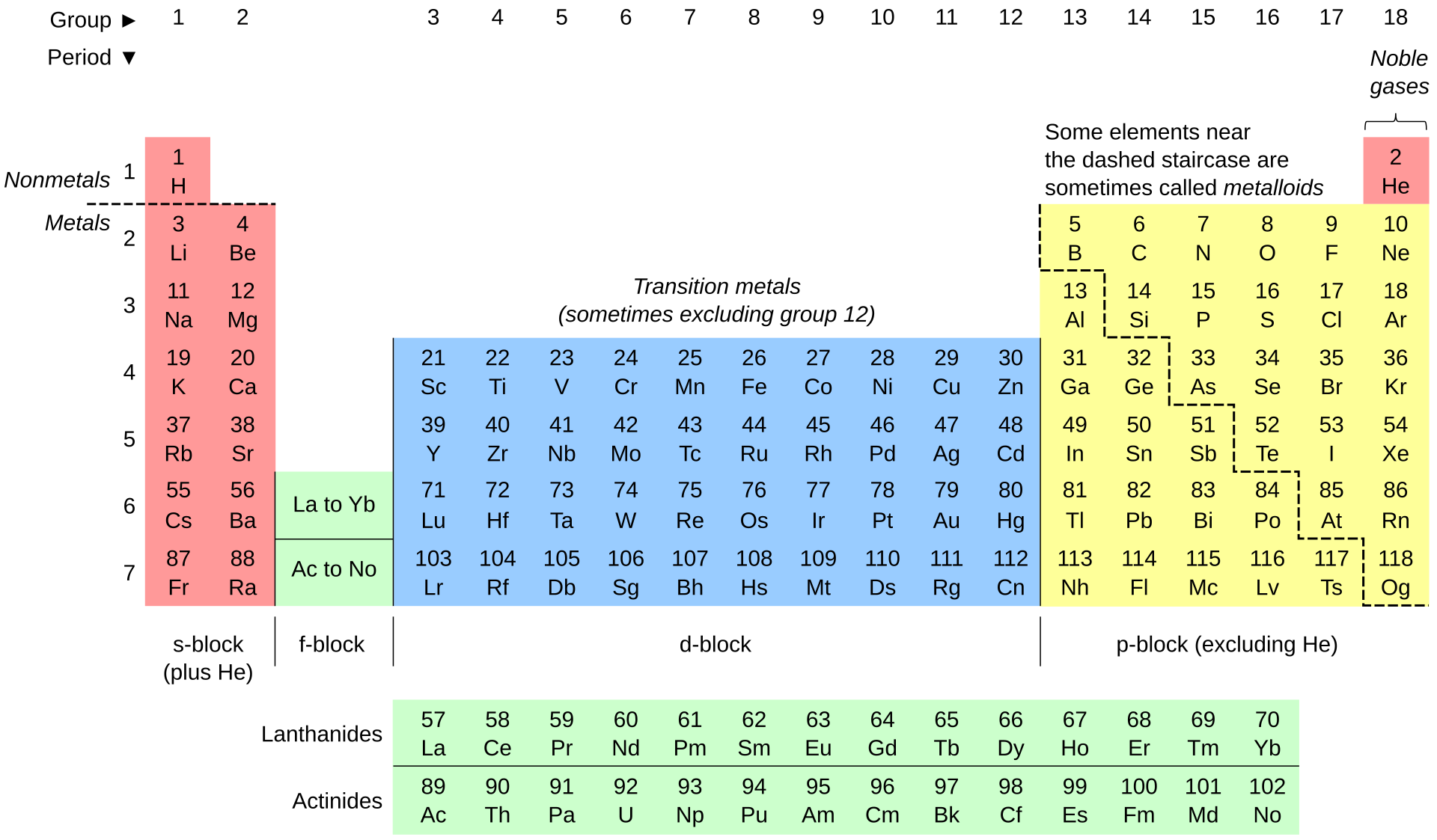
Each element on the periodic table has an atomic number, which is the number of protons in the nucleus, starting from atomic number 1 (hydrogen, which has one proton in the nucleus) all the way up to atomic number 118 (oganesson, an artificial element with 118 protons in the nucleus). It’s the number of protons in an atom that makes an element an element — carbon always has six protons, because having six protons in the nucleus of an atom is what makes that atom carbon.
But there are also neutrons in the nucleus, and the number of neutrons can vary. Most carbon on Earth, for instance, is carbon-12, which has six protons and six neutrons. But about 1% of carbon is carbon-13, which has seven neutrons. The most common isotope of helium is helium-4, which has two neutrons, but there’s also helium-3, which only has one. Most of the water molecules in Earth’s oceans are made up of hydrogen with no neutrons (hydrogen-1), but about one out of every 3200 water molecules contains a hydrogen with one neutron, also known as deuterium (water made from deuterium is sometimes known as “heavy water”).
We can visualize isotopes on what’s called a nuclide chart, shown below. The horizontal axis is the number of neutrons in a nucleus, while the vertical axis is the number of protons.
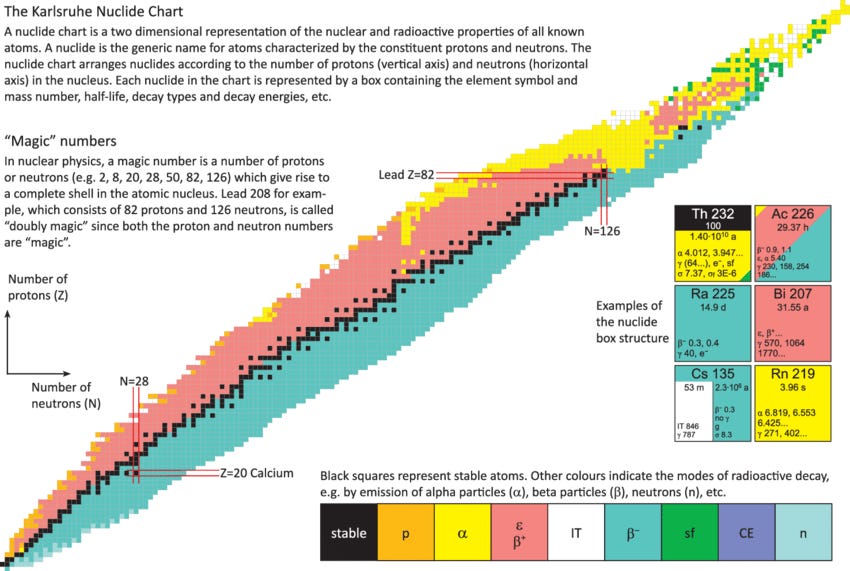
We can see that most elements have several different isotopes, most of which are unstable. Only the isotopes in black in the chart above are stable; everything else will eventually decay. Red isotopes on the chart above decay by what’s known as “beta-plus” decay or electron capture, turning a proton into a neutron. Teal isotopes decay by “beta-minus” decay, turning a neutron into a proton. Yellow isotopes decay by “alpha” decay, emitting an alpha particle (two protons and two neutrons). The rate at which an isotope decays into another isotope is typically described as its “half-life” — the amount of time it takes for half of a sample to undergo radioactive decay. Half-lives can vary wildly, from tiny fractions of a second for hydrogen-5 to hundreds of millions of years for uranium-235.
For isotopes that are stable, or that decay slowly enough that they can be found in the environment, it’s sometimes possible to obtain them by separating them out from other isotopes. But this is often difficult, because isotopes tend to be chemically identical, and most separation methods must rely on minute differences in the atoms’ weights. Much of the difficulty in the Manhattan Project, for instance, was in creating sufficient concentrations of a specific isotope of uranium, uranium-235, that would undergo nuclear fission. Uranium-235 only makes up about 0.72% of natural uranium, and producing a single, football-sized lump of it required a processing facility the size of a small city.
But many isotopes can’t be found in nature at all. There’s no natural source of the technetium-99m or molybdenum-99 used for medical imaging, or the selenium-75 used for welding inspection. It’s thus useful to be able to manufacture specific isotopes.
How do we do this?
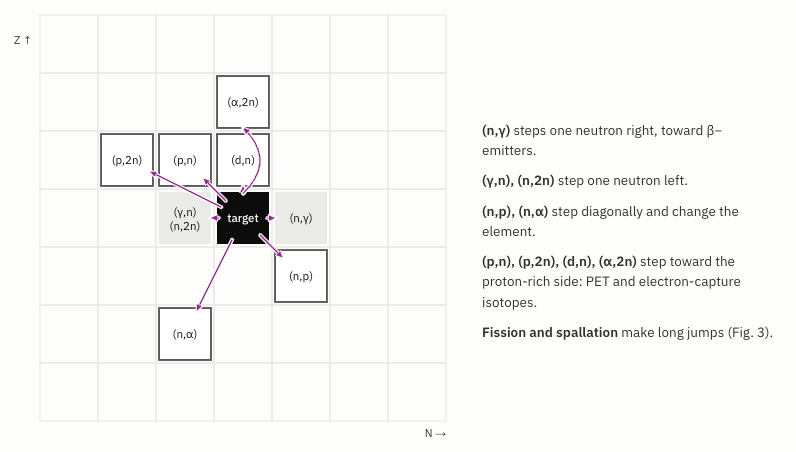
At a high level, creating isotopes means rearranging the interior of an atom. In some cases, this happens by natural radioactive decay. The americium-241 used in smoke detectors, for instance, mostly comes from decaying plutonium-241. But for most isotopes we’re interested in, we can’t rely on natural mechanisms; instead, we have to deliberately rearrange atomic nuclei by bombarding them with different sorts of particles. Depending on the sort of particle you hit the nucleus with, the energy of that particle, and the nature of the target atom, you can create different sorts of reactions. These reactions are typically described by the following format: target(input particle, released particle)product. So in 1917 when Rutherford bombarded nitrogen atoms with alpha particles, producing oxygen and hydrogen nuclei (protons), that reaction was N-14(alpha,p)O-17. The figure below shows different sorts of reactions and how they move an atom to a different location on the nuclide chart.
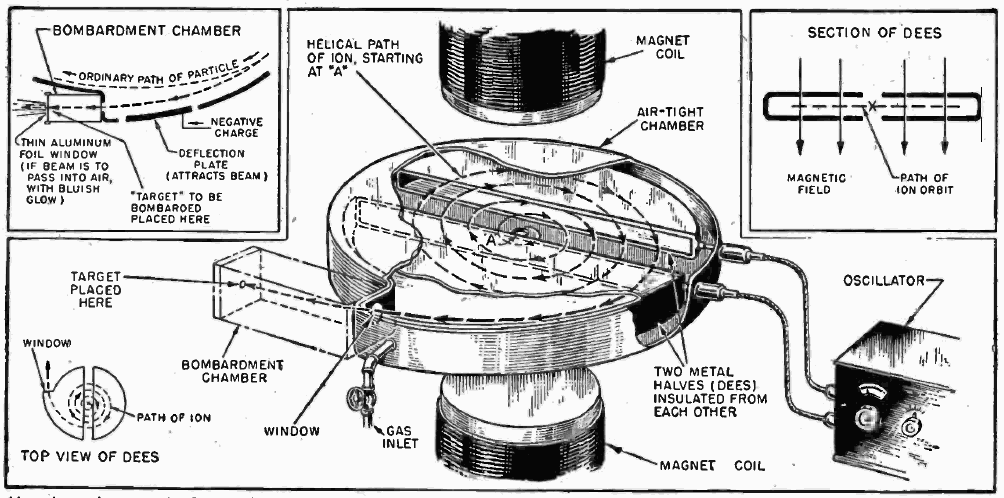
There are a few different ways we can hit an atom with a particle. One is to use a particle accelerator, such as the cyclotron, invented in 1929 by Ernest Lawrence (who would go on to win a Nobel Prize for his invention). The cyclotron uses powerful electromagnetic fields to accelerate charged particles along spiral paths. With his 27-inch particle accelerator, Lawrence could accelerate helium nuclei to roughly 1% of the speed of light.
It wasn’t long after Lawrence created his cyclotron that it began to be used to create various isotopes. Naturally occurring radium was already being used to treat cancer with radiation, and Lawrence hired personnel to investigate the potential of using cyclotron-created isotopes for medical and research purposes, such as radioactive phosphorus-32. Phosphorus-32, which has one more neutron than the stable phosphorus-31, was a promising research isotope because organisms naturally incorporate and accumulate phosphorus: if that phosphorus were radioactive, it would allow various metabolic pathways to be observed and possibly allow for highly targeted radiation treatments. Lawrence quickly found that demand for phosphorus-32 for experimental cancer treatments and biological research was “almost insatiable,” and by 1939 a dozen cancer patients had been treated with cyclotron-produced phosphorus-32.
Particle accelerators are still used to produce isotopes today. GE Healthcare, for instance, sells several different medical cyclotrons. The GE PETtrace 800 uses a beam of hydrogen or deuterium nuclei (protons or proton + neutron) to create isotopes such as oxygen-15, nitrogen-13, and fluorine-18, which are then used for medical imaging.
The downside of particle accelerators is that it’s hard to use them to produce a large volume of material efficiently. A medical accelerator costs in the single-digit millions (plus several more millions for the facility to house it) and can only produce about a dust-grain-sized speck of material every hour.
This is due largely to how particle accelerators work. They accelerate particles using electromagnetic fields and so only work on charged particles: electrons, protons, or positively charged atomic nuclei. With electrons, it’s apparently hard to get them to trigger nuclear reactions because they don’t feel the strong nuclear force — electron accelerators thus mostly work by firing the electron into another target and triggering the release of gamma rays, but most of this beam will end up as heat. Because protons or alpha particles are positively charged, they’ll be repelled by the positively charged nucleus of the target, similarly reducing conversion efficiency and creating a lot of heat that must be dealt with. When the PETTrace 800 uses protons to make fluorine-18 (which uses oxygen-18 as an input), only about 1 in 800 protons enters the oxygen nucleus.
Another way to create the necessary particle collisions is to use nuclear fission: unstable atomic nuclei splitting apart when struck by a neutron. There are a couple of ways to leverage this. One is to simply harvest the products nuclear fission naturally generates. Molybdenum-99, for instance, is naturally produced during the fission of uranium-235 and plutonium-239. Strontium-90 is similarly a byproduct of nuclear fission and is sometimes harvested from spent nuclear fuel.
You can also use nuclear fission as a particle source. The fission of uranium-235 releases neutrons, which can then be used to bombard various targets to produce isotopes. Cobalt-60, for instance, a widely used radiation source, is created by placing cobalt-59 in a fission reactor, causing some of the atoms to absorb a neutron via neutron capture.
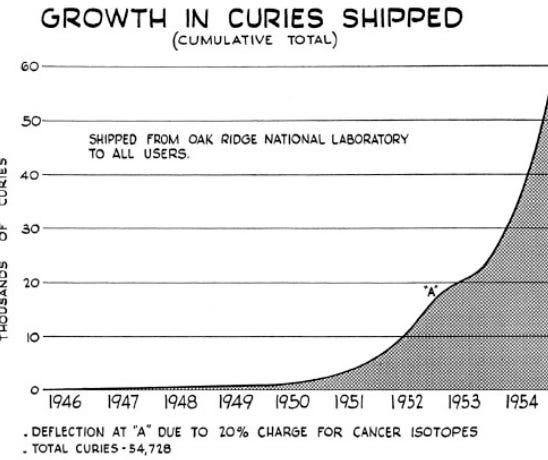
Using nuclear fission as a source of radioactive isotopes began almost as soon as the first nuclear reactors were created. Long before the Atomic Energy Commission built the first nuclear power plants, it was shipping reactor-created isotopes across the country and around the world for medical and scientific research. By 1956, more than a year before the first US civilian power station at Shippingport came online, there were 50,000 isotope purchases per year from the AEC.
But there are also drawbacks to using fission as an isotope source. For one, fission reactors are highly regulated, and constructing them is difficult and expensive. For another, most of the neutrons produced by fission reactors aren’t particularly high-energy, and in power reactors they’re generally deliberately slowed down to increase the chances that they’ll strike an atom and continue the chain reaction. The average fission neutron is created around 1.5–2 million electron volts (MeV), moving at about 6.5% of the speed of light, but in power reactors they’re slowed down using a moderator to about 0.025 electron volts. And even without moderation, the relatively low energy of most fission neutrons means that many nuclear reaction rates will be slow, and other reactions are out of reach.
To create isotopes efficiently, what we’d like is some way to generate a lot of neutrons at much higher energies. This would make many sorts of nuclear reactions possible while avoiding the inefficiencies of using particle accelerators.
One way to do this is with nuclear fusion. Much has been made about the difficulties of creating a fusion power plant, but fusion has always been a problem of efficiency: getting more energy out of your reaction than you put into it. Creating the fusion reaction in the first place has never been the issue, and fusion reactions have been created in the lab as far back as the 1930s. And these fusion reactions reliably produce high-energy neutrons. While fission can produce high-energy neutrons, only around 0.1% of them will be above 10 MeV. By contrast, neutrons produced when fusing hydrogen-2 (deuterium) and hydrogen-3 (tritium) are 14 MeV or more. Fusion has historically not been used to produce isotopes, but today a variety of startups and organizations are pursuing the idea. SHINE Technologies is currently building a facility, Chrysalis, to create Mo-99 via a complex process that requires a particle accelerator, a fission reaction, and a fusion reaction. Italy’s SORGENTINA-RF program similarly wants to create Mo-99 using fusion-generated neutrons. Marathon Fusion wants to use fusion neutrons to create a variety of different isotopes, such as terbium-149 and actinium-225 for cancer treatments, as does New Zealand fusion startup OpenStar.
Possibilities of cheap isotopes
Beyond its ability to generate high-energy neutrons, fusion also has the potential to make isotope manufacturing dramatically cheaper, at least for some isotopes/reactions. Particle accelerators take a lot of energy to operate: GE’s PETtrace draws about 75 kW, roughly as much as 75 microwaves when it’s running, which sets some floor on how cheaply they can produce anything. At 75 kW, it would take around 0.7 terawatt-hours to produce a gram of fluorine-18, which is around 1.5 hours of the entire electricity output of the US.
Energy costs aren’t actually all that significant for medical isotope production, since the doses are microscopic (600,000 doses of fluorine-18 combined weigh about as much as a single grain of salt). But if you wanted to produce large amounts of isotopes — grams, pounds, tons — it would eventually become a binding factor. And a particle accelerator is essentially only producing isotopes: the isotopes must be priced high enough to recover the costs of building and operating the facility. With fusion, however, your isotope-producing reactions can (potentially) also produce energy — so if you use the right reactions, you could use the sale of that energy to help pay for the facility and its operation.2 It’s conceivable that the right energy-generating fusion reactions, in the right arrangements, might be able to produce isotopes far more cheaply.
What sort of things become possible if we can produce isotopes far more cheaply? There are a few major categories of interest.
Medicine
One of the largest isotope markets, with some of the most expensive isotopes, is medicine. With medical imaging isotopes, a patient is given a very small amount of radioactive material, which gets taken up by the body and (generally) incorporated into specific cells or substances. Fluorine-18, for instance, gets incorporated into a glucose-like molecule called FDG, that the body then absorbs as if it were glucose. By monitoring the radiation released by the isotope, some area of the body or biological process can be monitored.
Medical isotopes are also used for radiation treatment. Some elements naturally collect in certain areas of the body, and radioactive isotopes can be used to deliver targeted treatment. Iodine, for instance, naturally collects in the thyroid gland, and radioactive iodine-131 can be used to treat thyroid cancer. Other isotopes, such as actinium-225, decay by emitting alpha particles, which travel an extremely short distance in tissue, also making them useful for delivering very targeted radiation therapy. A better process for manufacturing these isotopes could potentially allow existing medical isotopes to be made more cheaply and reliably; actinium-225, for instance, is a potentially promising isotope for cancer treatment, but current supplies are so limited that only a small number of patients a year can be treated using it. A better process could also potentially enable the creation of entirely new medical isotopes.
Nuclear power inputs
Both fission and fusion reactors rely on isotopes for various parts of their operation. For fusion, the reaction that creates valuable tritium within the fusion cycle requires an isotope of lithium, lithium-6, which makes up about 7% of all lithium and which currently must be produced via an expensive process of lithium enrichment (which is currently only done in Russia and China). Conventional fission reactors, similarly, require the extremely pure lithium-7 produced by the same process, since naturally occurring lithium with too much lithium-6 would absorb too many neutrons. Some new proposed fission reactors, such as TerraPower’s molten salt reactor, require another isotope, chlorine-37, which is currently only produced by the gram but is needed by the ton. A reliable, cheap source of these sorts of isotopes could thus potentially be very valuable (though as I understand it these are much less valuable than medical isotopes, since they’re stable and can be produced via separation processes, so probably not something we’ll see produced via fusion in the near term).
Nuclear batteries
One of the many nuclear technologies that remain somewhat under-explored is nuclear batteries: a battery that generates electric current using a small amount of radioactive material. These sorts of batteries were used for pacemakers for several decades, and are used to power spacecraft, but with the ability to manufacture better battery isotopes many other uses might be found, such as undersea drones that can stay permanently submerged for monitoring undersea cables.
Materials
In some cases, the nuclear chemistry process might let you make “normal” materials that are otherwise difficult or expensive to get. Marathon Fusion got a lot of attention last year (and last week) for a fusion neutron-driven reaction that can create gold using mercury as an input.
Cheap nuclear chemistry might also allow you to more efficiently make what’s known as “isotopically pure” materials. Most elements found in nature have multiple stable isotopes, and thus any minerals or materials that contain them will contain a mix of different isotopes. Steel, for instance, will be a mixture of several different stable isotopes of iron (iron-54, 56, 57, and 58) and carbon (carbon-12 and 13). But if you could make isotopes very cheaply, you could possibly more easily produce materials entirely using one elemental isotope, such as semiconductors that only contain silicon-28.
In some cases, these isotopically pure materials might have interesting or useful material properties. Isotopically pure diamond has far higher thermal conductivity than regular diamond, for instance (as do, apparently, many other isotopically pure materials). And because of its different quantum-mechanical properties, isotopically pure silicon is useful for building quantum computers.
Historically producing isotopically pure materials has been so difficult that much about them remains unknown; reducing the cost of making isotopes could break open this field of study.
Conclusion
For many technologies, how big an impact they have is a function of how cheap they can get. Solar PV was a niche power generation technology before decades of falling down the learning curve; steel was an expensive material used in limited ways before Henry Bessemer and others found ways to produce it cheaply; Ford’s Model T changed the world not because it was the first car, but because of how cheaply Ford could manufacture it. So a technology that offers the potential to produce some existing thing far more cheaply is always interesting to me, and I’ll be paying attention to see how this develops with isotopes.
Technetium-99m is technetium that’s in what’s known as a “metastable” state, an excited state that eventually decays to regular technium-99, emitting gamma rays in the process.
Specifically, most fusion uses deuterium and tritium as inputs, known as D-T fusion. Deuterium is incredibly common, but tritium is rare and expensive. But you can add a step to the fusion reaction so that it also creates tritium, reducing or eliminating the need for an outside source of it.