

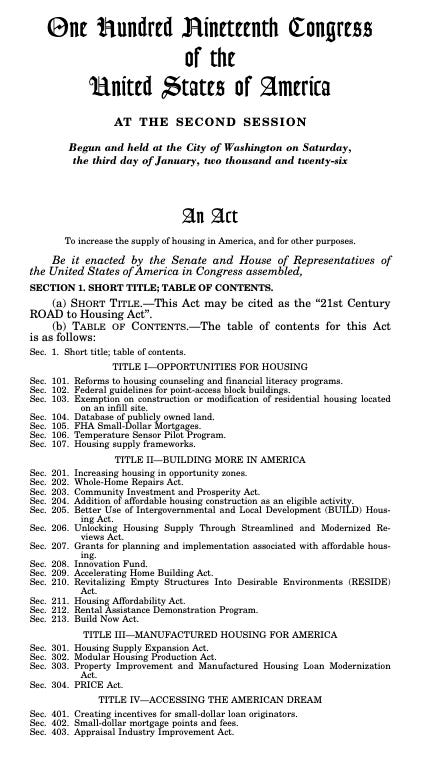
This is the second installment of my look under the hood of the recently passed 21st Century ROAD to Housing Act, looking at what each provision actually does and trying to suss out its actual impact on housing supply. You can read my previous essay on Title I of the Act here. This time I’ll look at Title II, “Building More in America,” and Title III, “Manufactured Housing For America,” which have 13 and 4 individual provisions respectively. Some of the most consequential chunks of this legislation are in these two titles.
The sections in this title mirror the act overall: only a small number of these changes are likely to be of major consequence, and how much they increase housing stock will depend a lot on whether the constraints they modify were actually binding, which is often hard to tell.
Title II — Building More In America
This is the largest title in the act, with 13 sections, each one of which targets housing production or preservation in some way. We’ll look at each section one by one.
Section 201 — Increasing Housing in Opportunity Zones. This section allows HUD to give additional weight when awarding housing grants to projects that will be built in Opportunity Zones: areas that are economically distressed and that have tax incentives available for investing in them.
The likely impact of this section on housing supply is almost definitely zero. It just shifts which housing projects HUD decides to allocate money to. It doesn’t increase the size of the pot of money, or the number of projects that can be funded.
Section 202 — Whole-Home Repairs Act. This section establishes a HUD pilot program for providing grants to homeowners and landlords for home repairs. This is potentially a useful program — some people get funds to make housing repairs that maybe otherwise wouldn’t be able to afford them — modeled on earlier, state-level programs like Pennsylvania’s. But it seems more about increasing housing quality than housing stock: improving energy efficiency, weatherization, safety, general habitability, etc.
That said, there might be a “it’s easier to keep an existing customer than finding a new customer” logic to this. If you want to turn dollars into housing supply, in some cases a dollar probably goes farther repairing an existing home than it does building a new home. Typically homes fall out of the housing stock at a pretty slow rate, but if there’s damage (say, a leak in the roof) that probably greatly accelerates the rate at which it happens. Funding those sorts of repairs is probably pretty useful from a cost/benefit point of view. Depending on how the repair money is distributed, this could potentially be a meaningful amount of homes, though probably not a huge number. I suspect mostly this will be about addressing quality-of-life more than keeping homes from falling out of the housing stock.
Section 203 — Community Investment and Prosperity Act. This section raises the cap of how much banks are allowed to invest in public welfare projects, most of which are Low Income Housing Tax Credit (LIHTC) housing projects. The LIHTC program is a federal housing subsidy program. Each year the federal government awards several billion dollars worth of tax credits to states, who in turn award them to housing developers for completing housing projects rented to low-income families. Roughly 70,000 LIHTC housing units are completed each year.
These projects are typically funded by banks, who take essentially all the project’s equity in exchange for funding it, and get the tax credit attached to it in return. (The tax credit reduces the amount of federal income tax you owe, and thus is most useful for organizations that have a lot of tax that could be reduced.) Banks are limited in how many of these sorts of projects they can invest in at once; this section raises those limits.
I had a hard time understanding the exact mechanics of these sorts of funding requirements, but as I understand it this change is more about preventing these limits from becoming binding in the future than them being constricting right now. So this section is possibly a big counterfactual deal (in the sense that we would get fewer LIHTC units in the future without it), but not one that will boost housing supply over current levels.
Section 204 — Addition of Affordable Housing Construction as an Eligible Activity. This section allows affordable housing projects (including LIHTC housing) to be funded by Community Development Block Grants (CDBG), a pot of money HUD hands out every year for states and other jurisdictions to do various community improvements. CDBG funding is fairly large, $3.3 billion each year, and this lets up to 20% of a jurisdiction’s CDBG funding be used for housing, so it’s a potentially large amount of money for housing projects.
The mechanics of these programs and the actual binding contraints are sufficiently complex that it’s hard for me to gauge whether it will be used all that much in practice, so my error bars here are quite wide.
Section 205 — Better Use of Intergovernmental and Local Development (BUILD) Housing Act. This section basically allows some NEPA environmental reviews for HUD housing projects that previously would have been done by HUD to instead be done by some local supervising entity within the project’s jurisdiction (with HUD still needing to approve the overall environmental review). This could speed up environmental review for these projects — this sort of delegation has sped up environmental review on transportation projects by 15-30% — if the jurisdiction in question has the capability of doing this sort of review. Overall I expect a positive but marginal improvement here that probably doesn’t shift housing supply all that much.
Section 206 — Unlocking Housing Supply Through Streamlined and Modernized Reviews Act. This is another “streamlining environmental review” provision, similar to 105 and 205, and is probably the most important section in the bill so far. This section exempts a bunch of HUD activities from NEPA review (mostly administrative ones), and provides categorical exclusions for a bunch of HUD-financed construction activities: new construction or rehabilitation of multifamily projects of up to 15 units, office to residential conversions, and any infill housing construction project (where “infill” means a project in some municipality on less than five acres of land that has been built on previously).
It doesn’t change the amount of funding for these projects, but it could make some of that funding stretch slightly farther if folks don’t need to take the time and effort to do an environmental review. And it also might just make folks more willing to do these sorts of projects. But the bigger impact is probably just significantly reducing the permitting difficulties for HUD-funded housing projects, making it easier to build them.
Section 207 — Grants for Planning and Implementation Associated with Affordable Housing. This section creates a HUD grant program for jurisdictions to study and implement pro-housing strategies, such as updating zoning codes or modifying housing-related regulations. This probably addresses a real constraint — there are thousands of permitting jurisdictions in the US, and many of them probably can’t easily spare the resources to analyze and modify their zoning regulations — but it would surprise me if it were particularly binding. I suspect jurisdictions that wanted to modify their regulations to be more pro-housing would find a way to do so, though this could conceivably be enough to encourage the marginal jurisdiction to pull the trigger.
These sorts of grant programs have been created before: in 1992 as part of the Housing and Community Development Act, and more recently in the form of PRO Housing Grants (which was first implemented by HUD as something like a planning grant but evolved after congressional pressure to be more like the Innovation Fund, below), but it’s not amazingly clear to me that these have had much of an impact. Overall the likely outcome of this seems fairly minor to me.
Section 208 — Innovation Fund. This section creates a $200 million per year Innovation Fund (which will need to be funded via a separate appropriation), which will be awarded to jurisdictions which show “objective improvement in housing supply growth.” Awards can be up to $10 million. This is a great provision, directly incentivizing the thing we want (increased housing supply). The only question, like with so many provisions in this bill, is how strong this incentive will actually be in practice: how likely is a jurisdiction to try and improve its housing delivery in the hopes of winning one of these grants down the road? I would be surprised if this is enough to make most jurisdictions make major changes to their housing or zoning regulations — the amount at stake is probably just too small, and too uncertain — but, like with Section 207, it might be enough to shift the marginal jurisdiction.
Section 209 — Accelerating Home Building Act. This section allows (but does not require) HUD to award grants to jurisdictions to implement pre-reviewed housing designs, often known as “pattern books.” Instead of coming up with the architectural design for some new housing project themselves, or hiring an architect to do it, the developer can just select one of these pre-reviewed designs. The benefit of this is twofold. One, the developer saves some money on design effort (since the design has already been done), and two, the permitting process becomes smoother, since the design has already been approved by the jurisdiction.
Pre-approved housing designs have been tried in a variety of jurisdictions, and they appear to be something of a mixed bag. In some cases, they’re used enough to make up a single-digit percentage of new housing construction; in other cases, they basically don’t get used at all.
Overall, I’d classify this as another “positive but marginal” section: assuming HUD decides to fund these, it probably means the marginal jurisdiction adopts pre-reviewed designs that otherwise wouldn’t, and in some fraction of those a meaningful (but not substantial) chunk of new housing gets built using them. Money and construction time are saved, which maybe means a few projects pencil out that otherwise wouldn’t, but probably not very many. My prior is that real estate developers want a lot of control over the specifics of their projects — exactly how the buildings are laid out, exactly what the floor plans are, exactly what finishes are used where — which makes me somewhat bearish on pattern books in general.
Section 210 — Revitalizing Empty Structures Into Desirable Environments (RESIDE) Act. This section authorizes (but does not require) HUD to create a grant program for converting existing vacant buildings into housing. There’s no set amount of money for it (it will depend on what’s appropriated), but the text of the law suggests it might be in the $100 million range.
Converting existing buildings into housing is a perennially popular idea that is often blunted by the fact that these sorts of conversions are expensive: it typically costs as much or more to convert an existing building into housing than it is to just build a new building from scratch. So a grant program that can provide money for these conversions might theoretically make more of these projects pencil out.
Other than funding limitations ($100 million does not buy all that many conversion projects), the impact of this is likely limited by the fact that the given vacant building must have been deemed abandoned or unsafe for occupation to be eligible for funding. The typical conversion targets are things like low-occupancy office buildings that are still in use and safe to occupy. But this is specifically aimed at abandoned, derelict buildings. So the universe of potential projects isn’t all that large. And it’s further narrowed by the fact that this section requires the resulting projects to have the majority of their units affordable to low-income households.
Overall I think this could potentially result in a few more conversion projects, but probably a pretty small number of them.
Section 211 — Housing Affordability Act. This section raises the per-unit limits for FHA insurance for multifamily mortgages. As we noted previously, the Federal Housing Administration is basically an insurance agency: it insures mortgages from the borrower defaulting, to incentivize the lender to make loans they otherwise wouldn’t. Most of these loans are for single-family homes, but it also does a few multifamily mortgages (around 17,000 units per year).
As I understand it, FHA insurance basically makes multifamily projects charging lower rents pencil out that otherwise wouldn’t, so it’s useful for building projects targeting lower-income occupants. But FHA insurance has limits on how much it can lend for a specific project, which is calculated based on the cost of the individual units. This section raises those individual unit limits, and so increases the limit on how large an FHA insured multifamily mortgage can be. It also changes the formula for how these limits are calculated.
It’s not amazingly clear to me how much this section will affect housing supply (even understanding how FHA multifamily insurance works at all was a struggle), but I suspect it will be fairly minor. For one, this is just a very small program, and this shift probably won’t change that. For another, the FHA has overall limits on the total amount the FHA can insure, and this doesn’t change those limits. Also, these limits have been repeatedly raised in the past, and don’t seem to have changed the trajectory of multifamily housing construction. This could be another case where this is pre-emptively reducing a constraint that otherwise would have become binding, but it’s hard to know. Overall I don’t expect much from this change.
Section 212 — Rental Assistance Demonstration (RAD) Program. The RAD Program restructures how certain public housing projects are administered, converting them to the Housing Choice Voucher Program, also known as Section 8 Housing. The purpose of this is to fund the maintenance of public housing: for abstruse financial reasons, this conversion basically makes it possible for housing projects to get loans against the value of their future subsidy income streams and use those loans to fund maintenance and repair projects. This section raises the cap on the number of housing units that can be converted by 100,000, from 455,000 to 555,000 units, and also makes the program permanent (it was previously set to expire in 2029).
This will potentially let 100,000 units of public housing fund maintenance projects. Some of those units might otherwise gradually decline to the point of being unoccupiable. So this is another provision that could keep some large chunk of housing units from being removed from the housing stock. And it also can result in the construction of new housing: some chunk of RAD projects involve tearing down an existing public housing project and building a new one, also building some non-public housing units along with it. The Fulton and Elliot-Chelsea redevelopment, for instance, done through New York’s RAD implementation, is replacing 2056 public housing units with 2056 new public housing units, and also adding another 3454 new housing units. So this is potentially a big deal.
Section 213 — BUILD Now Act. This section tethers a chunk of certain high-cost jurisdictions’ CDBG funding to their level of housing growth. If the rate of increase in housing production is lower than the median of these high-cost jurisdictions, you lose a chunk of your CDBG funding (10%), and that money gets reallocated to jurisdictions where housing production rose faster than it did historically.
At a high level, it’s good to have another fairly direct incentive for jurisdictions to try to increase housing production. And the threat of taking away federal funding has been successfully used before, such as when the federal government got states to adopt a national speed limit of 55 and a drinking age of 21 by threatening to take away highway funding. This is one of the first times the federal government has been willing to penalize high-demand places that don’t build housing. But there’s a few issues with this provision. One is that the way that it’s calculated is weird: per the text, a jurisdiction that went from 0.2% growth to 0.25% growth would score higher than a jurisdiction that went from 2% growth to 2.4% growth, even though the latter is a much larger increase in housing supply.
The big question here is whether this loss is enough to incentivize jurisdictions to make jurisdictions change their behavior. 10% isn’t necessarily a huge amount (the average CDBG is only like $2 million, though for the jurisdictions in question it’s probably substantially higher), but there may be loss aversion and a reluctance to lose money that had already been allocated that might be quite motivating in practice. And small funding reductions can be motivating: the threat of highway spending reduction to induce states to adopt a 21 year drinking age was only 5% of federal highway dollars. So this could be potentially quite meaningful, though it’s hard to tell.
—
That covers all of Title II. Next up is Title III, “Manufactured Housing For America.”
Title III — Manufactured Housing For America
This title has four sections, each of which are aimed at making it easier to build manufactured homes — homes built under the national HUD code for manufactured homes instead of local building codes, and formerly known as mobile homes or trailers.
Section 301 — Housing Supply Expansion Act. This section eliminates the requirement that manufactured homes have a permanent steel chassis. It also makes some adjustments around manufactured home energy regulations.
The permanent chassis removal is a pretty big deal: It’s something that manufactured home advocates have been requesting for decades. Historically manufactured homes were required to be built on a steel chassis to maintain the fiction that these were fundamentally portable trailers, but almost all manufactured homes are placed once and then never moved. The steel chassis adds substantial cost (on the order of 5-10% of the total cost of a manufactured home), so removing it could mean a potentiallyarge savings (though the steel chassis also acts as a structural support, so a home without one might require additional structural elements that will eat into this savings).
But I’m moderately skeptical that removing this requirement will increase the number of manufactured home purchases. For one, manufactured homes are already substantially cheaper than conventional construction, so it would be surprising to me if another few percentage points of cost reduction resulted in a big uptick in their adoption. For another, it’s often claimed that the steel chassis is what makes it possible for jurisdictions to discriminate against manufactured homes, but there’s no real reason to think that this is true: It would be trivial for jurisdictions to just restrict HUD-code homes, regardless of whether they had a steel chassis or not. So I don’t think this will make it easier to place these homes than it was previously.
This change could theoretically make it easier to build manufactured housing projects from multiple modules, taking advantage the 2024 change that allows the HUD code to be used for structures of up to four housing units (HUD has specifically noted that the chassis requirement makes it harder to build multistory manufactured housing structures). But I similarly suspect that this wasn’t enough of a constraint to meaningfully alter their uptake for this sort of structure. My prior here is that in the current environment it’s pretty hard to meaningfully increase manufactured home shipments via regulatory changes: folks have been trying various ways of doing that for the last two decades but don’t seem to have had all that much success.
What is true, however, is that jurisdictions often define manufactured homes by referring to their steel chassis, at least somewhere in their regulations. Because of that, implementing this will require states to modify their regulations, so this implementation will take some time: jurisdictions have a year to make the necessary regulatory changes. So it’ll be a while before we see chassis-less manufactured homes rolling down the road. Overall, I expect this change to possibly reduce the price of manufactured homes by a few percentage points, but probably not result in a huge uptick in their use.
Section 302 — Modular Housing Production Act. This section instructs HUD to study FHA construction financing, determine whether there are financing barriers that might be preventing the adoption of modular housing, and to issue a rule addressing the issue if it seems like one is justified.
This is looking at a real problem: construction projects are financed with construction loans, and these loans typically have a “draw schedule”: the funding gets issued a little bit at a time, just enough to complete the next phase of the project. But these draw schedules often don’t work well with modular construction, which requires a lot of funding upfront (before the project even begins) to fabricate the modules. So fixing this would be meaningful.
But there’s a few issues with this section. One is that it doesn’t mandate making any change: All HUD is required to do is study the problem, and there’s no deadline for completing the process. Two is that HUD (which oversees the FHA) already had the authority to modify FHA loan draw schedules for modular projects, and has since 1974. So it’s not clear why this section was actually needed. Three, making it easier to use modules doesn’t really impact supply at all. It just makes it possible for developers to use modules instead of conventional construction. (Theoretically, there could be projects that only make sense with modular, and this could make those projects happen that otherwise wouldn’t, but I suspect the number of these sorts of projects is very near zero.) Fourth, this probably only applies to FHA-insured multifamily projects, which as we’ve noted is a very small housing universe. So while this section is targeting a real problem, I expect the impact of this section to be basically nil, though the resulting HUD report will probably make for interesting reading.
Section 303 — Property Improvement and Manufactured Housing Loan Modernization Act. This section increases FHA-insured loan limits and the allowable duration for manufactured home loans, as well as improvements/renovations to single family homes and manufactured homes. It also allows loans for Accessory Dwelling Units (ADUs) to be FHA insured.
These are changes to a pretty small program — FHA insurance for manufactured home loans was a substantial lending program in the 1980s, but today it’s basically not used at all (there were three such loans in 2021). Property improvement loans are now just a few thousand a year. Possibly these changes increase those numbers somewhat, but probably not by much. And only some fraction of these loans will have an impact on overall housing supply (specifically, property improvement loans which keep a manufactured home or park in operation that would otherwise deteriorate and be unoccupiable, and loans for ADUs that allow ADUs to get built that otherwise wouldn’t). So overall I see a pretty small impact here.
This section also requires HUD to conduct a study on the cost-effectiveness of offsite construction, which I suspect will make for interesting reading but won’t impact housing supply.
Section 304 — Preservation and Reinvestment for Community Enhancement (PRICE) Act. The PRICE program funds maintenance and repair of infrastructure at manufactured home parks — sewers, plumbing or electrical lines, roads, and so on. PRICE grants were first issued in 2024, and this section basically makes the program “official,” instead of needing to be reapproved every year. The first round of PRICE grants was for $225 million, allocated to 17 projects.
This is a potentially useful thing to allocate funding towards, and is another “conservation” section: keeping units in the housing market that might otherwise deteriorate to the point that they’re unoccupiable. To me the bigger question is how much of a difference it makes to be an official, authorized program. So the counterfactual impact of this section, compared to what would occur if the program was just reapproved (or not) on a yearly basis, is plausibly pretty low.
Conclusion
Titles II and III mirrored what we saw in Title I: The biggest potential impacts are concentrated in a small number of sections (the Innovation Fund, the RAD limit increase, the manufactured home chassis rule), but their actual impact will be a function of how much the constraint it targets was actually binding and how strong the incentive is, which in general is difficult to know. And there are a bunch of sections that target real problems (commercial to residential conversions being expensive, construction draws not aligning well with modular building, jurisdictions with overly restrictive housing regulations), but probably don’t have enough juice to make much of a dent in them.
It's impressive how well these big bills are written to touch everything and do nothing. I'm not sure why its so hard to take a few key issues and really give them runway and resources to make a dent.
Thanks for the thorough review and commentary. My takeaway is this bill doesn’t do anything; instead, it was a political schtick ahead of the midterms to try to tackle affordability.
Sounds like Congress didn’t bring smart, well informed industry experts to the table to share their thoughts. My core belief is always focus on incentives, reduce regulations, and let innovation thrive.