

It’s long been believed the constantly rising costs of new home construction, and lackluster improvements in construction productivity more generally, are fundamentally a problem of production methods. Most houses in the US are still built on-site, using manual labor and hand tools, a manner of construction that doesn’t seem all that different from construction in the 19th century. By contrast, sectors like agriculture and manufacturing have shifted from this type of “craft production,” where work is done primarily by skilled manual labor, to industrialized, factory production, where work is mainly done by high-volume, highly automated machinery. Direct labor — the labor needed to actually physically produce something — makes up only about 10-12% of the cost to manufacture a modern car, while it’s roughly half of the cost of building a new single family home. Extending this line of thinking suggests that if construction could be similarly industrialized — if homes were built in factories and then delivered to their sites, rather than built on-site, by hand — we’d see the sorts of falling costs and rising productivity in construction that we’ve seen in manufacturing and agriculture.
The concept of industrializing homebuilding by bringing the process into the factory began to be articulated almost as soon as the benefits of mass production became apparent. Around the 1920s Alfred P. Sloan, president of General Motors, extolled the virtues of industrialized production, noting that an $800 Chevrolet would cost $5000 if it were made by hand, and suggested that the costs of building a home could be similarly and dramatically reduced using factory methods. In 1928, the German architect Walter Gropius noted that between 1913 and 1926 the price of new cars had halved, while the price of construction had doubled. Gropius later attributed this to the different production methods of car manufacturing and homebuilding, declaring that contemporary building methods were “far behind the times” and “not fit to solve the problem” of building affordable homes:
The greater proportion of hand-work involved in building increased the price in accordance with the increasing labor costs. Refinement of mass production methods, on the other hand, considerably lowered the price of automobiles. A decent dwelling became unattainable for the poor, yet the car became an everyman’s tool.
The potential efficiency gains and cost savings of factory-based construction have been a driver of numerous prefabricated — factory-built — homebuilding efforts. They were behind the Lustron Corporation, which received $37.5 million (over $500 million in 2026 dollars) in government funding to produce an enameled-steel panel home in an enormous former aircraft engine factory following WWII. They fuelled Operation Breakthrough, a 1970s US government initiative to kickstart the industrialized production of housing. They formed the core thesis of Katerra, a construction startup that in 2018 raised over $2 billion in venture capital on promises of driving down the costs of construction with factory methods (disclosure: I formerly managed an engineering team at Katerra).
However, these hopes have yet to bear out, and achieving cost savings with prefabricated construction has proved to be highly elusive in practice. Factory-based building methods have been tried extensively both in the US and abroad, but it’s hard to find examples of prefabricators achieving significant cost savings above more traditional methods. The savings that have occurred are frequently in the realm of 10-20%, a far cry from the huge reductions that followed the industrialization of car manufacturing. Often these cost savings don’t materialize at all, and prefabricators instead emphasize other benefits of factory methods like reduced construction time and increased quality. In cases where major savings do occur — such as with mobile homes — it’s often within somewhat narrow categories of building that have not generalized to the broad construction market.
What should we expect from factory-based homebuilding?
Before we look at the history of cost savings with prefabricated construction, it’s worth articulating what, specifically, we might hope to gain by using factory-based construction methods.
Prior to the age of mass-production, cars were assembled using craft production methods. In “The Machine that Changed the World”, a study of Japanese car manufacturing methods, the authors describe how cars were assembled at Panhard et Levassor, a French machine-tool company which at the end of the 19th century was the world’s leading car manufacturer:
P&L’s workforce was overwhelmingly composed of skilled craftspeople who carefully hand-built cars in small numbers…different contractors, using slightly different gauges, made the parts. They then ran the parts through an oven to harden their surfaces enough to withstand heavy use. However, the parts frequently warped in the oven and needed further machining to regain their original shape.
When these parts eventually arrived at P&L’s final assembly hall, their specifications could best be described as approximate. The job of the skilled fitters in the hall was to take the first two parts and file them down until they fit perfectly. Then they filed the third part until it fit the first two, and so on until the whole vehicle — with its hundreds of parts — was complete…by the time the fitters reached the last part, the total vehicle could differ significantly in dimensions from the car on the next stand that was being built to the same blueprints.
Because P&L couldn’t mass-produce identical cars, it didn’t try. Instead, it concentrated on tailoring each product to the precise desires of individual buyers.
This was a time-consuming and labor intensive process, and cars produced in this manner were expensive: in the early 1900s a new car cost on the order of $2000 to $3000 ($77,000 to $116,000 today).
Henry Ford and his systems of mass production changed all that. By introducing a series of manufacturing improvements — machine-made interchangeable parts, the moving assembly line, special-purpose automated machine tools — Ford was able to dramatically reduce the cost of producing a car. In 1908, Ford’s Model T cost $850, far less than competing cars. And as production methods improved and manufacturing scale increased, the costs fell even further: by 1925, a Model T was selling for just $260, a reduction of more than 80% in inflation-adjusted terms.
Notably, the enormous reductions in cost didn’t come at the expense of quality. An analysis of Buick’s 1911 Model 10, a competitor of the Model T, noted that “[a]nyone comparing a Model T Ford side by side with a Model 10 Buick would be unable to find anything superior on the Buick other than it had more brass trim. The Buick is crudely constructed, in essence years behind a Model T Ford in terms of manufacturing ease and serviceability, performance, and reliability. The Buick Model 10 is slow, heavy, and small.” This increase in quality meant reduced maintenance costs; the Model T cost around $100 a year to maintain at a time when other cars cost $1500.
Since automobiles transitioned from craft to industrialized production, the cost of cars has continued to fall in inflation-adjusted terms. And we see this pattern more broadly with manufactured goods: they tend to get cheaper over time. If we look at categories of manufactured goods in the consumer price index over the last several decades, nearly all of them have fallen in price in real terms.
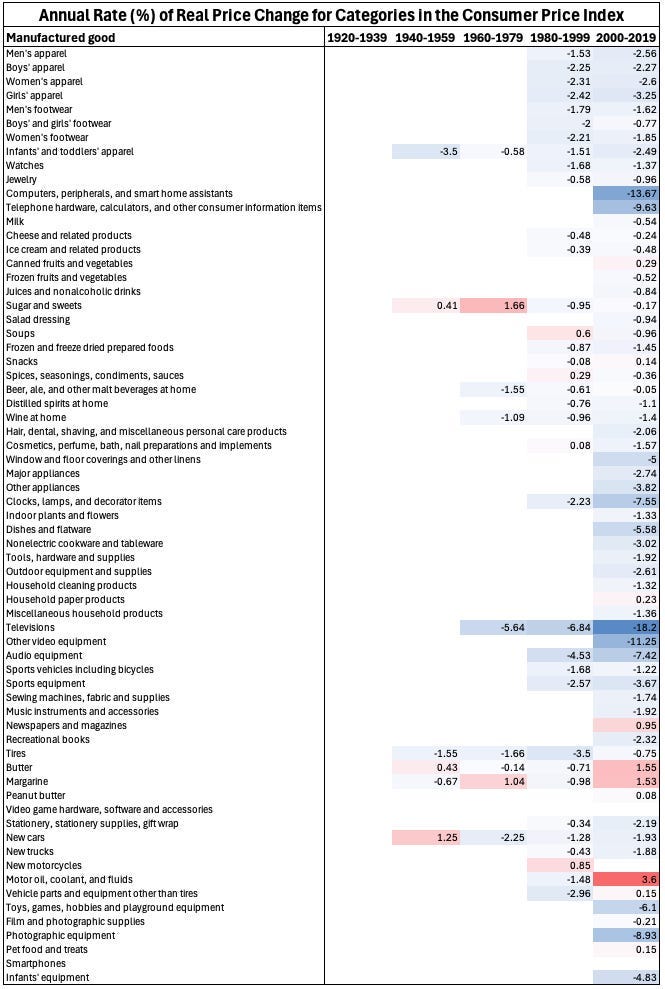
Notably, this shift to industrialized production isn’t dependent on the success of a single firm. Ford’s share of automobile sales peaked at around 60% of the US car market in the early 1920s, but by the 1930s it had fallen behind General Motors and Dodge, and by the middle of WWII the company “was on the brink of collapse,” to the point where the government considered taking it over. But even if Ford had gone out of business, the industry wouldn’t have shifted back to craft-methods of production. Similarly, a dramatic decline in the overall car market — car sales declined by about 75% during the Great Depression, and by nearly 50% following the global financial crisis — didn’t cause a shift back towards craft methods of production. Once industrialized production arrives, is benefits ensures that it sticks around even in the face of market downturns.
The promise of factory-based construction then, is that the new methods that are so superior, and result in such great decreases in cost while offering equal or even superior quality, that going back to the old methods is unthinkable, even in the face of major firm failures or market declines. People will often articulate other benefits of prefabricated construction, and these benefits are often real and valuable, but it’s the promise of durably improved efficiency and reduced cost that has continuously inspired enthusiasm for the concept.
A brief history of prefabricated homebuilding
The history of prefabricated construction dates back hundreds of years. In 1624, English colonists brought a prefabricated panelized house with them when they arrived at Cape Ann, Massachusetts which was disassembled and reassembled several times.
During the California Gold Rush of 1848, thousands of prefab homes were exported to California from the eastern US as well as England, France, Germany, and even China: by 1850, 5000 homes had been ordered and shipped to California from the New York area alone. In 1861, the lumber dealers Skillings & Flint patented a “portable house” made of panelized wood construction which could be erected in three hours, many of which they sold to the Union Army during the Civil War. In 1892, Ernest Hodgson began to sell prefabricated cottages made from wood panels, which the company continued to sell in one form or another until the 1970s.1
But it was really in the 1930s when the idea of prefabrication as a strategy for reducing the costs of building a home began to emerge. The ongoing Depression, and the high costs of housing, had put homes out of reach for many Americans. The success of mass production, or “Fordism,” in driving down the costs of cars inspired many entrepreneurs to try a similar strategy with homebuilding. An article in the Brooklyn Daily Eagle from 1935 noted that “mass production of prefabricated housing promises to revolutionize homemaking for the average family.” One early example was the Motohome, which debuted that same year as the “prefabricated house that comes complete with food in the kitchen.” Promotional material for the Motohome noted that other goods had become cheap thanks to mass production, and it was only logical to apply such methods to homebuilding:
THE greatest social and economic problem that has grown out of the depression has been the necessity of reducing the cost of homes to a price that is not out of balance with the price you pay for other necessities of life. Home building for years has remained on an antiquated basis. That is why the cost of homes has been going steadily higher and higher in relation to the cost of other things that have been lowered through the aid of mass production. It is obvious that by manufacturing homes on a mass-production basis, the cost can be brought down to a point where you may again afford to own your home and give your children their chance in life.
The Motohome was not particularly successful, selling only 150 units, and subsequent home designs from its manufacturer American Houses reduced the extent of prefabrication to “precutting [material] and partial preassembly of panels.”
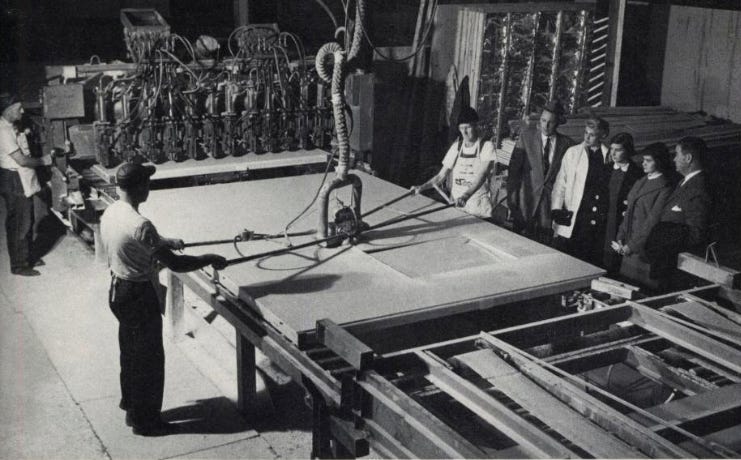
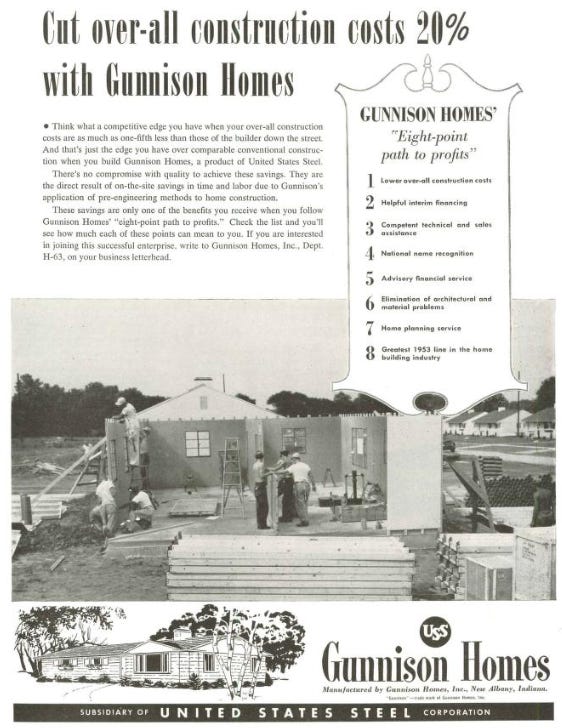
But other prefab companies found more success. In 1934, Foster Gunnison, a salesman of lighting fixtures, founded “Gunnison Magic Homes” (later shortened to Gunnison Homes), which aimed to “bring the full benefits of mass production technology to a backwards industry.” Gunnison hired manufacturing experts from car manufacturing, and developed a system of panelized construction using stressed-skin plywood construction (where the plywood exterior carries the weight of the structure, rather than wood studs) first developed by the US Forest Products Laboratories. Gunnison aimed to make his company “the General Motors of the homebuilding field,” and by 1944 Gunnison Homes’ factories were producing 600 houses a month. And in 1940, brothers George and James Price founded National Homes, producing prefabricated wood panel homes in their factory in Lafayette, Indiana. Within two years, National Homes had produced over 3600 homes. Overall, between 1935 and 1940 prefabricators produced an estimated 10,000 homes in the US.
Prefabricated construction gained further traction during WWII, when it was widely used to rapidly build homes for war workers moving into defense production areas. The 1942 Lanham Act authorized five manufacturers to produce 70,000 prefab homes for $153 million, and by 1943 there were at least 20 firms which had each manufactured more than 1000 houses, and several firms which were producing several hundred prefab homes a month. By the end of the war an estimated 200,000 prefabricated homes were built, roughly 12.5% of the 1.6 million homes built in America during the war.
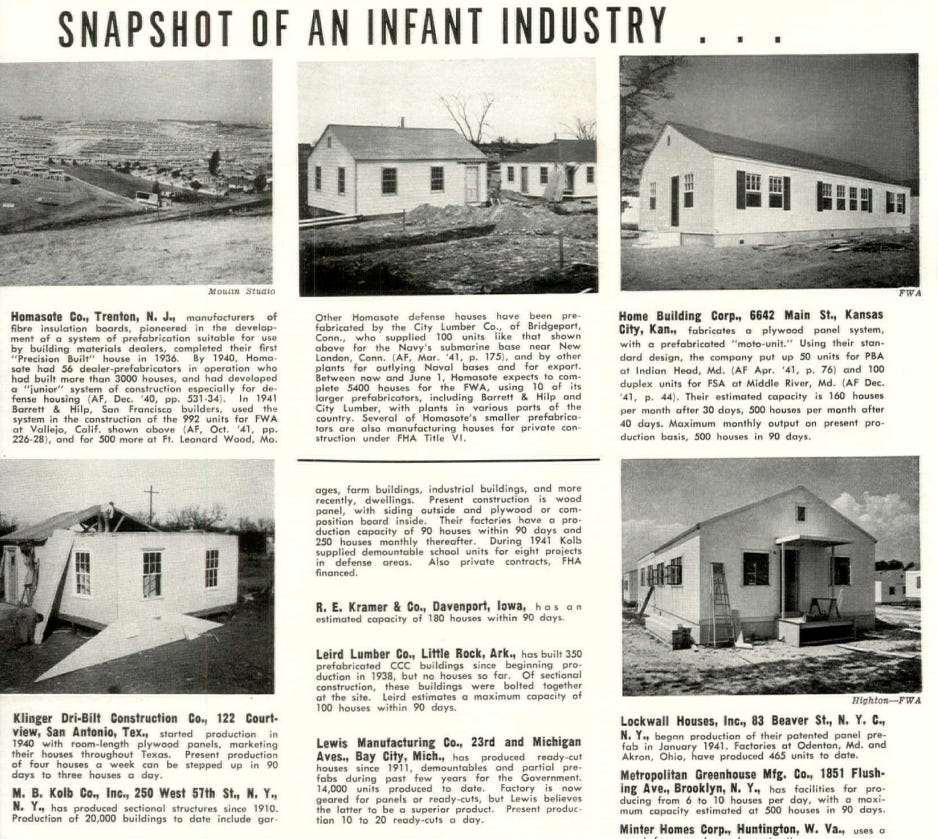
Following the war, US housing expediter Wilson Wyatt planned to use prefabrication to rapidly build large numbers of homes to address an “acute housing shortage”: 250,000 prefab houses were planned for 1946, and 600,000 for 1947. This didn’t come to pass — Wyatt resigned after less than a year, and the actual number of prefabs built in 1947 was around 25-35,000. But by the 1950s prefab construction was nevertheless beginning to carve out a meaningful, and increasing, fraction of the US housing market. In 1954 prefabs were around 5-8% of total single family home construction; by 1959 that fraction had risen to 6-12%.
Many of these prefab homes were mobile homes: permanently occupied travel trailers. But prefabricated construction of conventional homes was also becoming more popular. National Homes, in particular, became a force to be reckoned with in the prefab industry. In 1953 National Homes produced just over 14,000 homes, roughly 2% of all US houses built. In 1959, the company merged with seven other prefabricators, giving it a network of nine plants across the US (some of which it was eventually forced to divest thanks to an anti-trust lawsuit). In 1956 the company had produced its 100,000th home; by 1960, it had hit 200,000, and by 1963 a quarter of a million. Founder James Price had the audacious goal of being responsible for 50% of ALL US housing starts by 1975.
During the 1960s mobile homes, today known as manufactured homes, also began to rapidly gain in popularity. Mobile home sales rose from 90,000 in 1960 to nearly 600,000 in 1972, at which point there were mobile home factories in 45 states. By 1974, Skyline, the largest mobile home manufacturer in the US, was producing 50,000 homes a year, more than any other homebuilder, and the Mobile Home Manufacturer’s Association had become the world’s largest land developer as part of its efforts to build new mobile home parks. By the early 1970s, mobile homes along with other types of prefabricated, factory-built construction made up on the order of half (and possibly more) of all single family home construction.
But the early 1970s proved to be the peak of factory-built housing in the US. During the 1970s, many prefab firms went out of business or otherwise struggled. In 1972 the largest prefab factory in the US, owned by Behring Corporation, closed. Gunnison Homes, which had been purchased by US Steel in 1944, stopped producing homes in 1974. EL Hogdson similarly went out of business in the 1970s. National Homes entered a period of decline, losing $10 million in 1973 and $20 million in 1974, though the company managed to remain in business until the 1980s. Operation Breakthrough, a major government effort to kickstart large-scale production of factory-built housing, failed; despite $72 million in investment (plus millions more in Section 236 financing), 20 of the 22 building systems funded by Breakthrough were no longer being produced by the 1980s. Between 1973 and 1976 the number of mobile home factories in the US declined by nearly 40%, and the number of wood panel home factories declined by nearly 60%.
Since the 1970s, prefab has continued to gradually lose ground in the US housing market. Cardinal Industries, which was the largest prefab homebuilder in the US following the demise of National Homes, declared bankruptcy in 1989. By 1990, mobile homes (which had since been confusingly renamed “manufactured homes”) and other prefabs together were down to around 20% of the US single family home market, and almost certainly a much smaller share of the multifamily apartment market. Manufactured homes saw an uptick in popularity through the 1990s, buoyed by lax lending standards, but sales collapsed in the early 2000s as lending standards tightened and repossessed homes flooded the market. Other types of prefabricated homes declined significantly following the 2008 Global Financial Crisis.2
In the 2010s, there was a raft of US startups which spent enormous amounts of money to try and bring factory-based methods to homebuilding. In addition to Katerra ($2 billion), there was Veev ($475 million), Blu Homes ($217 million), Mighty Buildings ($100 million), Entekra ($75 million), and others. These companies all went out of business or otherwise failed (Mighty Buildings, for instance, pivoted to selling exterior cladding systems).
Today, prefabricated construction remains a small fraction of overall homebuilding in the US. For single family homes it’s around 10%, most of which are manufactured homes. For multifamily apartments, it’s roughly 3%.
Thus the lack of a robust prefab housing construction industry in the US is not for lack of trying. Many firms have taken swings at being the “Henry Ford” of housing: often these firms have been backed by very substantial investments, and many of them have produced thousands of homes. But none of them have catalyzed a transformation of the American homebuilding industry the way that Ford did for the car industry.
Prefab outside the US
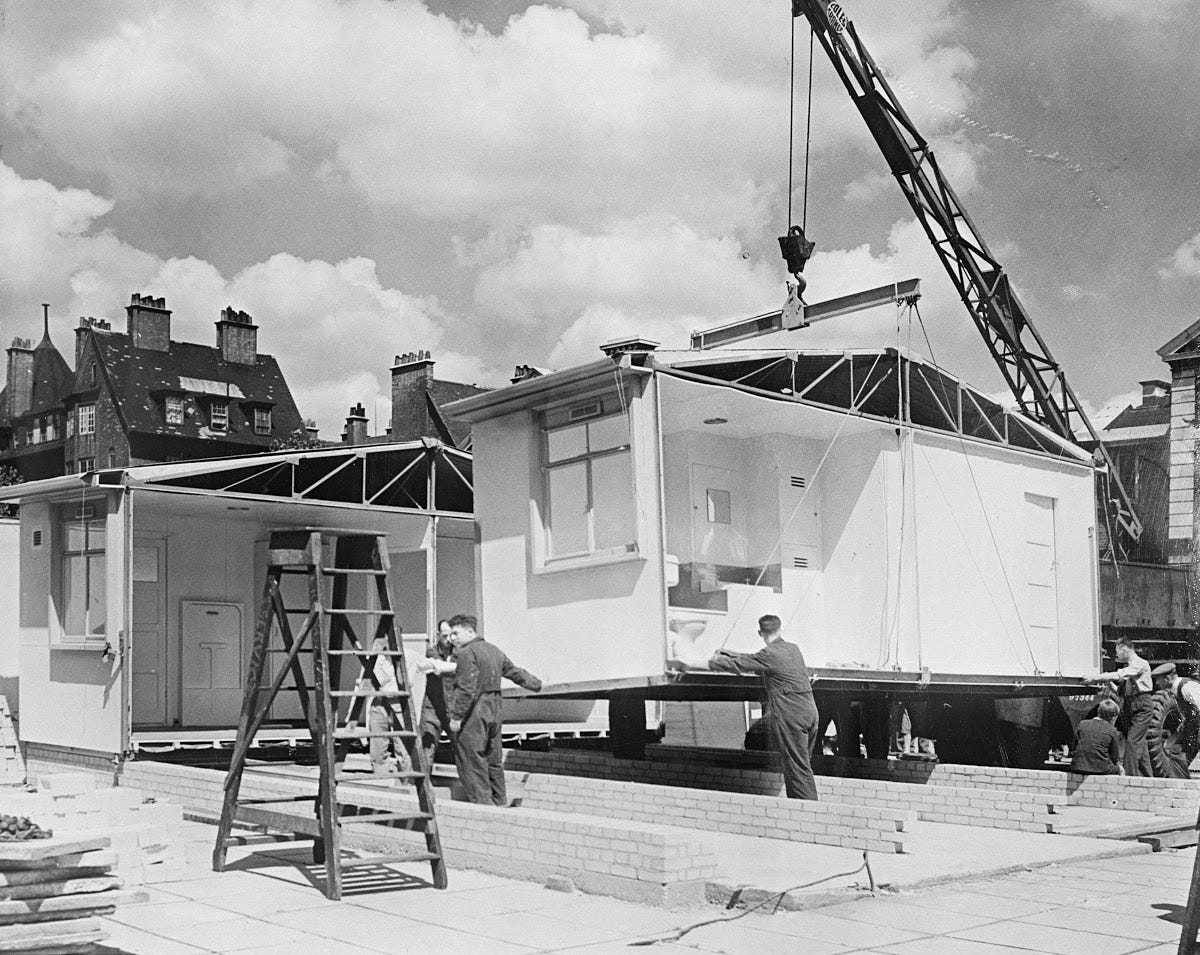
Prefabricated home construction has a similarly long history of use outside the US. In the UK, following WWII the government funded the construction of over 150,000 prefabricated homes as part of its “Emergency Factory Made” housing program. The most notable of these was the AIROH house, which was designed to make use of now-surplus aircraft manufacturing plants and the 100,000 tons of scrap aluminum that no longer needed to be turned into airplanes. Over 54,000 aluminum-framed AIROH houses were produced during the program, each one using two tons of scrap aluminum.
More recently, the UK government has poured enormous amounts of investment to encourage the adoption of prefabricated construction (what they refer to as “Modern Methods of Construction” or MMC). As in the US, this effort has been marked by numerous high-profile failures and bankruptcies. Tophat, a modular builder formed in 2016, secured over £160 million (~$215 million) in funding, then operated at a loss between 2020 and 2023 before declaring bankruptcy. Legal & General, a financial services company, formed a prefab homebuilding division in 2016; by the time it closed in 2023, it had lost £236 million (~$316 million). Ilke Homes, a modular homebuilder founded in 2017, closed in 2023 owning £320 million (~$429 million) in debt. Today, prefab construction remains a small fraction of the UK’s homebuilding industry, around 5-10%.
In Germany, prefab construction has had more success. Millions of precast concrete apartments were built in East Germany during the Cold War, and since the 1990s prefabricated construction (much of it using wood-panel construction) has gradually become more popular. From less than 10% of new housing units in 1990, prefab today accounts for more than 25% of new German homes.
Japan has similarly built large numbers of prefabricated homes. Prefabricated construction began to gain popularity in the 1960s, and by the 1970s Japan was producing over 100,000 prefabricated homes annually. Since the 1960s more than 10 million prefab homes have been built in Japan, and prefab makes up roughly 15% of the Japanese housing market.
But the country that has adopted prefabrication more than any other country is Sweden. Roughly 85% of single family homes, and 30-40% of multifamily apartments in Sweden are prefabricated.
It’s clear, then, that factory-based construction methods have been tried extensively, both in the US and around the world. It’s also equally clear that, in general, these methods have not displaced conventional construction. Outside of a few Scandinavian countries, prefabrication does not appear to be the primary method of homebuilding used in any major country.
Prefab’s record of cost savings
One major reason for the relative lack of success of prefab construction is cost. Unlike car manufacturing, where industrialized methods rapidly and dramatically reduced the cost to manufacture a car, the cost savings yielded by prefabricated construction have historically been much more modest, if indeed they’ve occurred at all.
The chart below shows the price per square foot of prefabricated homes built by different US manufacturers in the 1950s. It also includes the price per square foot of a typical conventionally-built US home in the 1950s.
And this chart shows the price per square foot of several prefabricated homes (not including land) circa 1947.
We can see that most prefabricated homes cost roughly as much, or more, than conventional construction. Only six of the 22 1950s homes have a lower square-foot cost than conventional construction, and none of the 1947 homes are.3 And the lower costs that do exist are somewhat modest, ranging from 5-20%. What’s more, some of this cost savings comes from prefabricated homes having fewer features, rather than any sort of factory-based productivity improvement. National Homes’ 1953 catalog, for instance, notes that to keep prices low, “certain minor features come to you unfinished.” The National Homes low-cost “Cadet” model didn’t include interior paint, had a concrete or plywood floor in lieu of things like carpet or tile, had no closet doors, and had no attic or garage (though a carport could be added for an extra fee).
Skipping ahead to the late 1960s and 1970s, we see a similar pattern. The 1969 report “Building the American City” from the presidentially-appointed Douglas Commission included a section on factory-based construction methods. It estimated the potential savings of a fully factory-built house as being around 16.5% when compared to conventional construction. Likewise, the 1975 publication “Good Shelter: A Guide to Mobile, Modular, and Prefabricated Houses” notes that in 1972 the average prefab home cost on average $9 to $12 per square foot. This is a substantial savings of 33-50% compared to the average cost of conventional home construction (around $18 per square foot that year), but it’s likely an outlier; the same publication gives prices of $18 to $20 per square foot for 1974, only slightly less than the average conventional cost of around $21 per square foot that year. A 1977 issue of the homebuilder publication “House and Home” gives a typical prefab house cost of $15 to $17 per square foot, plus the cost of shipping. This is substantially less than the typical conventional construction cost that year (around $29 per square foot), but that’s the cost the builder pays the factory, and doesn’t include any of the necessary site work (foundations, utilities), the cost to install or finish the home, or the builder’s profit margin. Once these are added in, the cost advantage becomes more marginal: the article notes that that price allows the builder to be competitive with conventional building methods, and offer some modest cost savings (which trades off against the reduced flexibility of prefab construction).4 It states that builders choose prefab to “get houses up quickly, or to sell in remote areas where assembling crews for conventional building would be difficult, or to control costs more accurately,” not for any major cost savings.
Operation Breakthrough, an ambitious government program to industrialize US homebuilding, provides another example of limited cost savings of prefabricated construction. Breakthrough began in 1969, and funded the development and construction of 22 housing systems (out of several hundred applicants) in the hopes that some of them would eventually achieve true mass production. Several thousand Breakthrough housing units were constructed at demonstration sites around the country, and HUD financed the construction of tens of thousands more under its Section 236 program for low-income housing.
As part of the program, the housing system producers estimated the cost of the systems they were developing. Only 5 of the 22 systems estimated their costs would be less than conventional construction, and once again these estimated savings were modest, on the order of 5 to 20%. And it seems unlikely that in practice these savings were achieved: the government paid tens of millions of dollars to the demonstration site developers to cover the excess costs of the housing systems beyond their market value, and by the 1980s 20 of the 22 housing systems (including every “low cost” system) were no longer in production.
By the 1980s, US prefab homebuilders had largely given up trying to compete by offering low-cost homes, a segment which was increasingly dominated by mobile homes. From a 1981 article in House and Home:
Ten years ago, [factory-built housing’s] banner had been “affordability,” and it had cultivated the image of an industry about to spark a revolution that would stand the conventional housing industry — slogging along with supposedly antiquated building methods — on its ear.
That revolution never came…
The sentiments expressed by John Baxter, manager of operations for Boise Cascade, are typical of how the industry sees itself now. “Modular housing is not going to be the answer for affordable housing in the next ten years,” says Baxter. [National Association of Home Manufacturers’ John] Kupferer agrees, and gladly passes the affordability banner on: “Mobile homes really have the answer when it comes to affordable housing.” And instead of that revolution, Kupferer sees modular’s share of the housing market growing via evolution.
The thrust of this evolution, says Kupferer, is that “dollar for dollar, you get much more value in a manufactured house.” There will be no more trying to stress a lower cost-per-square-foot than conventional builders: “We never say we can beat the other guy’s price. We don’t want to be known as the cheaper house.” (house and home march 1981).
The trends of prefabricated construction offering modest, if any, cost savings continued into the 1990s. A 1991 article on Utah prefab homebuilder Valgardson Housing System gives its costs per square foot as around $44, around a 19% savings compared to average conventional construction costs that year (deseret news, census). A 1998 HUD/NAHB study comparing conventional and factory-built homes found that a factory-built house would cost around 15% less than an equivalent conventional, site-built house.
This state of affairs continues today. Successful prefab homebuilders in the US rarely tout their cost savings, and instead emphasize benefits like faster build time or higher quality. High-end prefab homebuilder Bensonwood states on their website that “[a]pples to apples, we build a more consistent, higher quality product for less money than can be built with conventional construction methods. We are not, however, price-competitive with stick-built homes built to code-minimum levels.“ Vaughan Buckley, the CEO of modular multifamily builder Volumetric Building Companies, noted that cost savings of prefab was on the order of 5 to 10%, and that “It’s not a huge swing in cost that our clients typically seek modular for. It’s the reduction in schedule.” The founder of prefab design firm CleverHomes stated that “while there can be some savings with modular prefab construction, the more substantive benefits are the predictability of budget and process, the quality control, the speed of construction.” Derrick Seitz of construction management firm Windover construction stated that “[o]ne thing we always make clear at the forefront with clients considering modular is that the construction costs are the same as conventional methods.”
Outside of the US, we see the same thing. Sweden, as we’ve noted, has adopted prefabricated construction more than almost any other country; 85% of single family homes, and 40-45% of multifamily apartments in Sweden are prefabricated. But this hasn’t yielded low housing costs. Per Statistics Sweden, in 2023 the average price per square foot for a new single family home in Sweden was more than 70% higher than the average price in the US. And over the last 25 years construction costs and housing prices in Sweden have risen roughly as fast as they have in the US and above the level of overall inflation, rather than less than inflation like other manufactured goods.
In a New York Times article about Swedish prefabrication, Stefan Lindbäck, an executive at Swedish multifamily prefab company Lindbäcks admits that their construction costs aren’t lower than conventional builders, but suggests that they make up for it in other ways:
Building quality homes, whether on-site or off-site, will never be cheap. You don’t want to scrimp on materials or labor, and the savings of factory-built homes might not be obvious at the start, Lindbäck told our group. A conventional builder might bid lower than Lindbäcks, but then there are the costs of supervising the construction on-site and paying for delays in interest charges. And conventional builders profit from changes late in the process.
With factory-built houses, modifications are minimized because customers generally select from a standardized framework and changes are allowed only up to a certain point. The factory builder’s advantage is quality control and speed. Real profit, long-term profit, comes from streamlining the building system for predictable outcomes and fast delivery.
Similarly, Germany’s prefab home portal Fertighaus.de notes that “which construction method is cheaper, prefabricated house or solid house [on-site concrete or masonry construction], then the answer for an equivalent design is: None.” German homebuilding platform Massivehaus.de asks: “Is a prefabricated house cheaper than a solid house? In short: no. Prefabricated house prices as well as those of solid houses exist in a wide variety of levels, and none of the construction methods can be assessed as cheaper or more expensive today.”
German prefab homebuilder HUF HAUS likewise lists the advantages of choosing prefab construction, but these advantages do not include “lower price;” instead they are things like short construction time, energy efficiency, and a guaranteed fixed price.
In the UK, the CEO of prefab builder Vision Modular noted in 2023 that what drove demand for factory-built construction methods was “certainty of cost, of programme and of quality”, as well as sustainability and ESG requirements — not any cost savings. The numerous failures of various UK factory-built housing producers likewise suggests an inability to achieve any sort of major (if any) reduction in building costs. When the Swan Housing Association closed its factory in 2022 after five years of operation, it noted that “it is simply not financially sustainable to continue to build homes using modular construction, with Swan’s factory having been running at a loss.”
In Japan, the trajectory of prefabricated construction mirrors that of the US: an initial focus on using factory methods to achieve low costs, followed by a pivot to focusing on higher quality when that strategy failed. A 2003 study of Japanese prefabricated construction noted that:
During the 1960s and 1970s, Japanese housing manufacturers focused solely on the ‘mass production’ of their products, resulting in a supply of virtually identical, rather monotonous houses. Due to the ‘inferior’ image associated with the low-quality appearance of these houses, the public immediately rejected them. Since then, manufacturers have placed greater emphasis on improving industrialized housing quality…
The same paper notes that as of 2000 per-square foot costs of prefabricated construction in Japan were on average 8% higher than site-built construction. Likewise, the Japanese homebuilding platform japanese-architects.com notes that the least expensive method of building a new home is typically local, on-site builders, rather than prefabricated construction.
Toyota is an illustrative Japanese case. In the 1970s, in an attempt to apply its manufacturing expertise to other industries, Toyota formed a prefabricated homebuilding division, Toyota Home, which still exists today. But while Toyota’s manufacturing expertise, and its low-cost, high-quality cars, allowed it to become the largest automaker in the world, it hasn’t had the same success in homebuilding. Toyota Home has consistently been a minor homebuilder in Japan, and like other prefabricators it seems more focused on delivering high quality than on achieving low price (unlike with car manufacturing, where it successfully achieved both). In 2008 Toyota’s home prices ranged from $200 to $300 per square foot, far more than average prices in the US that year (around $90 per square foot per the US Census).
When there is cost savings, it’s often because a prefabricator can locate their operation in a place with low-cost labor, and ship it to a place with high-cost labor. Modular manufacturer Autovol is able to manufacture modules in their Utah factory (where labor costs are low), and ship them to California (where on-site labor costs would be high). Stack Modular uses a similar business model, manufacturing modules in China and shipping them to the western US and Canada. But this requires a substantial labor price differential, and the high costs of transporting large, bulky prefabricated building components means that there’s a limited number of places where this strategy works.
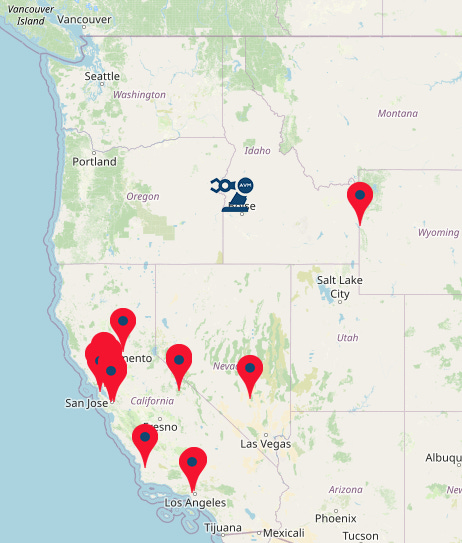
Thus wherever and whenever we look, we generally see the same story: factory-based homebuilding yielding at best relatively modest cost savings, and often no savings whatsoever. This is what we see in the US historically, it’s what we see in the US today, and it’s what we see in countries around the world.
Manufactured homes and cost savings
The biggest counterexample to this general trend that I’m aware of is manufactured homes, formerly known as mobile homes. Mobile homes were originally camping trailers, but over time have evolved to more closely resemble conventional homes, and today’s manufactured homes can be hard to distinguish from site-built homes at first glance. Unlike other types of housing in the US (including other types of prefabricated housing), manufactured homes don’t conform to local building code requirements, but instead follow a federal code authored and administered by HUD.
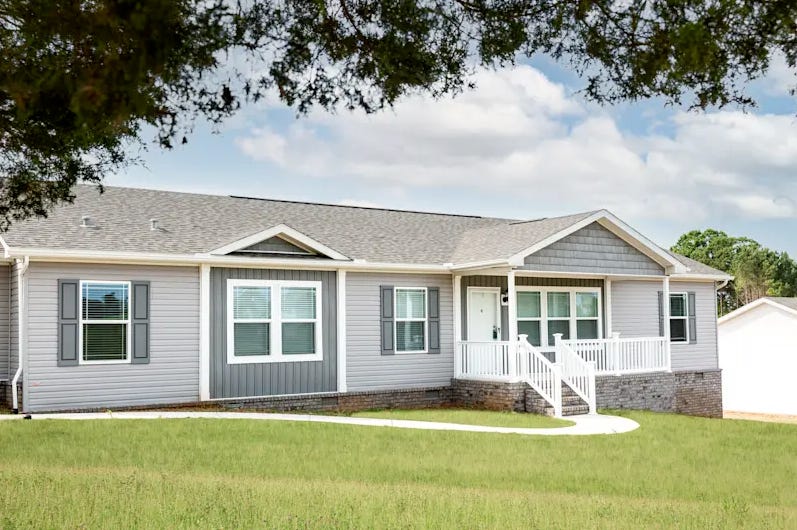
Unlike other types of prefabricated construction, manufactured homes have consistently been substantially cheaper than conventional construction. The cost of a “single-wide” – a manufactured home that comes in a single unit — has generally been 55-65% less per square foot than the cost of a conventional home. “Double wides” — larger manufactured homes that consist of two units stitched together — are somewhat more expensive, but still dramatically less than conventional single family homes.
Do manufactured homes show that factory-based construction can, in fact, yield substantial cost savings?
One challenge when comparing the costs of manufactured homes and conventional homes is properly adjusting for differences in quality. Historically, manufactured or mobile homes were of lower quality than conventionally built homes, both in their performance characteristics and the level of interior finish. Prior to the introduction of the HUD code in the 1970s, for instance, mobile homes were sometimes known as “ten second trailers” because of how quickly fire would spread in them. Ralph Nader’s Center for Auto Safety published a book in 1975 called “Mobile Homes: the Low Cost Housing Hoax,” documenting various deficiencies of mobile homes, such as leaky pipes, bowing walls, and faulty wiring and HVAC systems.
The quality of modern manufactured homes is far higher than it was historically, but there are still performance and finish differences in manufactured homes as compared to conventional homes. For instance, manufactured homes will often use vinyl-on-gypsum (VOG) panels with visible seams for the interior, rather than higher-quality (but more expensive) drywall, and manufactured home energy efficiency requirements are far less than conventional home construction.
Determining the extent to which factory efficiencies are behind manufactured homes low costs requires adjusting for these sorts of performance and interior finish differences, and comparing a manufactured home to a similarly-specced conventional home. This sort of comparison was done in a 2023 study by the Joint Center for Housing Studies at Harvard. The study compares the costs of a single-wide, double-wide, and conventional house which each have similar numbers of bedrooms and bathrooms, interior and exterior finishes, appliances, and HVAC systems. The study also included the costs of a CrossMod, a relatively new category of manufactured home designed to be similar enough to conventional site-built homes that it is eligible for Fannie Mae financing. CrossMods have permanent foundations, more stringent energy efficiency requirements, higher quality interior and finishes, and features like porches or garages.
Per the study, single-section manufactured homes ranged from 35-47% of the cost of a conventional home, depending on the region of the country where they were built. Double-sections ranged from 60-64%, and CrossMods, which are the most similar to a conventional home, ranged from 73-80%.
However, even this comparison does not fully account for quality differences between manufactured homes and conventional, site-built homes. The adjustments made in this study do not include any differences in code requirements, which include things like higher energy efficiency. Even the more stringent energy efficiency standards of the CrossMod are lower than conventionally-built home requirements, and the requirements for single and double-wides are lower still.5 The study also does not include any differences for things like wind speed design, which in many areas will be substantially higher for conventional construction. But these differences, while real, are likely relatively minor in terms of added cost, and are probably only responsible for a fraction of the cost differences between manufactured homes and conventional construction.
Another important factor when analyzing the cost of manufactured homes is how those costs have changed over time. We noted earlier that most manufactured goods typically rise in price less than overall inflation over time. However, this is not true with manufactured homes, which rise in price at roughly the level of overall inflation.6
So despite being factory-produced, manufactured homes do not see the same sort of cost trajectories as other manufactured goods — their cost trends look much more similar to those of conventional construction.
Overall, manufactured homes show that factory-based construction can, in certain cases, yield substantial savings over conventional construction. Even taking into account quality differences, a single-wide manufactured home is probably on the order of 40-50% cheaper than an equivalent site-built home. But manufactured homes also show us the limit to these sorts of factory savings. The greatest savings in manufactured homes are achieved with single-wide construction, when the entire house can be delivered as a complete, single unit, minimizing on-site work and eliminating any difficulties from breaking a home into multiple parts. But this is only feasible for homes small enough to be shipped in one piece. As you move away from this to larger and more complex homes, the cost savings of manufactured homes get eaten away: double section homes have less cost savings than single-wides, and with CrossMods — the homes that are most similar in features and performance to conventional construction — we approach the 15-20% “best-case” savings that we see with other forms of prefabricated homebuilding. And the fact that the cost trajectory of manufactured homes looks more like conventional construction than it does for other manufactured goods suggests that even with manufactured homes, factory-based construction hasn’t been an unlock for sustained productivity improvements.
Conclusion
The history of prefabricated construction is remarkably consistent. Cost savings of moving to factory-based production for homebuilding have consistently been much less (5-20%) than many practitioners hoped for, given the enormous reductions in cost that were achieved for things like car manufacturing. Often savings fail to materialize at all. Exceptions to this do exist, in the form of things like manufactured homes, but they serve as much as an illustration of the limits of factory-based homebuilding as they do its potential. Though many have tried to claim the mantle of “the Henry Ford of housing,” none have yet matched Ford’s achievements of transforming a craft-based industry into an industrialized one, driving down prices in the process.
This doesn’t mean that industrialization of homebuilding, or of construction more broadly, is a doomed enterprise. But they do show that it’s an enormously complex problem. The long history of prefabricated construction shows that we can’t merely move the construction process into a factory and expect enormous productivity improvements and massive reductions in cost. The problem must be tackled at a lower level of abstraction — understanding, what, specifically, is changing when a process moves from craft to factory production, how those changes result in productivity improvements and decreases in cost, and figuring out how we might apply those sorts of changes to the construction process.
One source claims that Hodgson sold 100,000 homes by 1942, but this seems like it must be an overestimate.
Mobile homes may have also declined following the GFC due to lower interest rates.
And its possible that costs are even higher than listed here, as for many of these houses its unclear if the price includes the lot. I’ve assumed that it does to be conservative, but if it didn’t, and only included construction costs, things would look even worse for prefab.
The article notes that that price allows prefab builders to “compete quite handsomely with the small stick builder, even allowing a price cushion for the relative inflexibility in design and plan.”
CrossMods can meet energy efficiency requirements by conforming to the 2009 International Energy Conservation Code (IECC), but most states have adopted newer and more stringent versions of the IECC. Regular manufactured homes are even less energy efficient than CrossMods.
We see similar trends in other areas of factory-based construction outside of homebuilding. The least expensive way to build a parking garage, for instance, is using precast concrete (concrete components which are cast in a factory and then delivered to the jobsite and lifted by crane into place). But the cost-per-parking space of a precast parking garage has risen roughly at the level of overall inflation.
Thank you for an interesting article!
Sweden and Finland have huge forestry sectors, with many local prefab industries having evolved near sawmills to capture more of the economic value. With the huge efficiency gains in forestry there has been a surplus of labor and cheap production facilities in these more rural areas.
It is also a mature industry. My parents prefab manufacturer was established 80 years ago. I’d say there are 10 or so strong brands that capture 50% of the market for single-family homes. That is were you start looking if you think of building a home. Different brands have different constructions imprinted in people’s mind. You don’t contract an architect, you browse a prefab brand website that suits your preferences. Or you might go for the same as your parents did when you grew up.
Another custom which might be unique to Sweden and Finland is to build the house yourselves to various degrees, as it was done traditionally. You order the house from the well-known prefab company that deliver all materials by truck, the prefab company has hired local building contactors to do the time critical assembly of the outer shell to get a weather proof frame. Your contract is with the prefab company and the construction is guaranteed by the prefab company. You don’t have to get to know and trust a local contractor that might go out of business. The rest of the assembly can be left to the home owner to do themselves in their spare time to save on cost, material and building plans delivered and code compliant for ready-to-stanp approval of the authorities. My parents did this 45 years ago while working jobs and raising kids. Doing the DIY route without help from a prefab company is out of reach for most.
Prefab companies also have a very optimized marketing and purchasing process to decide various options, mostly done online. None of my friends or family has hired an architect and then hired a builder. Prefab houses dominate. It is not due to cost primarily I think. A customer will not shop around for the cheapest option, rather go for the safest and most friction-less option for a once in lifetime investment.
The Swedish (Finnish?) prefab industry is worthy of a case study in itself! Wanted to illustrate with one local (small) prefab company from which a friend recently bought a garage/shop that he mostly raised himself. Pay attention to the online 3D CAD construction/customization tool, with on the fly cost calculation.
Lövångers Bygg
https://lovangersbygg.se/
I suspect that one of the hidden costs of home construction, which is differentially impacting prefab more than manufactured housing, is the complexity of local zoning ordinances.
Manufactured housing is manufactured to occupy lots that are effectively pre-negotiated with local residential zoning authorities. The number of variables left to negotiate and reconfigure to make a particular manufactured home development work is relatively small.
With prefab, the complexity explodes multiplicatively into the same range as regular home construction. Whatever savings there might be labor less the cost of transportation from where the labor is cheaper to where the home is assembled is more than offset by the increased cost of negotiating with local zoning authorities in order to complete the project.
The hypothesis then is that it's the cost of understanding and demonstrating compliance with local ordinances (and, where necessary, negotiating variances) that has prevented prefab from taking off, not the labor and materials that are holding up the projects. It's not a technology problem, it's a human nature problem.
An interesting corollary is that AI may reduce the search and translation costs of compliance with local zoning ordinances. Previously, it would have been completely infeasible to pay humans to try and figure out how a prefab housing plan might be compatible or incompatible with 100s or 1000s of different local zoning requirements. We can do that now. But note that the demonstrating compliance and/or negotiating for variances remains what it has always been.
This is a manifestation of what I have been calling the "synchronization tax" — effectively an extension of Coases's transactions costs to account for the costs of establishing a mutual understanding, which fundamentally requires counterparties to rewrite their descriptions of themselves and the world.