

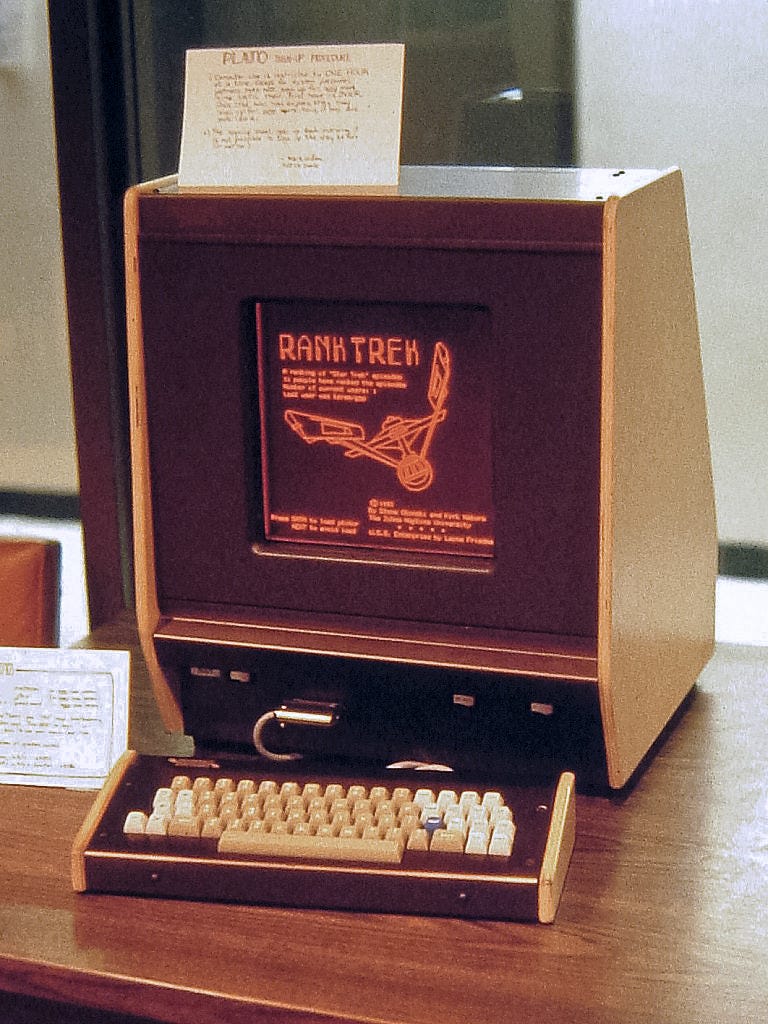
In 1960, a team at the University of Illinois released the first version of their PLATO “computerized instruction system,” a network of what would eventually be thousands of computer terminals connected to large mainframe computers. Users of PLATO could use the system to learn about various topics, with courses on subjects such as chemistry, math, music, and foreign languages.
The first iteration of PLATO used a simple TV screen for a terminal display, but this was at best a stopgap measure. TV screens used cathode ray tubes (CRTs), which used a magnetically deflected beam of electrons to paint an image on a glass screen. This beam redrew the entire screen 30 times a second, which meant that a computer had to feed the CRT screen a constant stream of high-bandwidth video data. This was fine for broadcast TV, since the same signal was being sent to every TV that received it, but on the PLATO system every terminal needed to be sent different data, depending on what the user was doing. Not only would this require high-bandwidth data connections between the mainframes and the PLATO terminals, it would force each terminal to have a large amount of memory storage to hold the video data, which at the time was extremely expensive. CRT-based screens worked well enough for a small system with a few terminals, but it was felt that the technology wouldn’t scale to the thousands or millions of terminals the PLATO designers envisioned. What was needed was a new type of screen, one that had a built-in “memory.” On such a screen, only the things that changed on the screen would need to be redrawn, which would dramatically reduce the bandwidth and data storage such a screen required compared to a CRT.
Donald Bitzer, one of the architects of the PLATO system, considered possible methods that might be used to make such a display. One potential option was gas plasma — running an electric current through a low-pressure gas, which would cause that gas to glow. Scientists had been making low-pressure gases glow using electric current since the 1600s, and the phenomenon had been used in neon signs since the early 20th century. But no one had yet found a way to turn the phenomenon into a computer display, which would require an array of thousands or even millions of independently controlled tiny gas plasma lamps, one for each pixel on the screen. Bitzer decided it was worth trying.
In 1962, Bitzer’s graduate student Robert Willson built a one-cell model of a plasma display screen, the equivalent of a single pixel. It consisted of a “sandwich” of three thin sheets of glass, with wires on either side of a tiny pocket of argon gas contained in a hole in the middle glass sheet. When electric current ran from the wires through the gas, the argon would glow brightly. Willson’s model suggested that a plasma screen might work, but also that there were many problems that needed to be overcome: the brightness of the cell was inconsistent, components burned out quickly, leaks were rampant, and over time the electricity-excited gas would deposit itself on the electrodes, reducing the flow of current. Willson’s design also required each individual cell to have its own resistor to prevent an electric arc forming between the electrodes, which was projected to add significant manufacturing difficulties on a full-sized display: a 500x500 pixel screen would require 250,000 individually attached resistors.
A breakthrough occurred in 1964, when Bitzer’s team had the idea to move the electrodes to the outside of the glass sandwich, which eliminated the need for a separate resistor. When building a test display of the new model, the team made a serendipitous discovery: a small amount of air accidentally introduced into the cell gave the display the sought-after memory effect: the gas would continue to glow even when the voltage at the electrodes was reduced. By 1967, the team had scaled up their single-pixel display to a 16 by 16 array of pixels (weber 2006), but this was still little more than a fragile prototype: leaks and contamination remained common, and the extremely thin sheets of glass (originally used for microscope slides) broke easily.
In 1967 Owens-Illinois, a glass manufacturer, licensed this technology, known as a plasma display, and began working to turn it into a real, practical product. Owens-Illinois eliminated the middle sheet of glass and the individual gas-filled pockets along with it, and simply filled the entire space between the two outer glass sheets with gas. Even though the gas within the panel was continuous, it would only glow at the intersection of charged electrodes, allowing individual pixels to be controlled. In 1968 Owens-Illinois debuted a 128 x 128 pixel plasma display, far sturdier and more reliable than the University of Illinois prototypes, and in 1971 the company shipped the world’s first commercial plasma display panel, a 512 x 512 screen dubbed the “Digivue.” The PLATO system, which would shortly be scaled up to thousands of terminals worldwide, was its first customer.
But the newly released plasma screen wasn’t alone in the market for electronic displays. The plasma screen had originally been conceived as an alternative to CRT screens and the bulky and expensive external memory they required. But memory technology wasn’t standing still either: in the late 1960s, as Illinois researchers were building plasma screen prototypes, researchers at IBM developed DRAM, a type of computer memory that stored data using transistors and capacitors. Computer memory was soon being pulled along by Moore’s Law, getting smaller, faster, and cheaper with every generation, and before long the memory requirement for CRT screens was a minor concern.
Plasma screens did have other advantages, beyond the way their physical properties enabled a kind of “memory.” Unlike a CRT, which required a bulky glass tube, a plasma display could be made extremely thin. And plasma screens could potentially be much more rugged than CRTs, which had fiddly and easily disrupted electron guns.
But plasma screens also had drawbacks: they were very power hungry compared to CRTs, weren’t as bright, and were far more expensive. And while Illinois researchers tested a color plasma screen in the late 1960s, it would be many years before a color plasma screen robust enough to be commercialized was developed.
What’s more, plasma wasn’t the only new display technology that appeared in the early 1970s. During the 1960s, scientists at Westinghouse and RCA had experimented with displays based on liquid crystals: substances that were liquid but displayed organized, repetitive structure like a crystal. Liquid crystal molecules were found to change their orientation when an electric field was applied to them, and if polarized light (light oscillating within a single plane) passed through a liquid crystal, its plane of polarization would rotate. By the late 1960s, researchers had used these phenomena to construct a display. The first liquid crystal display (LCD) screens appeared in calculators and other small electronic devices in the 1970s, and by the 1980s were being used in portable TVs.
Plasma didn’t slow down either. Over the next several decades, plasma display technology steadily improved. Engineers developed better electrodes, reduced power consumption, and invented a method for creating grayscale by rapidly flickering the pixels off and on (the more a pixel was “off,” the darker the pixel). Grayscale, in turn, opened the door for full-color plasma displays, and these began to appear in the late 1970s.
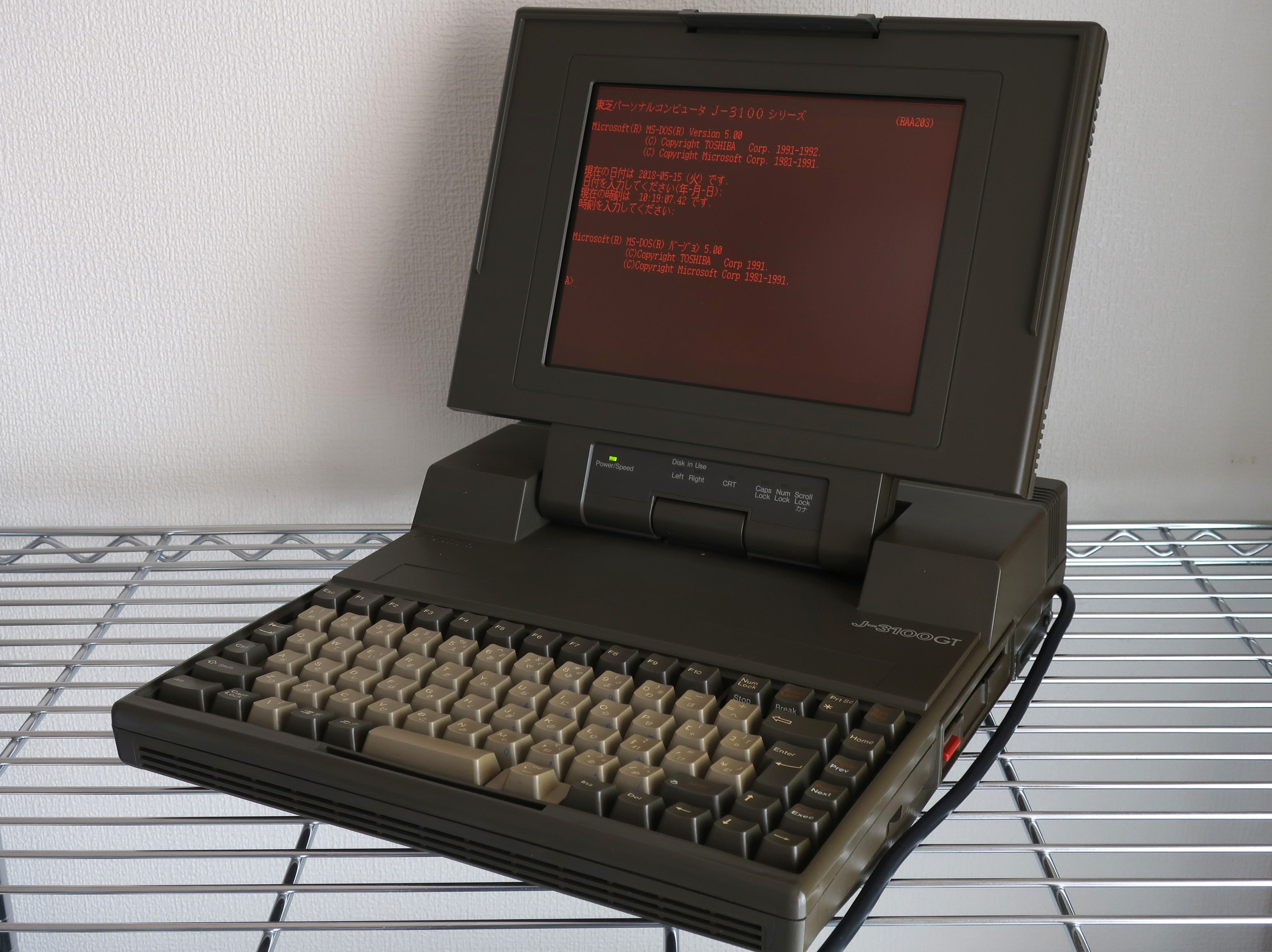
As their capabilities improved, plasma displays began to carve out a small niche in the electronic display market. IBM introduced a line of electronics for banks with plasma displays in 1973, and in the mid-1970s plasma displays began to be used for various military applications thanks to their rugged, low-maintenance designs. In the 1980s, laptops and portable computers with monochrome plasma screens began to appear. By the 1990s, however, LCD technology had advanced to the point where high-quality color screens could be made for laptops, entirely displacing plasma from that market.
As it was forced from the laptop display market, plasma was finding success in a new market: large-screen, high-definition televisions. Up through the 1990s CRT had been the standard technology used to make TVs, but the size of the tube required made it difficult to scale CRTs up to very large screens of 40 inches or more: when Sony introduced a 45-inch CRT TV in 1988, it weighed over 400 pounds. Thinner plasma screens, by contrast, could more easily scale to very large screens. Japanese electronics manufacturer Fujitsu demonstrated a 31-inch plasma TV in 1990, and then a 42-inch plasma in 1995. US display startup Plasmaco debuted a 60-inch plasma screen in 1999, and Samsung displayed an enormous 102-inch plasma screen in 2005.
However, LCD was entering the large-screen TV market at the same time, and by the early 2000s LCD manufacturers were making screens of similar size as plasma screens. Plasma had some advantages over LCD TVs — they could offer richer colors and higher refresh rates — but also some disadvantages. Plasma screens consumed more power, put out more heat, and were less bright than LCD screens. And for a given screen size, an LCD screen could be made much higher resolution than a plasma screen.
But the most important issue was likely manufacturing: it proved harder to achieve high yields and low manufacturing costs with plasma screens than with LCD screens, possibly because manufacturers invested far more in LCD manufacturing than they did plasma.
By the mid-2000s, plasma’s screen quality advantages had either been whittled away or simply gone unnoticed by most consumers: in 2006 reviewers found them roughly equal in quality, and LCD was significantly outselling plasma screens. Plasma and LCD battled over the TV market through the early 2010s, but by 2013 plasma had lost nearly all its market share. By the end of the 2010s, plasma screen manufacturing had essentially ceased, and today the technology is all but dead.
The classic pattern of new technology adoption is something like an S-curve: it starts out serving niche uses for users who need its particular combination of attributes, but as the technology gets more capable and less expensive, it gets adopted more broadly, until it reaches some particular peak. When a technology gets replaced, in turn, it tends to follow this pattern in reverse, getting removed from more and more uses but continuing to be used by users who value its particular combination of attributes. Sometimes this combination allows an “outdated” technology to continue to be used far into the future; vacuum tubes were replaced by the transistor for most uses decades ago, but they’re still manufactured today for use in certain audio equipment. But sometimes this isn’t enough to save a technology; while some folks prefer the look of plasma screens, this preference evidently wasn’t enough to maintain production of it.
Thanks for this. I read the popular history book on PLATO when it came out 8 or 9 years ago... http://friendlyorangeglow.com/ . I think often about it, in particular as the homebrew 'cybereck' scene has expanded in recent years. The PLATO tech stack and vision was very impressive and worthy of study / emulation in todays age.
The useful detail is that the display was commissioned for a teaching terminal network that never reached the scale it was designed for. The technology outlived its justification by decades, then lost to a format whose factories had already been paid for by a different product. Which one wins is mostly a question of who else financed the capacity first. Performance arrives late to that decision.