

Can We Lower Construction Costs with Cheaper Labor or Materials?
Last time in our series on the nature of the construction productivity problem, we looked at economies of scale, finding that capturing economies of scale in homebuilding is difficult. Economies of scale primarily operate on the difference between the costs of the material inputs to some process and the cost of the final product. With housing construction, this ratio is already pretty low, not much higher than what we see in high-volume manufacturing industries that already maximize these kinds of cost advantages, such as the auto industry.
There is, however, another possible route for reducing construction costs: reducing the costs of the inputs directly, either by using cheaper inputs (less expensive materials or labor) or by using fewer inputs. To use a baking analogy, capturing economies of scale is like improving the efficiency of baking cakes by making them in a high-volume, industrial bakery instead of your home kitchen. Reducing the input costs is more like changing the recipe of that cake to require cheaper/fewer ingredients.
For housing construction, we can broadly categorize the inputs to construction as either materials or labor. (There are also equipment/machinery costs, but these are a very small fraction of housing construction costs.) Reducing the cost of labor inputs is difficult, for the simple fact that conventional construction is done on-site, limiting the ability to use cheaper pools of labor. Reducing the cost of material inputs appears somewhat more viable in theory (at least for some materials), but a variety of barriers make actually doing so difficult in practice.
Finding cheaper construction labor is hard
Historically, manufacturers have reduced their labor costs by moving their operations to places where labor is cheaper. As I note in “The Origins of Efficiency”:
Garment manufacturing, for example, has proven resistant to automation and remains a labor-intensive industry. As a result, garment manufacturing operations tend to continuously relocate to sources of low-cost labor (which are often, not unrelatedly, places with poor working conditions). By the late 19th century, New York City had become one of the largest garment manufacturing centers in the world, such that in 1890 New York made 44 percent of the ready to wear clothes produced in the US. But by the 1920s, the industry had begun to move where labor was cheaper — first from Manhattan to Brooklyn and New Jersey, then to New England, then, as the interstate highway system developed, to the South, and, finally, overseas. Similarly, Nike began importing footwear from Japan in the 1960s, then began manufacturing its own shoes in Japan in the 1970s. As labor costs in Japan rose, Nike shifted production operations to Taiwan and Korea, then China, then Vietnam and Indonesia. There have been similar shifts in other labor-intensive industries, such as shipbuilding (which moved from the UK to Japan, then to South Korea, then to China), as well as toy manufacturing (which moved from the US to Japan, then to Hong Kong, then to China).
This strategy, however, is difficult to pursue in construction, for the obvious reason that conventional construction is done on-site and can’t be relocated to where labor happens to be inexpensive.
A relocation strategy does become available if your construction is prefabricated, but this introduces new complications, notably the high costs of transporting prefabricated building components. As we’ve previously noted, most prefabricated construction is produced in distributed, relatively small-volume factories located to minimize transportation distance. (A common limit, noted by several manufactured home producers, is 500 miles, about the maximum that a truck can drive in a single day.)
There are labor cost differentials in the US, and modular builders do indeed locate their operations to take advantage of them. If we use RSMeans City Cost Index values for “installation costs” as a proxy for construction labor costs, there’s a roughly 2x cost difference between the 10th percentile city and the 90th percentile city.1 Modular builder Autovol fabricates its modules in Nampa, Idaho, and ships them hundreds of miles (far beyond the typical 500-mile limit) to Los Angeles and the Bay Area, where labor costs are far higher. Stack Modular builds its modules in China and then transports them to West Coast building projects using bulk carriers. Volumetric Building Companies has similarly noted that modular construction works best when a large labor cost differential exists between the factory location and the site location. But the added capital and transportation costs of modular construction dull this benefit. Autovol does boast that its construction costs are lower than conventional construction in the high-cost California metros that it builds in. But Stack Modular, despite using low-cost Chinese labor, only makes the more modest, more common claim of the benefits of prefabrication, that it provides “cost certainty” and “reduced schedule” rather than lowering hard costs. Volumetric Building Companies similarly notes that the cost savings of prefabricated construction, when they exist, are typically modest (5–10%), and often don’t appear at all.
This constraint of being unable to relocate to a source of low-cost labor is shared by the agriculture industry, which likely explains why construction and agriculture are the two industries with the largest shares of (presumably lower-cost) undocumented labor.
Another strategy for using cheaper labor is to rework your production methods to allow the use of less skilled, and thus less expensive, labor. This was a major advantage of Henry Ford’s mass-production methods; the special-purpose machine tools Ford developed typically did not require a skilled machinist to operate. (Ford called the devices he used to streamline production “farmer’s tools,” because they would allow a farmer to produce parts as well as a trained mechanic.) But doing this requires some combination of sufficient economies of scale to amortize the equipment costs (which we’ve previously established as difficult) and changing the construction technology employed. We’ll look at the potential of this latter option in a future essay.
Lowering material costs is hard
The other strategy for reducing input costs is to lower material costs, either by using less expensive materials or using fewer materials.
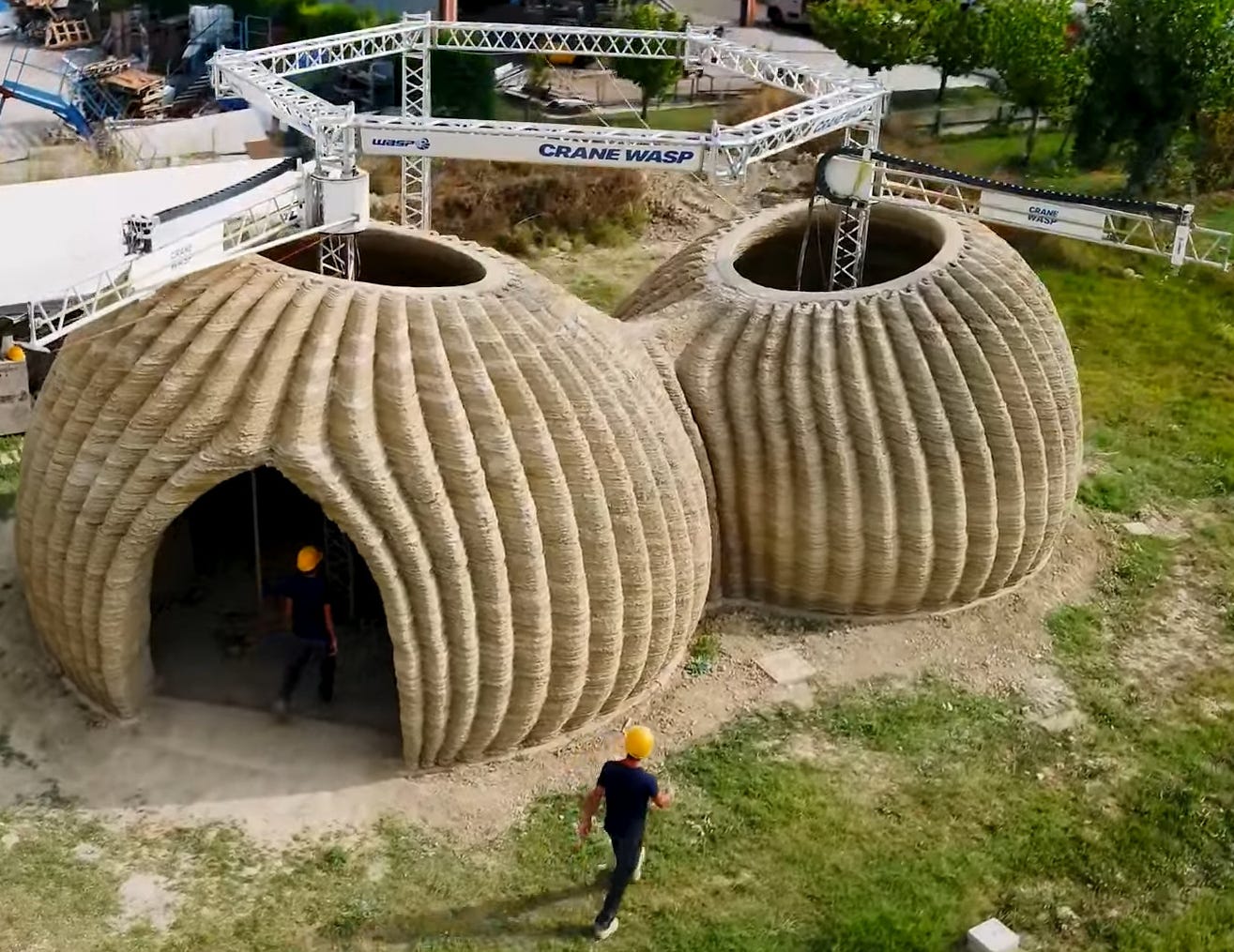
Finding a way to use fewer construction materials, often for the perceived environmental benefits rather than cost savings, is a common strategy for would-be developers of new building systems. One of the supposed benefits of concrete 3D printing, for instance, is that it allows for much more materially efficient construction by placing concrete only where it’s needed.
The problem with this strategy, however, is that most existing construction is likely fairly close to the “material efficiency” frontier. As I noted in a previous essay on reducing the material necessary for building, the entire job of structural engineers is already to minimize the size of the structure needed to support a given load:
Structural elements are designed to be as materially efficient as possible, and have been for many decades. Wood trusses (made up of conventional lumber stitched together with steel plates) and wood I-joists (made up of engineered lumber top and bottom chords with a center “web” of oriented strand board, or OSB) are standard for residential construction in the US. Steel W-sections and steel joists (basically trusses) are standard for commercial construction. For even lighter steel construction, there is light gauge steel framing, which consists of very thin sheets of steel bent into structurally efficient shapes. There are also things like insulated metal panels, which are in some ways the platonic ideal of an efficient structural element: a thin sheet of steel on the top and bottom, separated by a layer of insulation. (The wood version of insulated metal panels, SIPS, never quite caught on in the US, though not for lack of trying.)
Even heavy, cheap materials like concrete are used in materially efficient ways. For concrete floors, a common construction method is to pour concrete over a ribbed metal deck. The ribs give the steel the strength to support the concrete while it’s wet (eliminating the need for additional shoring), and give the whole assembly greater depth, increasing bending resistance and placing the steel at the outer edge where it’s most useful. There are also things like hollowcore slabs (concrete slabs manufactured with voids in the middle), and concrete blocks (which are hollow in the middle, though many of the voids will have reinforcement placed in them and be grouted solid).
When structural material use isn’t minimized, it’s often because further reductions trade off against something else, such as higher labor costs, deeper and more expensive floor depths, or increased construction complexity. There are many structural systems, such as castellated beams (beams with the centers cut out), advanced framing (house framing designed to minimize the use of dimensional lumber), or concrete void slabs (concrete floors cast around hollow plastic spheres), that are rarely used because they require more labor, have more complexity (and thus carry more risk), or have some other undesirable tradeoff.
Another barrier that can prevent the reduction in building materials is code requirements. Requirements for electrical wiring, for instance, were set assuming the use of relatively power-hungry incandescent lighting. With the rise of LED lighting, there’s an opportunity to reduce wiring requirements for lighting by using low-voltage DC wiring; some startups have been founded to try and tackle this, but the use of lower-voltage wiring has been limited by building code restrictions.
If using fewer building materials isn’t an obviously winning path, what about using less expensive building materials? Here there do appear to be somewhat more opportunities, at least theoretically, though capturing them is far from straightforward.
Many building materials, to be sure, are poor candidates for either cost reduction or replacement with a cheaper substitute. The largest single line item when constructing a new house, for instance, is the structural framing, which, with labor and materials, makes up around 20% of the cost of a new house. But dimensional lumber is already exceptionally inexpensive: in dollars-per-cubic-foot terms, it’s among the least expensive materials that civilization produces.
If we look at the gross margins of dimensional lumber producers, they’re not particularly high: Boise Cascade had a gross margin of 16.5% in 2025, when Weyerhaeuser had a gross margin of 14.8%. It’s thus not straightforward to either drive down the cost of wood framing or substitute it with a cheaper material.2
Similarly, there’s historically been a great deal of interest in finding an alternative to drywall, but virtually every alternative is significantly more expensive:
Despite its drawbacks, installing drywall is incredibly inexpensive. My 2022 Construction Estimator gives a cost of installing + finishing drywall at about $1.50 per square foot. RSMeans gives similar. Most of these alternative materials are much more expensive, even before taking into account the labor or extra backing materials they might require. MDF panels seem to be ~$1.50 for the material alone. PVC panels seem to be in the realm of $3.50 per square foot for just material. Fibo is closer to $10 per square foot, Corian around $50 per square foot, and Dekton up to $100 (though this is for the countertops, walls might be cheaper).
Other materials, however, seem like they have more opportunity for cost reduction, though these reductions aren’t necessarily enormously large or easy to capture. Concrete, for instance, is not particularly expensive (typically costing ~$6 per cubic foot), but if you look at the gross margins of concrete material suppliers, they’re often surprisingly high. Vulcan Materials, which makes aggregate, had a gross margin of 27% in 2025. Martin Marietta had 31% that year, and Cemex had 32%. These are high enough that you could imagine a modest decline in the cost of concrete in a more competitive concrete industry.
But it’s hard to get that increased competition, in large part because it has become extremely difficult to permit a new aggregate quarry. In some parts of Washington, it can take 7 to 10 years and upwards of $1 million to permit a new quarry, and the prospect is so risky that producers are often unwilling to even try. In California, Granite Construction spent 7 years trying to open a quarry, including writing an 8,500-page environmental impact report, only for the permit to be denied. For cement, the story is similar: St. Lawrence Cement spent 7 years trying to build a new cement plant in New York before giving up in 2005. There hasn’t been a new greenfield cement plant built in the US in 15 years. Without the ability to build new quarries or cement plants, we can’t expect prices to come down.
There also seems to be room for lower material prices for steel: prices for American steel are substantially higher than for European or Chinese steel. But this also isn’t straightforward to address. Tariffs and transportation costs whittle away the cost savings of importing foreign steel, and starting a new, more efficient American steel producer doesn’t seem like an obvious win, given the already-low gross margins of US steel producers even with the tariffs (12% for Nucor, 15% for Commercial Metals Co., and negative for Cleveland-Cliffs in 2025).
Similarly, many other building product suppliers have high enough margins that major cost reductions seem like they should theoretically be possible. James Hardie Industries, which manufactures fiber cement siding, had a gross margin of nearly 36% in 2025. Owens Corning, which produces insulation, roofing, and doors, had 28%. Armstrong World Industries, a manufacturer of ceiling and architectural products, had 40%. Simpson, a manufacturer of structural connectors, had a gross margin of 46%.
But as with the other materials we looked at, there are barriers to the increased competition that might drive down these costs. For many of these products, it would often be risky for engineers, architects, or building designers to specify an alternative. These products have typically gone through extensive semi-official testing, documented in things like ICC or IAPMO code reports, which give designers a third-party verification of what level of performance they can expect from the product. Products are often backed with warranties, and the companies typically put a great deal of effort into making it easy for designers to specify their products, through things like well-designed catalogs, free design software, and free engineering assistance. (Simpson’s connector catalog, for instance, is so well put together that it was actually used as a textbook in a course I had on wood design in college.)
Building professionals, as I’ve noted previously, are rationally risk-averse: the upside from specifying a slightly cheaper product is relatively minor compared to the huge downside risk of a building product that doesn’t work as expected. When a building product doesn’t work as advertised — polybutylene piping in the 1980s, EIFS cladding in the 1990s — engineers, architects, and builders are invariably drawn into the resulting lawsuits. This makes it hard to compete with existing manufacturers of many products: most engineers are reluctant to specify specify some no-name brand of connector over Simpson connectors, when a connector failure could cause a catastrophic failure in an earthquake or hurricane.
The construction startup Katerra (where I used to work) found this out the hard way. When it was first founded, it was a supply chain and logistics company. It would source low-cost materials from China and elsewhere and offer them more cheaply than competitors to builders in the US. But this plan didn’t work, because architects and builders weren’t willing to specify Katerra’s products, and Katerra pivoted to prefab construction, using factory methods and sourcing its own materials in the hopes of outcompeting other builders.
We also see the same sort of tradeoff problem at work with material substitutions as we did with material reductions. Often it’s possible to replace an expensive material with a cheaper one, but this incurs a tradeoff that people are often unwilling to make, particularly if the product is an interior finish. Fiberglass bath enclosures, for instance, are both less expensive and higher performance (i.e., less likely to leak) than ceramic tile, but tile is almost always preferred for aesthetic reasons. Similar aesthetic preferences exist for things like solid vs. hollow doors, granite vs. Formica countertops, fiber cement or brick vs. vinyl siding, drywall vs. vinyl-on-gypsum panels with visible seams, and so on. Cheaper finish materials often feel cheaper, either because they’re thinner and feel less solid or simply because we can tell the difference between them and more expensive materials.
Conclusion
Overall, prospects for lowering construction costs by way of finding a cheaper “recipe” — cheaper or fewer ingredients like materials or labor — are something of a mixed bag. For labor, the possibilities of cost reduction seem small, given construction’s on-site nature and the difficulties associated with off-site, prefabricated construction in low-labor-cost locations. For building materials, the possibilities are somewhat greater. While using more materially efficient designs likely has relatively little in the way of opportunity, many building materials seem like they could theoretically be made less expensively (either in the US or overseas). But a variety of barriers — the difficulty of permitting new production facilities, tariffs keeping out low-cost foreign supplies, the risk aversion of architects, engineers, and building designers — make achieving this less than straightforward.
Other estimates of labor cost differentials, however, give lower results. The Comparable Wage Index for Teachers (CWIFT), for instance, which measures “systematic, regional variations in the wages and salaries of college graduates,” finds that the wages in the 90th percentile of counties are only 28% higher than the wages in the 10th percentile of counties.
Long-term, I think there’s an opportunity to do this by a sustained tree improvement program to create trees that produce lumber more efficiently, but this would be a very long-term project.
Of all the levers we have to adjust housing cost, I’m convinced this is probably the least effective - because as you pointed out, we’ve already done a pretty good job with what we have. Short of some massive engineering or material breakthrough, any savings are likely to come from financing or permitting efficiency. Plus, if it costs 15% less to build, that doesn’t necessarily move the market, it just increases the developers margin.