

As I noted in my last essay, I increasingly think that the process of creating new technologies is usefully thought of as a search process — the would-be inventor must sift through a huge mass of possibilities and pluck out from within it the specific arrangement of phenomena, parts, and components that actually performs some useful function. This is done by way of collecting and applying information about which arrangements work and which don’t, information which the inventor can use to narrow down what would otherwise be an outrageously enormous and intractable search process. When an inventor is trying to bring some new technology into the world, gathering and applying information to narrow down the space of possibilities is the primary thing that they’re doing.
But while this is useful as a high-level description, it doesn’t tell us much about what, specifically, inventors are actually doing when they’re trying to invent something. A search process implies a search algorithm — some method, or methods, that inventors are using to find working designs amidst the vast sea of potential ones. Our previous explorations of the technological search process have used random generation of possible technologies, but of course actual inventors aren’t combining elements randomly in the hopes of stumbling across something that works. To understand the nature of technological progress, it would be useful to have a sense of what algorithm our would-be inventors are using when creating some new technology, and whether some other algorithm might work better.
It’s probably not feasible to figure out the exact algorithm at work (at least, not feasible for me), since that would basically mean understanding the still-mysterious workings of the human brain. But enough histories of inventions have been written that we can draw some tentative conclusions about what sort of algorithm inventors are using.
In particular, if we look at a large number of invention case studies, we see that the first milestone is almost always the same: the would-be inventor creates some technological concept, a basic idea of the arrangement of components and phenomena that will create the desired effect.
This idea goes by different names. In patent law it’s referred to as the “inventive concept.” Thomas Edison called it the “base principle,” as did economist Brian Arthur. Soviet inventor and creator of the TRIZ method of invention Genrich Altshuller called it the “solution concept.” Engineer and professor of engineering Walter Vincenti referred to it as the “operational principle.” But regardless of what we call it, creating the technological concept is virtually always one of the very first steps when creating some new technology: once the concept is in hand, the technological search problem becomes considerably easier.
Technological concepts
Read any history of invention, and you’ll almost always find the creation of the technological concept behind it as a critical early step. The maser, for instance, began its life when physicist Charles Townes stitched the concept together while he was sitting on a park bench:
Sitting in the park, Townes took an envelope from his pocket, and worked through how such a device might work. By feeding a stream of appropriately stimulated molecules into a resonator (a cavity that would reflect electromagnetic radiation of the appropriate wavelength), any electromagnetic radiation generated within the resonator would bounce back and forth, gaining energy each time it passed through the molecules as more and more photons were generated. The device would amplify any incoming signal as an electromagnetic wave passed through the population inversion molecules. And because the resonator would reflect the wave back and forth through the molecules (a form of feedback), it could also act as an oscillator — a generator of electromagnetic signals. Power would only be limited by how quickly molecules carried energy into the resonator.
Likewise, Chester Carlson assembled the concept for what would become the Xerox machine by trawling through the scientific literature to find phenomena that could be used to copy the contents of a document:
Using finely divided powders to make visible images of electrostatic charges was an old idea in physics; it had first been done in 1777, when George Christoph Lichtenberg, a German professor, noticed that house dust adhered to an electrostatically charged piece of amber in a distinctive arrangement, which later became known as a “Lichtenberg figure.” Carlson knew about Lichtenberg figures, and Selenyi’s work reminded him of them. Suddenly, he saw that he might be able to make copies by employing a similar phenomenon in combination with photoconductivity. Instead of trying to use light to generate an electric current in a sheet of paper placed on top of a photoconductor, as he had done in his kitchen experiments, he would use light to remove electrostatic charges from the nonimage areas of a uniformly ionized photoconductor. Then he would make the pattern visible by dusting it with powder, and transfer the powder to a sheet of untreated paper.
And Paul Lauterbur came up with the concept for MRI when thinking through how the phenomenon of nuclear magnetic resonance (NMR) might be used to extract information from living tissue:
If you could find a way to localize the NMR signals to specific places in a patient without using harmful invasive procedures, well, that would be a different matter altogether. If physicians could do that, they could look into any part of the body remotely to see what the problem was, and the patient would be unaffected by the analysis. “I believed that NMR relaxation time measurements on tissue specimens were unlikely to contribute much to the rich variety of information available from optical microscopy. All of this information about the tissues was apparently there, however, within the living organism. Was there any way that one could tell exactly which location an NMR signal was coming from within a complex object?” That same evening he figured it out. He had taken a dinner break with Don Vickers, a friend and company officer, at a fast-food place. “On the second bite of a Big Boy hamburger,” just as he was explaining to Don that the physics of NMR precluded imaging, in midsentence, he found the principle of MRI. “I realized that inhomogeneous magnetic fields labeled signals according to their spatial coordinates, and made a leap of faith to the conclusion that the information could be recovered in the form of images.” He sketched the general idea to Don. “Heck, you could make pictures with this thing!”
We see the same thing if we look at Frank Whittle’s invention of the jet engine, or Kary Mullis’s invention of PCR, or James Watt’s invention of the separate condenser for the steam engine; in each case, the first step was the technological concept.
Technological concepts have different origins. Sometimes, like with Townes and Carlson, a concept is the product of working backward from a desired goal and gets stitched together piece by piece. Other times, they seem to appear suddenly in an inventor’s mind, such as with Tesla and his AC induction motor:
As I uttered these inspiring words the idea came like a flash of lightning and in an instant the truth was revealed. I drew with a stick on the sand the diagrams shown six years later in my address before the American Institute of Electrical Engineers, and my companion understood them perfectly. The images I saw were wonderfully sharp and clear and had the solidity of metal and stone, so much so that I told him: “See my motor here; watch me reverse it.” I cannot begin to describe my emotions. Pygmalion seeing his statue come to life could not have been more deeply moved.
Sometimes concepts are the result of thinking by analogy, applying some existing technology or concept to a new domain. The idea for the Greenfield blood clot filter, for instance, was adapted from a similar filter used in oil wells, which itself was adapted from a filter to prevent people from siphoning gas out of cars:
Greenfield took his dilemma to Garman Kimmell. Kimmell, a prolific inventor, ran a company that made valves and other machinery for oil and gas wells and pipes, but he also dabbled in medical devices. As Greenfield recalls, upon hearing about pulmonary embolism, Kimmell told him, “That sounds a lot like the problem we have in the oil field with sludge.”
In oil pipelines, sludge and debris are trapped by a cone-shaped filter. The geometry of the cone, Kimmell explained, allows oil to continue flowing around its edges while concentrating the sludge in the center, whereas a flat screen, with sludge spread across it, could completely clog the pipeline. Kimmell and Greenfield decided that the conical-filter idea was worth a try in blood vessels.
Sometimes concepts are the immediate, obvious implication of some newly discovered phenomenon or material. When William Perkin accidentally created a mysterious purple chemical when trying to synthesize quinine, he immediately saw that it might be useful as a dye. Similarly, when learning about electromagnetic waves, Guglielmo Marconi immediately saw that they might be used for communication. And the discovery of X-rays by Roentgen immediately prompted people to use them for medical imaging.
A concept will often be sufficiently obvious that it will be “in the air,” and the would-be inventor will inherit it rather than come up with it themselves. The concept of the incandescent lamp is sufficiently obvious once you know that running electric current through a resistor will make it glow that it was well established decades before Edison worked on the problem. Likewise, the basic concept of a heavier-than-air flying machine was in place for nearly a century before the Wrights mounted their attempt.
Different concepts might pin down the combinations and arrangements of the elements of an invention to different degrees. Some might be rather abstract, and some might be quite specific, though they almost never pin it down so completely that no subsequent empirical searching is required. The transistor, for instance, started with what was barely a concept at all — merely the idea that some sort of solid-state phenomenon could be used to construct an electronic amplifier — and it took years of studying solid materials and how they behaved before the specific phenomena that made it possible were uncovered. The concept of the pendulum clock, by contrast — using the (nearly) constant-time swing of a pendulum as the oscillator in a clock — pinned the specifics of the invention much more tightly. Often a concept lies somewhere in the middle, providing a general idea of how an invention should work but leaving significant blank spaces in how it will be implemented. Edison, for instance, started his hunt for a practical electric lamp with the high-level concept of using electric current to heat a filament to the point of incandescence, but there were many specifics that needed to be worked out. Edison’s first implementation used a platinum filament (chosen for its resistance to oxidation) connected to a temperature regulator, specifically because he wanted to avoid dealing with vacuums. Only later did Edison modify this arrangement to eliminate the temperature regulator and use a carbon filament in a high-vacuum bulb.
More generally, while having a starting technological concept doesn’t eliminate further technological search, it does considerably narrow it. Each phenomenon selected has specific triggering conditions: to get incandescence you need some way of heating your object; to get a population inversion you need the right sort of energy combined with the right sort of material. When Edison was creating his lamp he had a huge number of possibilities to sift through — different ways to prevent the filament from burning up, different materials that might be used as a filament, different bulb atmospheres — but it was massively reduced compared to a blind search through the entirety of technology space. Similarly, any existing technology that’s used as a component can be implemented in a variety of ways, but the range of possible variation is constrained by what’s needed to make that technology work. This kind of refinement is different than needing to make a discovery of a new phenomenon, wholesale. When Frank Whittle was working on his jet engine, he needed to build new, better compressors that were far more efficient than existing ones. But he wasn’t inventing a new type of compressor working on some novel principle: Whittle’s compressor worked more or less like existing compressors did and had a very similar arrangement of elements.
We can see the effects of this search space reduction using a PTOP (Phenomena Triggered by Objects with Properties) model — a model of technology inspired by Brian Arthur’s work, where different sorts of objects, with different sorts of properties, are placed in specific arrangements to trigger various phenomena, which then modify the objects in various ways. We’ll use the simple, linear PTOP model that we looked at previously. In this model, the goal is to create an object with the highest-level triggered property (P4), by placing the right objects with the right sizes in the right order. Even with this very simple implementation — 10 object types, 10 size values, and five objects that must be chosen correctly — there are 1 billion possible options. Guessing the entire technology at once randomly requires an expected 1 billion guesses, and even randomly guessing one step at a time still requires roughly 1,300 expected guesses.
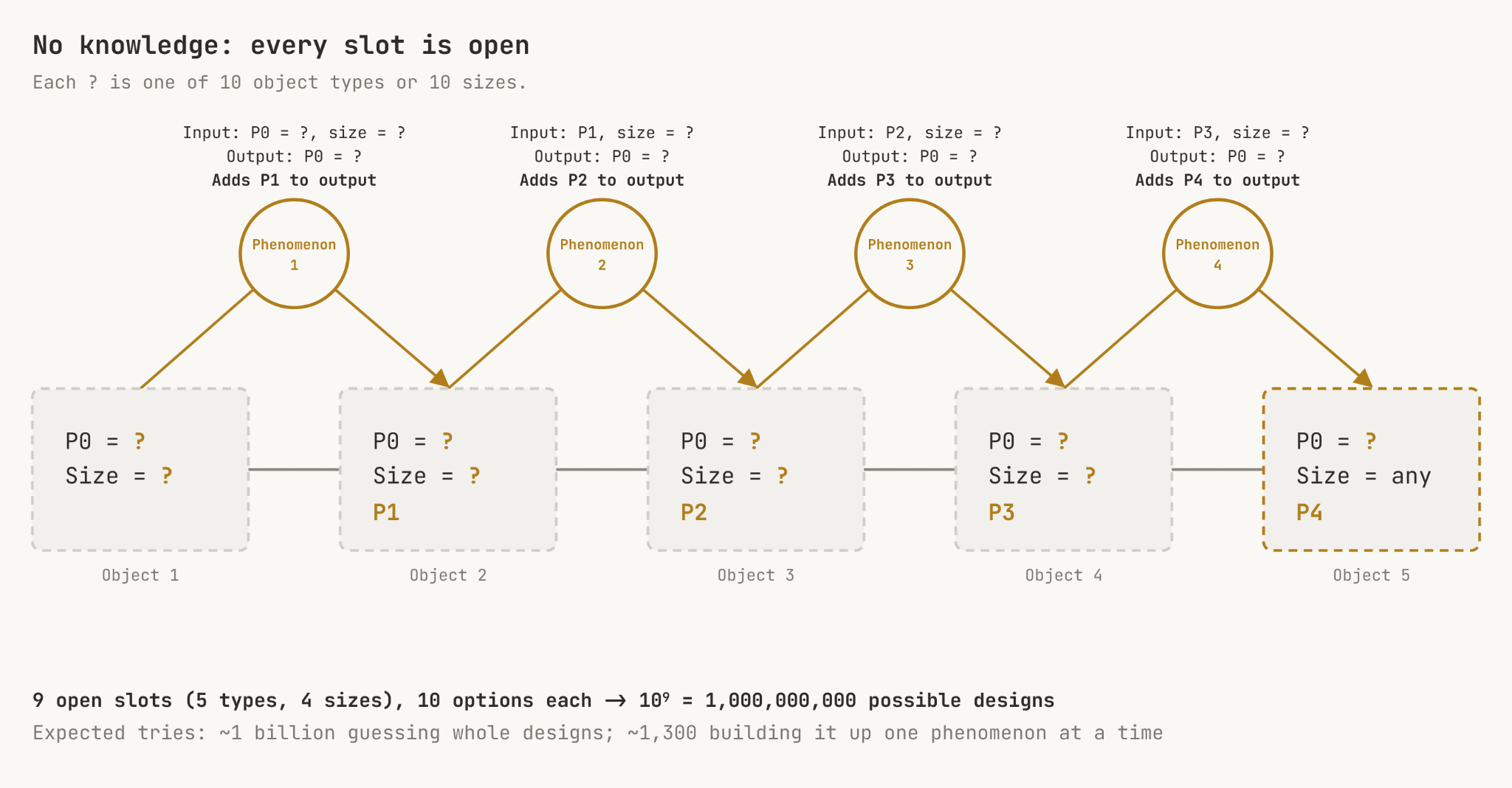
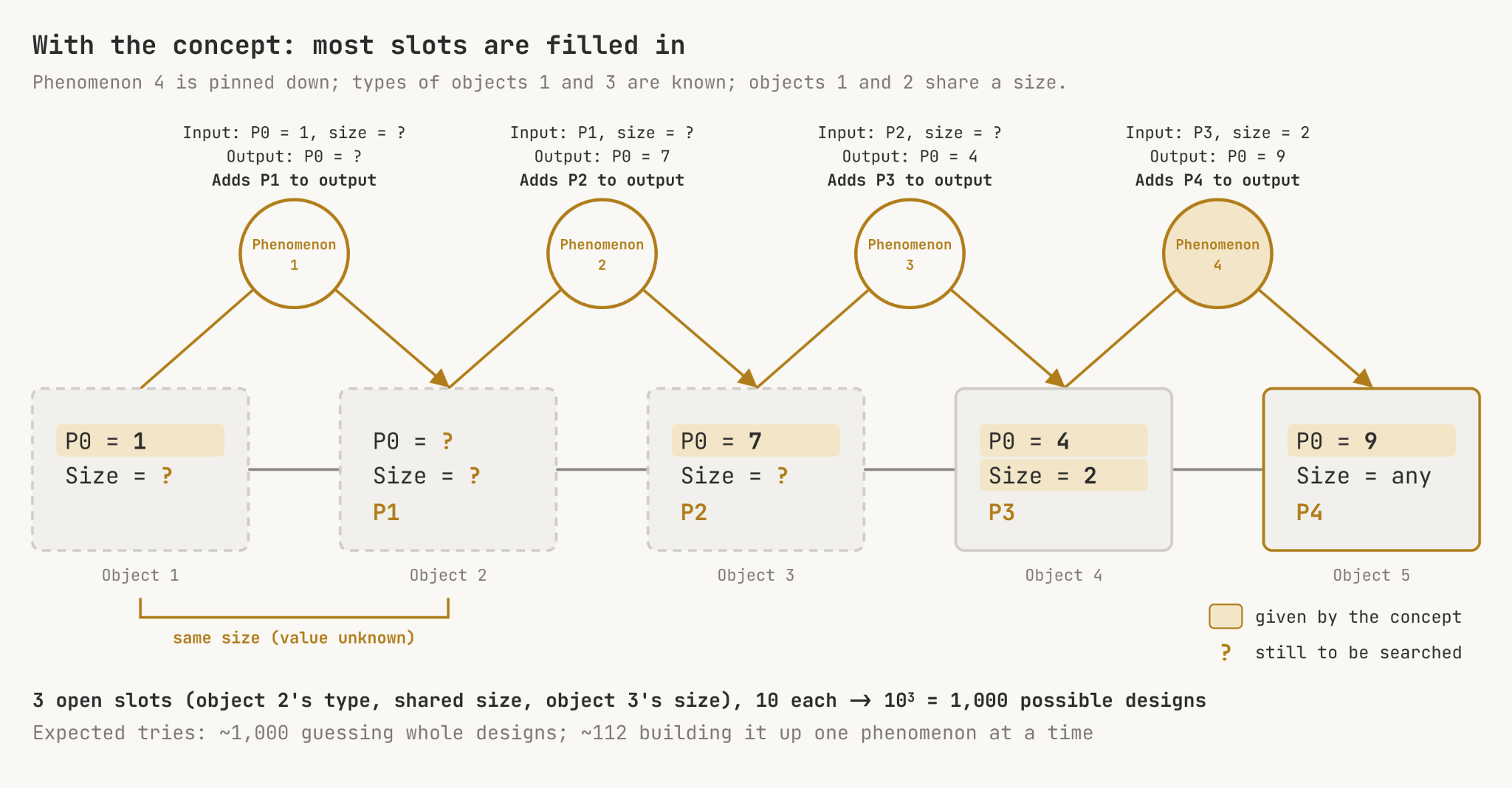
But let’s say we have a technological concept guiding our search, telling us roughly how the technology we’re searching for will work. This hypothetical concept pins down the final phenomena exactly (we know the two object types and sizes that we need), but everything else is only narrowed a bit: we know the first and third objects’ types but not their sizes, and we know that objects 1 and 2 need to be equal in size. We can see that this basic concept provides a great deal of information, significantly reducing the expected number of trials required.

This level one search is so simple that it only barely resembles the search for a real technology (even very simple technologies in the modern age have more components and potential states), but we could conduct the same exercise with a larger and more complicated PTOP model and get the same results. A concept encodes knowledge about the world and how it works, and that knowledge narrows down the range of possibilities that must be considered when building a working technology. It may not fill in the blanks completely: the would-be inventor might have no initial idea how some step in his imagined process will work. Paul Lauterbur, for instance, had to make a “leap of faith” that there would be some way to recover the magnetic field strengths of individual coordinates to turn it into pictures. And Bell’s concept for the telephone was to use a varying electric current to carry voice along a wire, but he didn’t know how to produce that current and only stumbled across a method for doing so by accident. But a concept nevertheless makes the search process far easier, bringing it from “impossible” to “tractable.”
Concepts and information
Technological concepts are, obviously, a product of our knowledge: knowledge of existing phenomena (such as the particle physics Townes used to create the concept for the maser), knowledge of existing technological elements (such as the knowledge of compressors and turbines Whittle used when creating the jet engine), and so on. This knowledge might be virtually certain, such as Edison’s knowledge of carbon’s melting point, or it might be only probable, such as the bet that there was a second histamine receptor that could be blocked by an appropriate molecule for ulcer treatment.
The knowledge that a would-be inventor has available to him acts as a sort of “palette” that he can draw from when coming up with ideas, and different inventors with different stocks of knowledge might proceed down different paths; historian Reese Jenkins notes that “[a]ny creative technologist possesses a mental set of stock solutions from which he draws in addressing problems,” (gorman and carlson 1990). Thomas Edison, for instance, repeatedly used mechanisms that he was familiar with in his inventions: Edison’s first kinetoscope used the same sort of rotating cylinder he had used in his phonograph. Likewise, in the race to build the first laser, every team attempting to build one was working off the same high-level concept but implemented it in different ways depending on their existing information endowment: the glass experts at American Optical pursued a glass laser, the gas experts at Bell Labs pursued a gas laser, ruby expert Theodore Maiman pursued a ruby laser, and so on. The more knowledge a would-be inventor has, the more possible options they have available to them, and the greater the chance they can come up with a workable concept: in the 1931 book “Industrial Creativity,” which surveyed 710 inventors on the characteristics that make for a successful inventor, “knowledge and memory” was the third most frequent characteristic noted.
When we looked at Brian Arthur’s technological evolution simulation, we noted that the key thing that made it possible to generate complex circuits randomly was modularity — combining simple elements into chunks, then making that chunk an element that could be directly manipulated and combined with other elements. Our knowledge of the world also has this basic structure: we can mentally manipulate things — concepts such as compressors, or motors, or resonant cavities — that are themselves arrangements of many individual elements, making it possible to orchestrate the arrangement of a large number of elements simultaneously.
Related to this ability to manipulate chunked information, some evidence suggests that strong mental visualization ability is an important characteristic for coming up with promising technological concepts. Inventors such as the Wright Brothers and Samuel Morse have been described as having exceptional mental visualization ability, and other notable inventors, such as Elmer Sperry, Oliver Evans, and Elihu Thomson, all described picturing a working invention in their minds before trying to build anything. Thomson stated that he “regard[ed] the imaginative faculty as chief in value to the inventor,” and that he never began a piece of work “in which I could not in my mind follow the whole thing through to an apparently satisfactory conclusion.” In “Industrial Creativity,” “imagination” was the second most frequently mentioned characteristic of successful inventors, losing out only to “perseverance.”
With mental visualization, together with the use of visual aids such as drawings, the inventor can to some extent “test” the workability of a concept, modifying it as necessary or discarding it for a new one without having to take the time and effort to build something in the real world. The Wright Brothers, for instance, initially considered a series of gears and shafts as a way to control their aircraft, but were able to foresee that its performance would be poor, and discarded it in favor of their famous wing-warping system without ever having built it. We can think of visualization as another way of processing a large number of elements at once. “A picture is worth a thousand words” is a saying for a reason: an image contains a huge number of relationships between different objects displayed that, thanks to our extensive neural machinery devoted to vision, we can process simultaneously and rapidly.
What makes a good technological concept?
We can think of a technological concept as a region in technology space that’s promising to search. A good concept is one that both has a high probability of containing a working technology and has what we might think of as an easily traversable “technological landscape” — ideally, we’d like a region that, from a given starting point (a first attempt to build a working invention), we can improve the performance of the technology rapidly in as few iterations as possible, and that allows us to reach a very high level of performance without getting trapped in local optima.
There’s probably much to be explored about what sort of technological concepts will have these sorts of characteristics, but we can venture a few guesses. One key characteristic is that we’d like our technological landscape to give us information on how we should traverse it. Specifically, if you think of “technology space” as compressed down to a 2D plane, with the third dimension, height, representing a technology’s performance, we’d like to know the slope of the landscape, so we can walk uphill: make adjustments that will yield higher and higher performance. This, of course, is how machine learning works: gradient descent via backpropagation calculates the slope of the loss landscape and then walks downhill by changing the model parameters to move in the direction of lowest loss.
This sort of technological landscape doesn’t necessarily exist automatically. In “Inventive Minds,” a book about the nature of technological creativity, Harvard professor David Perkins talks about the concept of technological “Klondike spaces”: spaces that give little to no information on the direction to proceed:
Suppose you were searching for gold in the Alaskan Klondike at the end of the nineteenth century. The governing principle of your search would have to be, “Gold is where you find it.” You would look here, there, everywhere you could. You would be persistent, try different areas, and hope for the big strike. You would know a good deal about how to look, of course. You would know what kinds of rocks might bear ore. You would have a sharp eye out for the glint of gold in river gravel. You would search upstream from sites that showed some traces, in hopes of finding the mother lode. Despite this savvy, however, you would still find that most of your time was spent in searching rather than in systematically homing in on a find.
Your search for gold is, of course, a special case of problem-solving. You are searching in the physical space of the Klondike, shifting from one position to another, exhausting dead ends, seeking new and promising terrain. Indeed, it’s useful to generalize the characteristics of this “Klondike Space,” because many other problem situations not so geological and geographical in nature have essentially the same logical topography. Many problem spaces, that is, involve punctuate targets with sharply defined boundaries (see Figure 13.1A), like a needle in a haystack or a few large nuggets or a hominid bone in a stratum. In such circumstances, it is difficult to move systematically toward a target. Rather, you find yourself casting about a lot. [My emphasis]
“Klondike spaces” are spaces where modifying a technology — making some part bigger or smaller, or faster or slower — doesn’t give obvious clues as to the direction of improvement. There are, broadly, two reasons this might occur. One is that a landscape might be highly uncorrelated — the performance of one technological option might have little relationship to adjacent options, so figuring out the local slope by making a small tweak and observing the change in performance doesn’t tell us much about which direction to head generally. When Edison was first hunting for a workable carbon filament, he found himself in this sort of landscape — he didn’t know which sort of carbon would work best, and just testing a material and seeing how long it lasted didn’t tell him much about the results he’d get from other materials, so he simply tested every type of carbon he had available to him until he found an option that was good enough.
The other reason that modifications might be uninformative is if the landscape is flat, and all nearby areas have the same performance. Consider, for instance, a string of Christmas lights where bulbs are connected in series, and every bulb needs to be working for the string to light up. If you plug the string in and it doesn’t turn on, you know that at least one bulb is burned out, but you don’t know which one, and testing one bulb doesn’t tell you anything about other bulbs or give hints as to which of them might be burned out.
An example of this sort of failure is Shockley’s first attempt to build a field-effect transistor in 1945; his theory of semiconductor behavior suggested a field-effect device should work, but extensive experiments with slightly different variations produced an effect “at least 1500 times smaller than predicted,” and he was forced to shelve the idea.
However, inventors are not simply at the mercy of these sorts of technological Klondike spaces; in practice it seems to be nearly always possible, with the proper knowledge, to determine a direction to proceed. This comes down to how we create concepts: a concept is based on some orchestration of phenomena whose behavior and triggering conditions are, to some extent, known; the individual workings of a technology can thus (in theory) be probed and experimented with to see whether the individual phenomena are behaving as expected, and give ideas as to the sort of modifications that are needed. Shockley’s failure to build a field-effect device suggested something was wrong with the existing theory of semiconductor behavior, which could then be tested and explored. Thanks in part to Shockley’s failure, it was eventually discovered that electrons trapped on the surface of a semiconductor (so-called “surface states”) were blocking the predicted field effect, a phenomenon that was then exploited to build the first point-contact transistor.
Similarly, Edison’s initial search for a carbon filament simply tested every carbon material that happened to be available, but careful examination of the materials tested suggested that materials that consisted of many parallel fibers performed the best — Edison later stated that paper was useless as a filament material because under a microscope it looked like “a bunch of sticks thrown together.” This initial search was followed then by a second, more thorough search that was focused specifically on fibrous carbon materials, leading to the bamboo filament.
This, I think, is one of the key things that technological concepts, and the knowledge that underlies them, do for the technological search process: they mean that the would-be inventor is never trapped in a Klondike space, and with the proper information and experiments can nearly always figure out a promising search direction.
We can similarly make some tentative conclusions about the sorts of technological concepts that might be improved upon rapidly, in as few iterations as possible. Something that has been demonstrated repeatedly is that the more modular the design of a technology is, the easier it is to improve rapidly. McNerney et al. 2011, for instance, used simulations to show that technologies with a greater degree of connectivity between components — the more the performance of one element was a function of other elements — had shallower learning curves and a slower rate of improvement compared to technologies with less connectivity.
But the most thorough demonstration of this effect I’m aware of is Stuart Kauffman’s NK model, developed to model fitness landscapes in evolution. In the NK model there are two parameters: N, which is the number of genes in some genome, and K, which is how much each gene’s fitness contribution depends on other genes. When K is 0, every gene contributes to fitness independently; if genes can have either a “good version” with a value of 1 and a “bad version” with a value of 0, overall fitness is just the sum of every gene’s value. But if K is 1, then the fitness of each gene depends on the value of one other gene; if K is 2 it depends on two other genes, and so on.
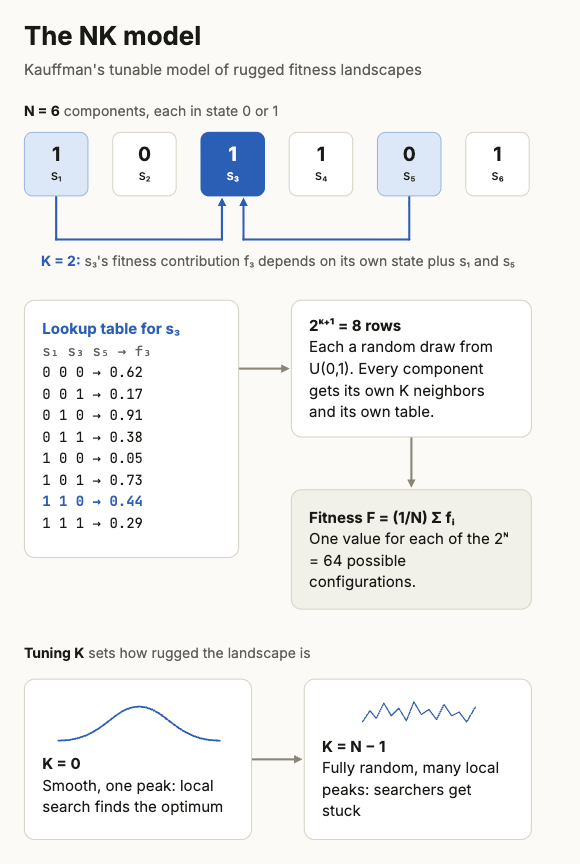
Increasing K increases the ruggedness of the fitness landscape. When K is 0, the landscape is smooth, there’s a single peak of maximum fitness, and it’s easy for evolution to walk up the hill to reach it. When K is very high, the landscape becomes, according to Kauffman, like “the surface of the moon,” there are a huge number of local optima, and finding the peak becomes very slow. From “At Home in the Universe”:
As the density of interconnections increases, changing a single gene (or bit in the program) will have effects that ripple throughout the system. It will be difficult indeed for it to smoothly evolve, with slight changes in the genome making correspondingly slight changes in fitness. So putting the effects together, as K increases, the heights of the peaks decrease, their numbers increase, and evolving over the landscape becomes more difficult.
We can demonstrate these same benefits of modularity with a PTOP model. The technology below is made up of 25 objects, arranged in five modules; each group of objects triggers its own series of phenomena, which modifies a different property in the final, output object. The goal of the technology is to maximize the product of all five output phenomena, which is achieved by dialing in the proper size for each object.
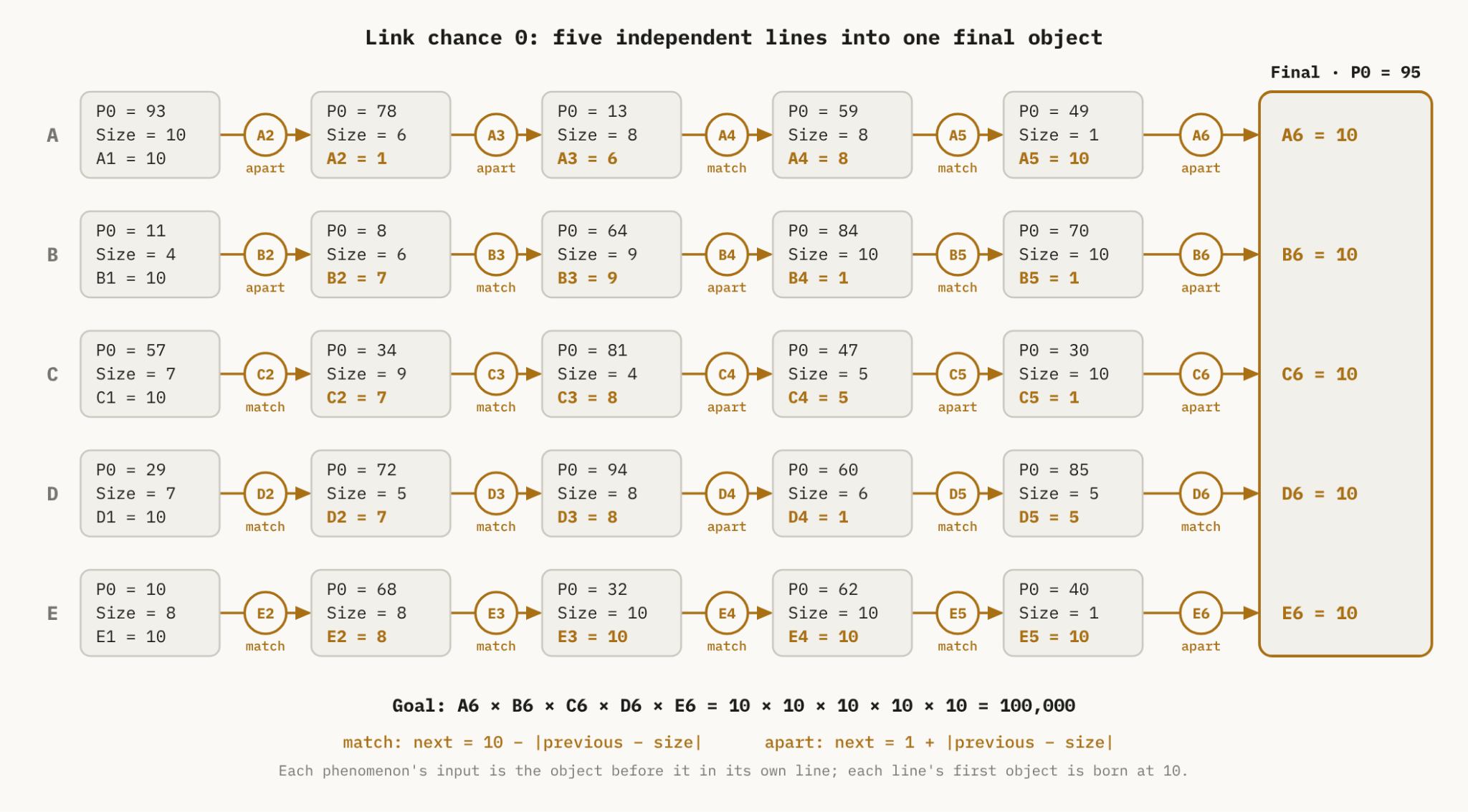
This implementation of the technology is highly modular; there’s little connectivity between the various objects/phenomena, and finding the maximum possible performance is relatively quick. This is the equivalent of a very low value of K in Kauffman’s NK model.
We can increase “K” by changing the nature of phenomena. In the model below, phenomena have a 40% chance to depend on the properties of multiple input objects, not just one, and these extra connections can be between any predecessor object, including ones in different modules. This makes it harder to find the best possible design, because hill-climbs now get stuck on local peaks. And the greater the degree of connectivity, the smaller the chance that the best design gets found. While in the unconnected version you could dial in each object’s size independently (smoothly climbing up the single peak), that doesn’t work when you start adding connections: you can’t simply dial in the optimum value at one spot and then move on to the next one.
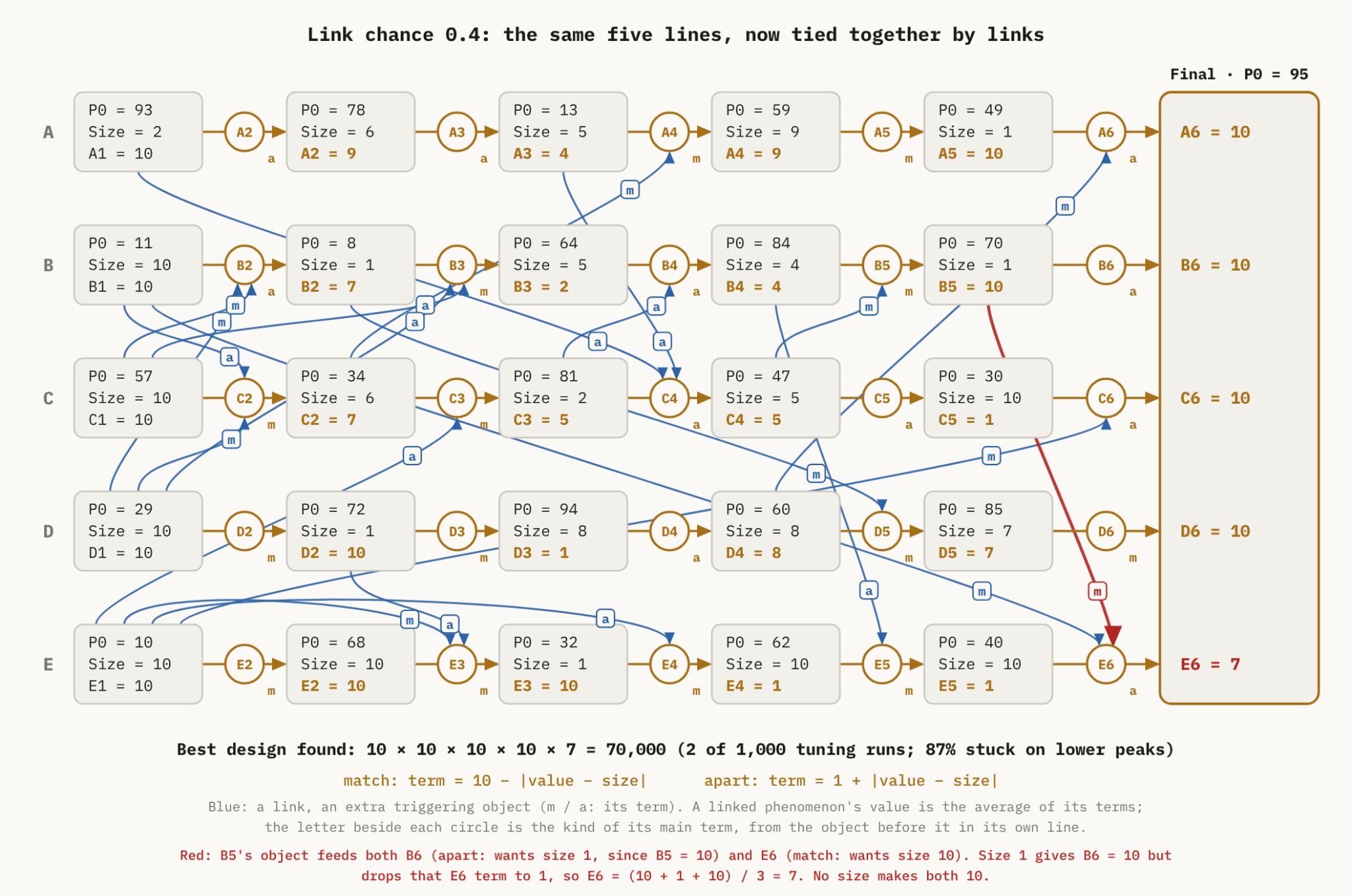
So modularity doesn’t just make it easier to find working arrangements in technology space — it makes improving the performance of a technology far faster and easier.

What sort of algorithm should we use to find concepts?
Creating the concept is only the first milestone in the technological search process, and it’s my impression that it’s not a particularly binding step — if it was, I think we’d see a lot more inventions that could have been invented far earlier than we do. But it would nevertheless be useful if we could create technological concepts that reliably contained workable technologies capable of a high degree of performance. How might we go about this?
There have been various suggestions for these sorts of “invention algorithms.” One such algorithm has been suggested by Ed Boyden, neuroscientist and co-inventor of expansion microscopy and optogenetics. Boyden calls his method the “tiling tree”: break the problem down into the elements that it needs to contain and think of every possible way of doing each of them:
With optogenetics, my co-inventor Karl Deisseroth and I — when we were both students, we just started going through all the laws of physics. How would you control the brain? Well, there’s only so many kinds of energy. There’s mechanical force. There’s magnetism. There’s light. The list is pretty short, actually. You can actually try to write down every possible way of doing it. I call this method the tiling tree method, where you try to take this base of possibilities and break it down into parts.
If you draw it properly, it looks like a tree diagram. Here’s this base of possibilities split into two parts, and each of those splits into more parts, and eventually it covers a page. It looks like a tree, and then the leaves of the tree — the bottom nodes — are ideas you could actually test by doing a literature search or doing an experiment. A lot of our projects, actually, at some point or another involve this kind of can-we-think-of-every-possible-idea approach.
Boyden points to Fritz Zwicky, a 20th-century astronomer, as the originator of this concept, who dubbed it “morphological analysis.” Here, for instance, is a chart showing a partial morphological analysis of different sorts of telescopes you might build:
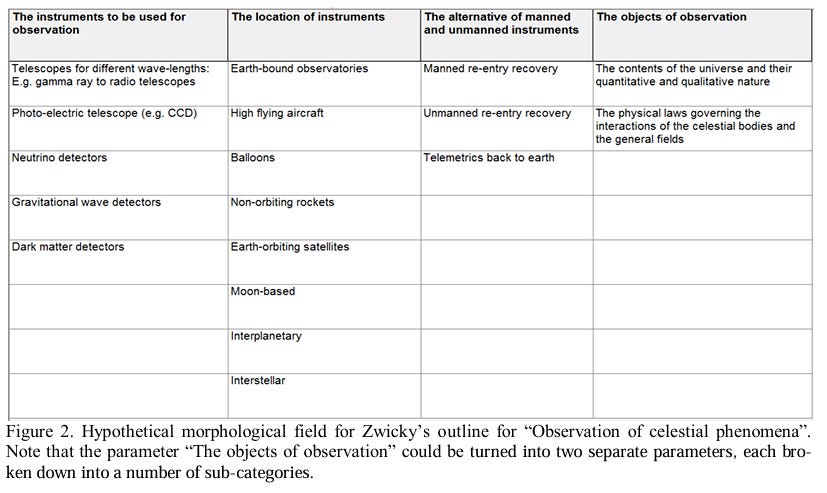
In Zwicky’s version, the result is a “morphological box” — a multidimensional box where each axis is one category of variation the technology could have. So in the example above, you could have “unmanned, balloon-mounted neutrino detectors,” or “moon-based gamma ray telescopes that send telemetrics back to earth.” The goal of this sort of algorithm is to systematically list the different possibilities, letting you come up with concepts that you otherwise might have missed.
But the most developed method I’m aware of for coming up with technological concepts is called “TRIZ.” TRIZ, which is an acronym for “Theory of Inventive Problem Solving” in Russian, was created by Soviet engineer Genrich Altshuller in the second half of the 20th century. In the 1940s, Altshuller was in the Soviet Army working as an “invention inspector” and was tasked with helping inventors prepare patent applications and solve various problems related to invention. Having no good method for helping inventors with their problems, Altshuller eventually created one.
I would classify TRIZ as a sort of industrial improvement system, like Lean or Six Sigma or scientific management, with all that the designation implies. Having spent a lot of time studying industrial improvement systems, I think that they’re almost always based around some core insight or insights that are correct and useful. But they tend to put too little emphasis on building the intellectual foundations around these insights, and the insight tends to get applied in a “when you have a hammer everything looks like a nail” sort of fashion; practitioners are quick to take the insight out of its original domain and try to apply it as broadly as possible. Literature on industrial improvement systems tends to have “salesman energy,” implying the ability to solve all your problems with one weird trick. It’s often targeted at managers or other nontechnical people (and thus written in a less-than-rigorous way), and is often extolled by a sort of cadre of consultant-types that collects around the system, selling books and courses and offering cringey-sounding certifications. (So just as you can be a black belt in Six Sigma, you can earn the title of TRIZ Master.) In my experience there’s often value in extracting the actual valuable information embedded within industrial improvement systems from the consultant slop that accretes around them — my book “The Origins of Efficiency” is in some ways one big exercise in doing this — and I suspect TRIZ is similar.
TRIZ is, essentially, based around the idea of technological search. Altshuller breaks new inventions down into five categories, based on how difficult the search process is for coming up with the idea for them. Level 1 inventions require simply small variations of an existing idea and can be discovered easily after a few trials. Level 2 inventions are slightly more complex and might require 10 to 100 different ideas before an engineer discovers a workable concept. At level 5, the most complex, the unaided inventor might require 10 to 100,000 trials, or perhaps might never discover a workable concept, because it requires a fundamentally new phenomenon that the inventor isn’t aware of. The greater the level of invention, the greater the knowledge needed to find a good concept.
The basic thesis of TRIZ is that by default people do not search for concepts very efficiently; they try different arrangements of elements based on their own experience or simply try and combine ideas by pure trial and error in the hopes they might work. This sort of search process might work for the simplest level 1 and level 2 inventions, but it’s inappropriate for the more transformative inventions of the higher levels. TRIZ is in large part devoted to getting people to think in new ways to come up with more promising concepts, sort of in the tradition of brainstorming or Oblique Strategies. Altshuller notes Zwicky’s morphological analysis as a way to generate new concepts that’s better than people’s default methods, but thinks it’s insufficient in part for combinatorial explosion reasons: the more axes of possibility you add, the more possible options you must consider, and the number of variants quickly gets enormous. An invention with merely mid-level difficulties, Altshuller notes, might have millions of possible variations to consider.
Instead of enumerating all possible concepts, TRIZ focuses on using tools to come up with better concepts. The heart of this is what’s known as a “technical contradiction.” Per Altshuller, the fundamental difficulty in coming up with a good technological concept is conflicting requirements: increasing performance along one axis might require raising some value, while increasing it along another axis might require lowering it. For an airplane, getting it into the air is aided by decreasing the weight, but making it strong enough to withstand the forces subjected to it is aided by increasing the weight. In Altshuller’s view, the creation of a new invention fundamentally requires some way of overcoming this contradiction, so you don’t have to sacrifice one measure of performance for another.
To overcome these technical contradictions, TRIZ provides several tools, chief of which is its list of 40 principles: a list of heuristics for how to rearrange the elements of a concept to eliminate the technical contradiction. Principles are things like “segmentation — divide an object into independent parts,” “prior counteraction — preload countertension to an object to compensate for excessive and undesirable stress,” and “asymmetry — replace symmetrical forms with asymmetrical forms.” These principles are, supposedly, based on analysis of tens of thousands of patents to determine what technical contradictions are encountered in practice and what methods can be used to overcome them. There’s an involved algorithm for applying these principles called ARIZ, but in essence a would-be inventor first imagines the most perfect, ideal version of an invention, a North Star to navigate by. He then determines the technical contradiction at work preventing him from achieving the ideal version of the invention and consults a “contradiction matrix,” which states which principles might be applied to resolve it. Properly applied, this results in the generation of a better concept that pushes an invention toward its ideal state.
I don’t necessarily think TRIZ holds the key to understanding the nature of invention; like with any industrial improvement system, I think it’s probably a mix of valuable ideas, exaggerated benefits, and consultant drivel. But I suspect there’s some promising work that could be done by analyzing the various elements of TRIZ — the ARIZ algorithm, the contradiction matrix, the list of principles, and so on — to try and understand more about the nature of technology space and how it might be searched effectively.
For instance, many TRIZ principles suggest pushing some particular parameter higher or lower: making air more reactive (principle 38) or less reactive (principle 39), changing the degree of feedback (principle 23), amplifying a harmful factor (principle 22), and so on. (In fact, principle 35 is just a bunch of parameters you might try changing.) This reminded me of a bit from Richard Hamming’s “The Art of Doing Science and Engineering,” where he notes that in high-dimensional spaces, almost all the mass of an object is concentrated near the surface, which suggests that for any given design of an object the optimal design will have some particular parameter pushed as far as it can go.
Similarly, one of the steps in one version of the ARIZ algorithm is applying the “size time cost” heuristic — imagining the invention with size, time, and cost pushed either toward zero (as small as possible, a process as fast as possible, or a cost as cheap as possible) or toward infinity, and imagining what the solution looks like under these modified constraints. This is a specific example of a more general idea, expressed in Judea Pearl’s book on problem-solving heuristics, that search heuristics are often developed by thinking of ways to solve simplified versions of the problem (such as problems with various constraints eliminated or added).
Conclusion
The first milestone in creating some new technology is the creation of the technological concept: some basic idea of what arrangements of phenomena and objects will, together, create a working technology. This doesn’t eliminate the search problem — many of the most famous inventors, such as the Wright Brothers and Thomas Edison, faced most of their difficulties once the concept was in place. But the concept transforms what would be an impossibly difficult search problem into one that’s far more tractable.